1. Introduction
1.1. Background
In the contemporary landscape of higher education, the success of any academic institution is inextricably linked to the satisfaction of its human capital. Staff job satisfaction is not merely a reflection of organizational quality or standardized output; rather, it represents the complex, multidimensional relationship between the employee, the services provided by the institution, the physical work environment, and the broader provider-user dynamic
| [1] | Teshome GS, Woldeyohans FW, Haile ES, Alene EK. Assessment of customer satisfaction in Menelik II Health Science College, Addis Ababa, Ethiopia, 2018. J Health Educ Res Dev. 2018; 6(2): 252.
https://doi.org/10.4172/2380-5439.1000252 |
[1]
.
Staff job satisfaction encompasses an employee's overall affective reaction to their job, including feelings of fulfillment, fairness, recognition, and professional growth. In health science colleges specifically, staff, comprising both academic instructors and administrative personnel, serve as the primary drivers of institutional excellence. Academic staff dedication directly influences student learning outcomes, research productivity, and community service quality. Simultaneously, administrative personnel ensure the operational integrity of the learning environment, including admissions, procurement, finance, and student services
.
When staff is satisfied, they demonstrate higher levels of organizational commitment, lower turnover intentions, greater discretionary effort, and more positive interactions with students and colleagues. Conversely, dissatisfied staff are more likely to experience burnout, absenteeism, and disengagement, all of which compromise institutional effectiveness
| [3] | Tinto V. Leaving college: rethinking the causes and cures of student attrition. Chicago: University of Chicago Press; 1993. |
[3]
. As such, satisfaction functions as an internal barometer for institutional health, where high levels of morale correlate with increased commitment and professional efficacy
.
1.2. The Higher Education Context in Ethiopia
Ethiopia has experienced rapid expansion of higher education institutions over the past two decades, including both universities and health science colleges. This growth has been accompanied by increasing concerns about quality, relevance, and the working conditions of academic and administrative staff
| [7] | Ministry of Education Ethiopia. Education statistics annual abstract 2024. Addis Ababa: Ministry of Education; 2025. |
[7]
. Many institutions struggle with limited resources, high student-to-staff ratios, inadequate infrastructure, and bureaucratic administrative processes
| [7] | Ministry of Education Ethiopia. Education statistics annual abstract 2024. Addis Ababa: Ministry of Education; 2025. |
| [8] | Mohammed K, Melese D, Esa E. Status of job satisfaction among academic staffs of federal higher education institutions in Amhara Region, Ethiopia. Ethiop Renaissance J Soc Sci Humanit. 2019; 6(2): 39-52. Available from:
https://erjssh.uog.edu.et/index.php/ERJSSH/article/view/136 |
| [9] | Gessesse KT, Premanandam P. Job satisfaction among academic employees in private and public sector universities at Addis Ababa, Ethiopia: a comparative analysis. Cogent Soc Sci. 2023; 9(1): 2196105.
https://doi.org/10.1080/23311886.2023.2196105 |
[7-9]
.
In health science education, the stakes are particularly high. Graduates from these institutions enter the healthcare workforce directly, where their competence affects patient outcomes and community health. Thus, the satisfaction and motivation of staff who train these future health professionals is not merely an administrative concern but a public health imperative
| [1] | Teshome GS, Woldeyohans FW, Haile ES, Alene EK. Assessment of customer satisfaction in Menelik II Health Science College, Addis Ababa, Ethiopia, 2018. J Health Educ Res Dev. 2018; 6(2): 252.
https://doi.org/10.4172/2380-5439.1000252 |
| [10] | World Health Organization. Transforming and scaling up health professionals’ education and training. Geneva: World Health Organization; 2013. |
[1, 10]
.
1.3. Statement of the Problem
Despite the recognized importance of staff satisfaction, systematic assessments remain limited in regional Ethiopian institutions, particularly in health science colleges outside major urban centers. There is often a significant disconnect between administrative perceptions of institutional performance and the actual lived experiences of frontline staff. Without periodic, methodologically sound assessment, identifying specific areas of dissatisfaction remains speculative, and interventions may be misdirected or ineffective
| [8] | Mohammed K, Melese D, Esa E. Status of job satisfaction among academic staffs of federal higher education institutions in Amhara Region, Ethiopia. Ethiop Renaissance J Soc Sci Humanit. 2019; 6(2): 39-52. Available from:
https://erjssh.uog.edu.et/index.php/ERJSSH/article/view/136 |
| [9] | Gessesse KT, Premanandam P. Job satisfaction among academic employees in private and public sector universities at Addis Ababa, Ethiopia: a comparative analysis. Cogent Soc Sci. 2023; 9(1): 2196105.
https://doi.org/10.1080/23311886.2023.2196105 |
[8, 9]
.
Previous studies conducted in Ethiopian health science and higher education settings have identified several recurring themes: inadequate compensation, limited career development opportunities, poor communication between management and staff, lack of resources (including internet, computers, and laboratory equipment), and perceptions of unfairness in hiring, promotion, and performance evaluation
| [1] | Teshome GS, Woldeyohans FW, Haile ES, Alene EK. Assessment of customer satisfaction in Menelik II Health Science College, Addis Ababa, Ethiopia, 2018. J Health Educ Res Dev. 2018; 6(2): 252.
https://doi.org/10.4172/2380-5439.1000252 |
| [11] | Merga H, Fufa T. Predictors of job satisfaction among health professionals in public hospitals in Eastern Ethiopia. BMC Health Serv Res. 2019; 19(1): 494.
https://doi.org/10.1186/s12913-019-4317-5 |
| [12] | Awoke A, Ayele H, Tesfa E, et al. Prominent factors on job satisfaction of academic laboratory technical assistants at Mizan Tepi University, Southwest Ethiopia. BMC Psychol. 2026; 14: 257. https://doi.org/10.1186/s40359-026-04079-3 |
[1, 11, 12]
. However, these studies are often dated, conducted in different institutional contexts, or focused exclusively on either academic or administrative staff rather than the entire workforce
| [8] | Mohammed K, Melese D, Esa E. Status of job satisfaction among academic staffs of federal higher education institutions in Amhara Region, Ethiopia. Ethiop Renaissance J Soc Sci Humanit. 2019; 6(2): 39-52. Available from:
https://erjssh.uog.edu.et/index.php/ERJSSH/article/view/136 |
| [9] | Gessesse KT, Premanandam P. Job satisfaction among academic employees in private and public sector universities at Addis Ababa, Ethiopia: a comparative analysis. Cogent Soc Sci. 2023; 9(1): 2196105.
https://doi.org/10.1080/23311886.2023.2196105 |
| [11] | Merga H, Fufa T. Predictors of job satisfaction among health professionals in public hospitals in Eastern Ethiopia. BMC Health Serv Res. 2019; 19(1): 494.
https://doi.org/10.1186/s12913-019-4317-5 |
| [12] | Awoke A, Ayele H, Tesfa E, et al. Prominent factors on job satisfaction of academic laboratory technical assistants at Mizan Tepi University, Southwest Ethiopia. BMC Psychol. 2026; 14: 257. https://doi.org/10.1186/s40359-026-04079-3 |
| [13] | Omachar BS, Majanga E, Mukonyi P. Work environment as a driver to university academic staff levels of job satisfaction in selected public and private universities in Kenya. Afr J Empir Res. 2025; 6(4): 570-579.
https://doi.org/10.51867/ajernet.6.4.51 |
[8, 9, 11-13]
.
In regional centers such as Dessie, changing academic demands, evolving professional standards, and recent institutional upgrades (including the transition to degree-granting status) necessitate a fresh, comprehensive evaluation of staff morale and satisfaction in 2026. Without current data, institutional leaders cannot prioritize interventions or allocate scarce resources effectively.
1.4. Significance of the Study
This study is significant for several reasons. First, it provides empirical, institution-specific data that can guide evidence-based decision-making by college leadership. Second, it identifies both strengths (what is working well and should be preserved) and weaknesses (what requires urgent attention). Third, by including open-ended qualitative questions, the study captures the voice of staff in their own words, revealing nuances that quantitative scales alone cannot detect. Fourth, the findings may be generalizable to other similar health science colleges in the Amhara region and beyond, contributing to the broader literature on staff job satisfaction in Ethiopian higher education.
While the global and national literature provides broad conceptual insights into workplace satisfaction, a distinct empirical gap exists regarding localized, dual-population (academic and administrative) assessments in regional health science colleges within Ethiopia. Most historical studies either evaluate large, urban public universities or focus exclusively on hospital-based healthcare workers rather than the specialized educational staff training them
| [8] | Mohammed K, Melese D, Esa E. Status of job satisfaction among academic staffs of federal higher education institutions in Amhara Region, Ethiopia. Ethiop Renaissance J Soc Sci Humanit. 2019; 6(2): 39-52. Available from:
https://erjssh.uog.edu.et/index.php/ERJSSH/article/view/136 |
| [9] | Gessesse KT, Premanandam P. Job satisfaction among academic employees in private and public sector universities at Addis Ababa, Ethiopia: a comparative analysis. Cogent Soc Sci. 2023; 9(1): 2196105.
https://doi.org/10.1080/23311886.2023.2196105 |
| [11] | Merga H, Fufa T. Predictors of job satisfaction among health professionals in public hospitals in Eastern Ethiopia. BMC Health Serv Res. 2019; 19(1): 494.
https://doi.org/10.1186/s12913-019-4317-5 |
| [14] | Dawit TE, Muluken AD. Enhancing organizational commitment through effective leadership in higher education: the mediating role of job satisfaction. Ethiop J Res Innov Foresight. 2026; 14(1): 45-58. |
[8, 9, 11, 14]
.
As regional centers like Dessie undergo transitions to degree-granting status and adapt to evolving clinical competencies in 2026, their staff face unique structural and administrative pressures. This study addresses this gap by utilizing a mixed-method approach to empirically evaluate the systemic predictors of satisfaction and dissatisfaction specifically within the distinct ecosystem of Dessie Higher Education Health Science College.
1.5. Literature Review
1.5.1. Theoretical Foundations of Workplace Satisfaction
Understanding staff job satisfaction in academic environments requires an evaluation of traditional behavioral theories adapted to institutional settings. The conceptual underpinning of this study, Herzberg’s Motivation-Hygiene Theory, posits that job satisfaction and job dissatisfaction are governed by independent sets of factors
| [15] | Herzberg F. One more time: how do you motivate employees? Harv Bus Rev. 1968; 46(1): 53-62. |
[15]
. Intrinsic factors ("motivators"), such as academic autonomy, professional recognition, and the civic impact of training medical personnel, promote active engagement and institutional commitment
| [15] | Herzberg F. One more time: how do you motivate employees? Harv Bus Rev. 1968; 46(1): 53-62. |
[15]
. Conversely, extrinsic factors ("hygiene factors"), including administrative policies, physical workspaces, and economic compensation, serve as the operational floor; their absence guarantees profound organizational dissatisfaction
| [14] | Dawit TE, Muluken AD. Enhancing organizational commitment through effective leadership in higher education: the mediating role of job satisfaction. Ethiop J Res Innov Foresight. 2026; 14(1): 45-58. |
| [16] | Specchia ML, Cozzolino MR, Carini E, Di Pilla A, Galletti C, Ricciardi W, et al. Leadership styles and nurses’ job satisfaction: results of a systematic review. Int J Environ Res Public Health. 2021; 18(4): 1552.
https://doi.org/10.3390/ijerph18041552 |
[14, 16]
.
In contemporary developing higher education frameworks, the rigid boundary between these factors often blurs. Empirical evidence indicates that in resource-constrained environments, what Herzberg traditionally classified as a "hygiene factor", such as basic infrastructural adequacy or timely payment of clinical allowances, frequently operates as a primary driver of intrinsic motivation itself
| [12] | Awoke A, Ayele H, Tesfa E, et al. Prominent factors on job satisfaction of academic laboratory technical assistants at Mizan Tepi University, Southwest Ethiopia. BMC Psychol. 2026; 14: 257. https://doi.org/10.1186/s40359-026-04079-3 |
[12]
. Therefore, evaluating satisfaction requires a holistic model that treats these components not as isolated variables, but as interacting pillars of an employee's professional experience
| [12] | Awoke A, Ayele H, Tesfa E, et al. Prominent factors on job satisfaction of academic laboratory technical assistants at Mizan Tepi University, Southwest Ethiopia. BMC Psychol. 2026; 14: 257. https://doi.org/10.1186/s40359-026-04079-3 |
| [13] | Omachar BS, Majanga E, Mukonyi P. Work environment as a driver to university academic staff levels of job satisfaction in selected public and private universities in Kenya. Afr J Empir Res. 2025; 6(4): 570-579.
https://doi.org/10.51867/ajernet.6.4.51 |
[12, 13]
.
1.5.2. Institutional Leadership, Governance, and Trust
The nature of institutional governance is a primary determinant of organizational health in modern academic environments. In Ethiopian public higher education, leadership methodologies significantly impact both institutional commitment and frontline faculty morale
| [15] | Herzberg F. One more time: how do you motivate employees? Harv Bus Rev. 1968; 46(1): 53-62. |
[15]
. Transformational and supportive leadership models, characterized by transparent communication, decentralized decision-making, and individualized consideration, highly correlate with elevated staff job satisfaction and lowered turnover intentions
| [6] | Gorfie GT. The mediating role of job satisfaction in the relationship between organizational culture and organizational commitment among academic staff in Ethiopian higher education institutions. Discov Educ. 2026; 5: 1037.
https://doi.org/10.1007/s44217-026-02156-8 |
| [14] | Dawit TE, Muluken AD. Enhancing organizational commitment through effective leadership in higher education: the mediating role of job satisfaction. Ethiop J Res Innov Foresight. 2026; 14(1): 45-58. |
| [15] | Herzberg F. One more time: how do you motivate employees? Harv Bus Rev. 1968; 46(1): 53-62. |
| [16] | Specchia ML, Cozzolino MR, Carini E, Di Pilla A, Galletti C, Ricciardi W, et al. Leadership styles and nurses’ job satisfaction: results of a systematic review. Int J Environ Res Public Health. 2021; 18(4): 1552.
https://doi.org/10.3390/ijerph18041552 |
| [17] | Matan AA, Mohamed J, Kyeyune JK. Job satisfaction and associated factors among health workers at Hargeisa Group Hospital, Somaliland: a cross-sectional study. BMC Health Serv Res. 2026 Mar 17; 26(1): 573.
https://doi.org/10.1186/s12913-026-14378-5 |
| [18] | Kasalak G, Güneri B, Ehtiyar VR, Apaydin Ç, Türker GÖ. The relation between leadership styles in higher education institutions and academic staff’s job satisfaction: a meta-analysis study. Front Psychol. 2022; 13: 1038824.
https://doi.org/10.3389/fpsyg.2022.1038824 |
[6, 14-18]
.
Conversely, autocratic or highly bureaucratic management frameworks breed systemic alienation among frontline staff. In public health science colleges, this alienation is frequently exacerbated by a perceived disconnect between senior administrative leadership and technical department heads. When faculty and administrative personnel perceive promotions, performance evaluations, and resource distribution as non-transparent or politically motivated, institutional trust erodes
| [15] | Herzberg F. One more time: how do you motivate employees? Harv Bus Rev. 1968; 46(1): 53-62. |
[15]
. Furthermore, administrative inertia in addressing workplace grievances or implementing clear institutional career pathways limits professional growth and actively undermines institutional efficacy
| [6] | Gorfie GT. The mediating role of job satisfaction in the relationship between organizational culture and organizational commitment among academic staff in Ethiopian higher education institutions. Discov Educ. 2026; 5: 1037.
https://doi.org/10.1007/s44217-026-02156-8 |
| [14] | Dawit TE, Muluken AD. Enhancing organizational commitment through effective leadership in higher education: the mediating role of job satisfaction. Ethiop J Res Innov Foresight. 2026; 14(1): 45-58. |
| [19] | Pass, Jerrod Jaquii, "Strategies Higher Education Leaders Use to Improve Job Satisfaction Among Administrative Staff" (2026). Walden Dissertations and Doctoral Studies. 19831.
https://scholarworks.waldenu.edu/dissertations/19831 |
| [20] | Assefa Y, Tilwani SA, Alhur AA, Spahiu I, Abera WG, Majeed H, et al. Organizational justice in higher education: a qualitative inquiry into faculty perspectives on issues of distributive, procedural, and interactional justice. SAGE Open. 2026; 16(1). https://doi.org/10.1177/21582440251415068 |
[6, 14, 19, 20]
.
1.5.3. The Physical Environment, Digital Infrastructure, and Technical Facilities
For medical and health science educators, the physical work environment functions as a critical prerequisite for professional efficacy rather than a minor convenience. The core academic mandates of health science colleges, such as teaching clinical skills, conducting laboratory diagnostics, and maintaining community health extensions, rely heavily on technical infrastructure
| [1] | Teshome GS, Woldeyohans FW, Haile ES, Alene EK. Assessment of customer satisfaction in Menelik II Health Science College, Addis Ababa, Ethiopia, 2018. J Health Educ Res Dev. 2018; 6(2): 252.
https://doi.org/10.4172/2380-5439.1000252 |
| [12] | Awoke A, Ayele H, Tesfa E, et al. Prominent factors on job satisfaction of academic laboratory technical assistants at Mizan Tepi University, Southwest Ethiopia. BMC Psychol. 2026; 14: 257. https://doi.org/10.1186/s40359-026-04079-3 |
| [13] | Omachar BS, Majanga E, Mukonyi P. Work environment as a driver to university academic staff levels of job satisfaction in selected public and private universities in Kenya. Afr J Empir Res. 2025; 6(4): 570-579.
https://doi.org/10.51867/ajernet.6.4.51 |
[1, 12, 13]
.
Recent assessments within the Amhara region and wider Ethiopian higher education sectors reveal that infrastructural deficiencies remain chronic barriers to faculty readiness and operational morale
| [21] | Hailu S, Negash B, Kassaye D, Ahmed N, Yeshitila M, Mezmur H. Health professionals’ readiness and its associated factors to implement telemedicine system at public hospitals in Harari region, Eastern Ethiopia, 2024: a cross-sectional study. Health Sci Rep. 2026; 9(3): e71960.
https://doi.org/10.1002/hsr2.71960 |
[21]
. Academic technical staff and clinical instructors frequently report profound frustration regarding:
| [12] | Awoke A, Ayele H, Tesfa E, et al. Prominent factors on job satisfaction of academic laboratory technical assistants at Mizan Tepi University, Southwest Ethiopia. BMC Psychol. 2026; 14: 257. https://doi.org/10.1186/s40359-026-04079-3 |
| [13] | Omachar BS, Majanga E, Mukonyi P. Work environment as a driver to university academic staff levels of job satisfaction in selected public and private universities in Kenya. Afr J Empir Res. 2025; 6(4): 570-579.
https://doi.org/10.51867/ajernet.6.4.51 |
| [21] | Hailu S, Negash B, Kassaye D, Ahmed N, Yeshitila M, Mezmur H. Health professionals’ readiness and its associated factors to implement telemedicine system at public hospitals in Harari region, Eastern Ethiopia, 2024: a cross-sectional study. Health Sci Rep. 2026; 9(3): e71960.
https://doi.org/10.1002/hsr2.71960 |
[12, 13, 21]
1) Inadequate laboratory facilities, outdated diagnostic equipment, and irregular supplies of essential reagents
| [12] | Awoke A, Ayele H, Tesfa E, et al. Prominent factors on job satisfaction of academic laboratory technical assistants at Mizan Tepi University, Southwest Ethiopia. BMC Psychol. 2026; 14: 257. https://doi.org/10.1186/s40359-026-04079-3 |
[12]
.
2) Unreliable digital infrastructure, including intermittent power supplies, lack of institutional computer terminals, and absent or severely limited campus internet connectivity
| [13] | Omachar BS, Majanga E, Mukonyi P. Work environment as a driver to university academic staff levels of job satisfaction in selected public and private universities in Kenya. Afr J Empir Res. 2025; 6(4): 570-579.
https://doi.org/10.51867/ajernet.6.4.51 |
| [21] | Hailu S, Negash B, Kassaye D, Ahmed N, Yeshitila M, Mezmur H. Health professionals’ readiness and its associated factors to implement telemedicine system at public hospitals in Harari region, Eastern Ethiopia, 2024: a cross-sectional study. Health Sci Rep. 2026; 9(3): e71960.
https://doi.org/10.1002/hsr2.71960 |
[13, 21]
.
3) Substandard, overcrowded office spaces that lack the layout necessary for student advising, lecture preparation, or collaborative research
| [17] | Matan AA, Mohamed J, Kyeyune JK. Job satisfaction and associated factors among health workers at Hargeisa Group Hospital, Somaliland: a cross-sectional study. BMC Health Serv Res. 2026 Mar 17; 26(1): 573.
https://doi.org/10.1186/s12913-026-14378-5 |
[17]
.
In the digital era, these technological bottlenecks prevent faculty from integrating modern pedagogical techniques or accessing open-access biomedical journals, accelerating professional burnout and decreasing satisfaction scores
| [13] | Omachar BS, Majanga E, Mukonyi P. Work environment as a driver to university academic staff levels of job satisfaction in selected public and private universities in Kenya. Afr J Empir Res. 2025; 6(4): 570-579.
https://doi.org/10.51867/ajernet.6.4.51 |
| [21] | Hailu S, Negash B, Kassaye D, Ahmed N, Yeshitila M, Mezmur H. Health professionals’ readiness and its associated factors to implement telemedicine system at public hospitals in Harari region, Eastern Ethiopia, 2024: a cross-sectional study. Health Sci Rep. 2026; 9(3): e71960.
https://doi.org/10.1002/hsr2.71960 |
| [22] | Bagirobwira, S., & Nkwasibwe, N. (2025). Leadership styles and employee job satisfaction: A case of health centres in Ibanda Municipality. International Journal of Research and Innovation in Social Science (IJRISS), 9(9), 9910-9917.
https://doi.org/10.47772/IJRISS.2025.909000817 |
[13, 21, 22]
.
1.5.4. Administrative Efficiency, Procurement, and Financial Management
The operational backbone of any higher education institution is its administrative support system. In health science institutions, the provider-user dynamic is deeply impacted by the efficiency of procurement, finance, and human resource protocols
| [1] | Teshome GS, Woldeyohans FW, Haile ES, Alene EK. Assessment of customer satisfaction in Menelik II Health Science College, Addis Ababa, Ethiopia, 2018. J Health Educ Res Dev. 2018; 6(2): 252.
https://doi.org/10.4172/2380-5439.1000252 |
[1]
. Bureaucratic delays in purchasing specialized lab equipment, protracted financial reimbursement cycles, and rigid, inefficient administrative processes cause substantial friction between academic faculty and administrative divisions
.
Furthermore, structural inequities regarding compensation and benefits remain a dominant predictor of workforce dissatisfaction in public institutions
| [12] | Awoke A, Ayele H, Tesfa E, et al. Prominent factors on job satisfaction of academic laboratory technical assistants at Mizan Tepi University, Southwest Ethiopia. BMC Psychol. 2026; 14: 257. https://doi.org/10.1186/s40359-026-04079-3 |
[12]
. In the shifting economic climate of 2026, fixed public salaries often fail to keep pace with living expenses. This financial stress is compounded when institutions lack transparent frameworks for distributing extra-contractual benefits, such as research grants, continuing professional development (CPD) sponsorships, or clinical practice allowances
| [12] | Awoke A, Ayele H, Tesfa E, et al. Prominent factors on job satisfaction of academic laboratory technical assistants at Mizan Tepi University, Southwest Ethiopia. BMC Psychol. 2026; 14: 257. https://doi.org/10.1186/s40359-026-04079-3 |
| [15] | Herzberg F. One more time: how do you motivate employees? Harv Bus Rev. 1968; 46(1): 53-62. |
[12, 15]
. When administrative processes are viewed as slow or inequitable, it reduces the morale of administrative staff who manage these systems, while causing severe operational frustration for the academic instructors who rely on them
| [5] | Abebe A, Assemie A. Quality of work life and organizational commitment of the academic staff in Ethiopian universities. Heliyon. 2023; 9(4): e15139.
https://doi.org/10.1016/j.heliyon.2023.e15139 |
| [9] | Gessesse KT, Premanandam P. Job satisfaction among academic employees in private and public sector universities at Addis Ababa, Ethiopia: a comparative analysis. Cogent Soc Sci. 2023; 9(1): 2196105.
https://doi.org/10.1080/23311886.2023.2196105 |
| [11] | Merga H, Fufa T. Predictors of job satisfaction among health professionals in public hospitals in Eastern Ethiopia. BMC Health Serv Res. 2019; 19(1): 494.
https://doi.org/10.1186/s12913-019-4317-5 |
| [12] | Awoke A, Ayele H, Tesfa E, et al. Prominent factors on job satisfaction of academic laboratory technical assistants at Mizan Tepi University, Southwest Ethiopia. BMC Psychol. 2026; 14: 257. https://doi.org/10.1186/s40359-026-04079-3 |
[5, 9, 11, 12]
.
1.5.5. Socio-Demographic and Professional Predictors of Dissatisfaction
The distribution of job satisfaction across an institution's workforce is rarely uniform; rather, it is highly stratified by socio-demographic and professional characteristics.
1) Gender: Female academic and administrative staff in higher education often experience lower satisfaction rates than male counterparts, driven by unequal representations in senior leadership, disparities in career mentoring, and structural challenges balancing domestic responsibilities with rigid institutional workloads
| [8] | Mohammed K, Melese D, Esa E. Status of job satisfaction among academic staffs of federal higher education institutions in Amhara Region, Ethiopia. Ethiop Renaissance J Soc Sci Humanit. 2019; 6(2): 39-52. Available from:
https://erjssh.uog.edu.et/index.php/ERJSSH/article/view/136 |
| [9] | Gessesse KT, Premanandam P. Job satisfaction among academic employees in private and public sector universities at Addis Ababa, Ethiopia: a comparative analysis. Cogent Soc Sci. 2023; 9(1): 2196105.
https://doi.org/10.1080/23311886.2023.2196105 |
[8, 9]
.
2) Professional Category: Significant divergence is consistently documented between academic instructors and administrative support staff. Instructors tend to experience dissatisfaction rooted in limited research support, high student-to-instructor ratios, and deficient laboratory environments
| [12] | Awoke A, Ayele H, Tesfa E, et al. Prominent factors on job satisfaction of academic laboratory technical assistants at Mizan Tepi University, Southwest Ethiopia. BMC Psychol. 2026; 14: 257. https://doi.org/10.1186/s40359-026-04079-3 |
[12]
. In contrast, administrative personnel report dissatisfaction linked to lower institutional status, lower pay scales, and poorer physical workspaces
| [8] | Mohammed K, Melese D, Esa E. Status of job satisfaction among academic staffs of federal higher education institutions in Amhara Region, Ethiopia. Ethiop Renaissance J Soc Sci Humanit. 2019; 6(2): 39-52. Available from:
https://erjssh.uog.edu.et/index.php/ERJSSH/article/view/136 |
| [9] | Gessesse KT, Premanandam P. Job satisfaction among academic employees in private and public sector universities at Addis Ababa, Ethiopia: a comparative analysis. Cogent Soc Sci. 2023; 9(1): 2196105.
https://doi.org/10.1080/23311886.2023.2196105 |
| [12] | Awoke A, Ayele H, Tesfa E, et al. Prominent factors on job satisfaction of academic laboratory technical assistants at Mizan Tepi University, Southwest Ethiopia. BMC Psychol. 2026; 14: 257. https://doi.org/10.1186/s40359-026-04079-3 |
| [13] | Omachar BS, Majanga E, Mukonyi P. Work environment as a driver to university academic staff levels of job satisfaction in selected public and private universities in Kenya. Afr J Empir Res. 2025; 6(4): 570-579.
https://doi.org/10.51867/ajernet.6.4.51 |
| [19] | Pass, Jerrod Jaquii, "Strategies Higher Education Leaders Use to Improve Job Satisfaction Among Administrative Staff" (2026). Walden Dissertations and Doctoral Studies. 19831.
https://scholarworks.waldenu.edu/dissertations/19831 |
[8, 9, 12, 13, 19]
.
3) Tenure and Education Level: Early-career staff and younger professionals often report high initial motivation but rapidly experience dissatisfaction due to low compensation and limited initial career pathways
| [12] | Awoke A, Ayele H, Tesfa E, et al. Prominent factors on job satisfaction of academic laboratory technical assistants at Mizan Tepi University, Southwest Ethiopia. BMC Psychol. 2026; 14: 257. https://doi.org/10.1186/s40359-026-04079-3 |
[12]
. Conversely, long-serving, highly qualified faculty members (e.g., those with MSc or PhD credentials) demonstrate lower satisfaction levels when they experience a lack of institutional autonomy, poor administrative efficiency, or limited opportunities to participate in broader scientific and international collaborations
| [5] | Abebe A, Assemie A. Quality of work life and organizational commitment of the academic staff in Ethiopian universities. Heliyon. 2023; 9(4): e15139.
https://doi.org/10.1016/j.heliyon.2023.e15139 |
| [6] | Gorfie GT. The mediating role of job satisfaction in the relationship between organizational culture and organizational commitment among academic staff in Ethiopian higher education institutions. Discov Educ. 2026; 5: 1037.
https://doi.org/10.1007/s44217-026-02156-8 |
| [9] | Gessesse KT, Premanandam P. Job satisfaction among academic employees in private and public sector universities at Addis Ababa, Ethiopia: a comparative analysis. Cogent Soc Sci. 2023; 9(1): 2196105.
https://doi.org/10.1080/23311886.2023.2196105 |
| [12] | Awoke A, Ayele H, Tesfa E, et al. Prominent factors on job satisfaction of academic laboratory technical assistants at Mizan Tepi University, Southwest Ethiopia. BMC Psychol. 2026; 14: 257. https://doi.org/10.1186/s40359-026-04079-3 |
| [15] | Herzberg F. One more time: how do you motivate employees? Harv Bus Rev. 1968; 46(1): 53-62. |
[5, 6, 9, 12, 15]
.
1.5.6. Identification of the Literature Gap
While the global and national literature provides broad conceptual insights into workplace satisfaction, a distinct empirical gap exists regarding localized, dual-population (academic and administrative) assessments in regional health science colleges within Ethiopia. Most historical studies either evaluate large, urban public universities or focus exclusively on hospital-based healthcare workers rather than the specialized educational staff training them
| [8] | Mohammed K, Melese D, Esa E. Status of job satisfaction among academic staffs of federal higher education institutions in Amhara Region, Ethiopia. Ethiop Renaissance J Soc Sci Humanit. 2019; 6(2): 39-52. Available from:
https://erjssh.uog.edu.et/index.php/ERJSSH/article/view/136 |
| [9] | Gessesse KT, Premanandam P. Job satisfaction among academic employees in private and public sector universities at Addis Ababa, Ethiopia: a comparative analysis. Cogent Soc Sci. 2023; 9(1): 2196105.
https://doi.org/10.1080/23311886.2023.2196105 |
| [11] | Merga H, Fufa T. Predictors of job satisfaction among health professionals in public hospitals in Eastern Ethiopia. BMC Health Serv Res. 2019; 19(1): 494.
https://doi.org/10.1186/s12913-019-4317-5 |
| [15] | Herzberg F. One more time: how do you motivate employees? Harv Bus Rev. 1968; 46(1): 53-62. |
[8, 9, 11, 15]
.
As regional centers like Dessie undergo transitions to degree-granting status and adapt to evolving clinical competencies in 2026, their staff face unique structural and administrative pressures. This study addresses this gap by utilizing a mixed-method approach to empirically evaluate the systemic predictors of satisfaction and dissatisfaction specifically within the distinct ecosystem of Dessie Higher Education Health Science College.
3. Materials and Methods
3.1. Study Design and Setting
An institutional-based cross-sectional study was conducted at Dessie Higher Education Health Science College during the 2026 academic year.
3.2. Population and Eligibility
The source population included all employees of the college. The study population consisted of randomly selected academic instructors and administrative staff with a minimum tenure of six months. Senior management was excluded to minimize response bias.
3.3. Sample Size and Sampling Technique
A total of 60 respondents participated, representing a census of available staff who met inclusion criteria. Participants were selected using a systematic random sampling technique based on the institutional human resource registry.
3.4. Data Collection and Instruments (Survey-Heart App)
Data were gathered using a survey too of the Survey-Heart application l designed and distributed the link via the email and telegram. The electronic format allowed for efficient data capture, automated skip logic, and real-time response tracking. The questionnaire employed a five-point Likert scale (1 = Very Dissatisfied to 5 = Very Satisfied). Key domains included:
1) Demographics (gender, work unit, experience, education)
2) Leadership and management fairness (Dean, Academic VP, Admin VP)
3) Institutional facilities and work environment
4) Compensation, career growth, and recognition
5) Administrative processes (performance evaluation, respect for ideas)
6) Open-ended qualitative questions (strengths, needed improvements, advice to management)
3.5. Data Processing and Analysis
Data were processed and analyzed using Survey-Heart. Descriptive statistics, including frequencies and percentages, were used to summarize overall staff satisfaction. Qualitative responses to open-ended questions were analyzed thematically to identify recurring themes and key issues.
3.6. Ethical Considerations
Ethical approval for this study was obtained from the Research Ethics Committee) of Dessie Higher Education Health Science College (DHEHSC). Institutional support and permission to conduct the survey were secured from the college administration prior to data collection.
Participation in the study was entirely voluntary. All academic and administrative respondents were fully informed of the study's purpose, scope, and procedures before accessing the online Survey Heart questionnaire, and all participants provided informed consent. Respondents were explicitly assured of their right to withdraw from the study at any time without any administrative or professional consequence.
To ensure complete anonymity, no personal identifiers (such as names or department-specific titles that could reveal identity) were collected, and IP address tracking was disabled on the survey platform. All collected data were stored on a password-protected computer accessible exclusively to the principal investigator. The data were analyzed and reported in aggregate form only, ensuring that individual responses could not be traced back to any staff member. Confidentiality was strictly maintained throughout all phases of the research process.
4. Results
Overall Satisfaction Analysis
The findings revealed that 32.0% of staff reported high or very high job satisfaction, indicating that approximately one-third of employees had a positive perception of their work and were generally satisfied with their jobs. In contrast, 28.0% of respondents reported a medium or neutral level of satisfaction, suggesting that these employees both expressed no strong satisfaction or dissatisfaction and may be influenced by improvements in workplace conditions. However, the largest proportion of participants (40.0%) reported low or very low job satisfaction, demonstrating that a substantial segment of the workforce was dissatisfied with their jobs. Overall, these results indicate that job dissatisfaction outweighed job satisfaction among the study participants.
4.1. Demographic Profile of Respondents
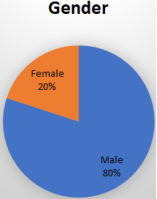
A total of 60 institutional staff members participated in the study. The vast majority of the respondents were male (80.0%, n = 48) (
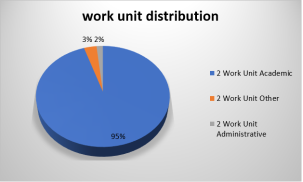
Figure 1) and primarily assigned to the academic work unit (95.0%, n = 57), while administrative and other technical staff accounted for 1.7% (n = 1) and 3.3% (n = 2), respectively (
Figure 2). In terms of professional tenure, more than half of the workforce possessed over 7 years of institutional work experience (55.0%, n = 33), whereas early-career professionals with less than a year of experience constituted the smallest subgroup (3.3%, n = 2) (Table1). Regarding educational attainment, more than half of the participants held a Bachelor's degree (56.7%, n = 34), followed closely by Master's degree holders at 33.3% (n = 20), with the remaining staff holding diplomas or other designations (Table1).
Figure 1. Gender distribution of survey respondents at Dessie Higher Education Health Science College, 2026 (N = 60).
Figure 2. Work unit distribution of survey respondents at Dessie Higher Education Health Science College, 2026 (N = 60).
Table 1. Socio-demographic and professional characteristics of respondents at Dessie Higher Education Health Science College, 2026 (N = 60).
| Category | N (%) |
Gender | Male | 48 (80.0) |
Female | 12 (20.0) |
Work Unit | Academic | 57 (95.0) |
Administrative | 1 (1.7) |
Other | 2 (3.3) |
Work Experience | > 7 years | 33 (55.0) |
4-6 years | 13 (21.7) |
1-3 years | 12 (20.0) |
< 1 year | 2 (3.3) |
Education Level | Bachelor Degree | 34 (56.7) |
Masters | 20 (33.3) |
Diploma | 4 (6.7) |
Other | 2 (3.3) |
4.2. Leadership and Administrative Services
4.2.1. Evaluation of Dean Service Fairness
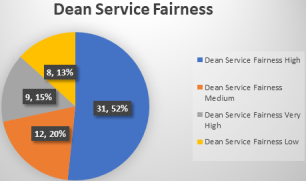
The largest proportion of respondents rated dean service fairness as high 31 out of 60, or 52%. This was followed by medium 12 respondents, or 20%, very high 9 respondents, or 15%, and low 8 respondents, or 13%. Overall, the distribut3ion suggests that most respondents viewed dean service fairness positively, since 67% selected high or very high (
Figure 2 and
Table 2).
This indicates that over half of the services are perceived as high in fairness, with a notable portion achieving very high fairness ratings. However, a small percentage of services are still rated as low, highlighting areas for potential improvement.
Figure 3. Dean Service Fairness among survey respondents at Dessie Higher Education Health Science College, 2026 (N = 60).
4.2.2. Analysis of Academic VP Service Fairness
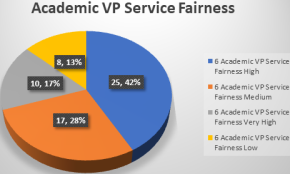
As shown in the
Figure 4, the perceived fairness levels of the Academic VP Service varied across respondents. The highest proportion rated fairness as High (25 respondents, 42%), followed by Medium (17 respondents, 28%), Low (10 respondents, 17%), and Very High (8 respondents, 13%). These results indicate that while a substantial plurality of participants perceived high fairness in the Academic VP Service, a combined 45% rated fairness as medium or low, suggesting notable room for improvement in academic administrative equity at the college.
Figure 4. Academic VP Service Fairness distribution among survey respondents at Dessie Higher Education Health Science College, 2026 (N = 60).
4.2.3. Evaluation of Admin VP Service Fairness
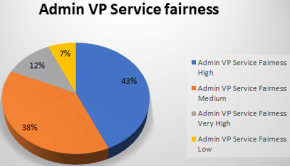
As illustrated in the
Figure 5, the perceived fairness levels of the Admin VP Service varied among respondents. The largest proportion rated fairness as High (26 respondents, 43%), followed by Medium (43% as well, based on the visual share), Very High (4 respondents, 7%), and Low (remaining percentage). These findings suggest that while the majority of participants viewed administrative fairness positively, a considerable minority perceived only medium or low fairness levels, indicating room for improvement in service equity at the college.
Figure 5. Admin VP Service Fairness distribution among survey respondents at Dessie Higher Education Health Science College, 2026 (N = 60).
4.2.4. Staff Motivation and Commitment, Property Department Courtesy and Complaint Handling Courtesy
The study assessed staff motivation and commitment, property department courtesy, and complaint handling courtesy among respondents.
Regarding staff motivation and commitment, the majority of respondents rated it as medium and high. Specifically, 23 (38.3%) respondents rated staff motivation and commitment as medium, while 21 (35%) rated it as high. In addition, 9 (15%) respondents perceived it as low, and 7 (11.7%) rated it as very high (
Table 2). This indicates that most respondents perceived staff motivation and commitment at a moderate to high level.
Concerning property department courtesy, 27 (45%) respondents rated the service as high, followed by 19 (31.7%) who rated it as medium. Furthermore, 10 (16.7%) respondents rated it as very high, whereas only 4 (6.7%) respondents rated it as low (
Table 2). The findings suggest that the courtesy level of the property department was generally perceived positively by most respondents.
With respect to complaint handling courtesy, the largest proportion of respondents, 26 (43.3%), rated it as low. Additionally, 19 (31.7%) respondents rated it as medium, while 12 (20%) rated it as high. Only 3 (5%) respondents rated complaint handling courtesy as very high (
Table 2). These findings indicate that complaint handling courtesy was perceived less favorably compared to the other service dimensions assessed.
Table 2. Institutional leadership fairness, administrative courtesy, and staff motivation perceptions among respondents at Dessie Higher Education Health Science College, 2026 (N = 60).
Variable | Category | N | (%) |
Dean Service Fairness | High | 31 | 51.7 |
Medium | 12 | 20 |
Very High | 9 | 15 |
Low | 8 | 13.3 |
Academic VP Service Fairness | High | 25 | 41.7 |
Medium | 17 | 28.3 |
Very High | 10 | 16.7 |
Low | 8 | 13.3 |
Admin VP Service Fairness | High | 26 | 43.3 |
Medium | 23 | 38.3 |
Very High | 7 | 11.7 |
Low | 4 | 6.7 |
Staff Motivation/Commitment | Medium | 23 | 38.3 |
High | 21 | 35 |
Low | 9 | 15 |
Very High | 7 | 11.7 |
Property Dept Courtesy | High | 27 | 45 |
Medium | 19 | 31.7 |
Very High | 10 | 16.7 |
Low | 4 | 6.7 |
Complaint Handling Courtesy | Low | 26 | 43.3 |
Medium | 19 | 31.7 |
High | 12 | 20 |
Very High | 3 | 5 |
4.3. Compensation, Professional Growth, and Recognition
Table 3 presents the detailed distribution of satisfaction scores across financial and professional development indicators, revealing a marked concentration of negative attitudes. Economic compensation emerged as a primary concern: a combined 65.0% (n = 39) of staff reported dissatisfaction with their Salary and Benefits (45.0% very dissatisfied; 20.0% dissatisfied), while only 5.0% (n = 3) expressed positive satisfaction. Structural stagnation was further emphasized by scores for Training Opportunities, where an overwhelming 81.7% (n = 49) of respondents provided negative feedback (51.7% very dissatisfied; 30.0% dissatisfied), compared to a negligible 1.7% (n = 1) who felt satisfied.
A parallel negative trend was observed for Career Growth Opportunities, with 60.0% (n = 36) of the institutional workforce reporting dissatisfaction or very dissatisfaction with their upward professional pathways. In contrast to these structural bottlenecks, the interpersonal climate surrounding Recognition presented a notable institutional strength. Combined positive satisfaction regarding workplace recognition reached 41.7% (n = 25), alongside a neutral sentiment of 33.3% (n = 20), leaving a smaller baseline of dissatisfaction at 25.0% (n = 15). This contrast confirms that while social capital and peer appreciation thrive within the college, resource-dependent growth factors face significant systemic challenges.
Table 3. Detailed breakdown of compensation, professional growth, and recognition satisfaction among staff at Dessie Higher Education Health Science College, 2026 (N = 60).
Variable | Satisfaction level | N | % |
Salary and Benefits | Very Dissatisfied (1) | 27 | 45 |
Neutral (3) | 18 | 30 |
Dissatisfied (2) | 12 | 20 |
Very Satisfied (5) | 2 | 3.3 |
Satisfied (4) | 1 | 1.7 |
Professional Growth Opportunity | Very Dissatisfied (1) | 23 | 38.3 |
Neutral (3) | 19 | 31.7 |
Dissatisfied (2) | 13 | 21.7 |
Satisfied (4) | 4 | 6.7 |
Very Satisfied (5) | 1 | 1.7 |
Recognition | Satisfied (4) | 21 | 35 |
Neutral (3) | 20 | 33.3 |
Very Dissatisfied (1) | 8 | 13.3 |
Dissatisfied (2) | 7 | 11.7 |
Very Satisfied (5) | 4 | 6.7 |
Training Opportunities | Very Dissatisfied (1) | 31 | 51.7 |
Dissatisfied (2) | 18 | 30 |
Neutral (3) | 10 | 16.7 |
Satisfied (4) | 1 | 1.7 |
4.4. Work Environment and Interpersonal Relationships
Table 4 presents the distribution of satisfaction scores across five workplace indicators: Coworker Relationship, Supervisor Support, Work Environment Comfort, Communication Flow, and Work Inputs Availability.
Coworker Relationship emerged as the strongest domain, with a combined 88.3% (n = 53) of respondents reporting satisfaction (45.0% very satisfied; 43.3% satisfied). Only 3.3% (n = 2) expressed dissatisfaction, and 8.3% (n = 5) remained neutral. This indicates exceptionally positive interpersonal dynamics among peers.
Supervisor Support also received favorable ratings, with a combined 65.0% (n = 39) satisfied or very satisfied (48.3% satisfied; 16.7% very satisfied). An additional 25.0% (n = 15) were neutral, while 10.0% (n = 6) reported dissatisfaction. These findings suggest generally adequate supervisory relationships, though with room for improvement.
Work Environment Comfort showed more moderate results. The largest proportion was neutral (46.7%, n = 28), followed by satisfied (23.3%, n = 14) and very satisfied (11.7%, n = 7). Combined dissatisfaction reached 18.3% (n = 11). This distribution suggests that while the work environment is not widely perceived as uncomfortable, it also fails to generate strong positive sentiment among most staff.
Communication Flow received predominantly neutral ratings (43.3%, n = 26), with 31.7% (n = 19) satisfied or very satisfied and 25.0% (n = 15) dissatisfied or very dissatisfied. The relatively high neutral and negative proportions indicate that communication effectiveness is an area requiring attention.
Work Inputs Availability was the weakest domain. Only 21.7% (n = 13) reported satisfaction (20.0% satisfied; 1.7% very satisfied), while 40.0% (n = 24) were neutral. Alarmingly, 38.4% (n = 23) expressed dissatisfaction (16.7% dissatisfied; 21.7% very dissatisfied). This represents the highest dissatisfaction rate among all five variables, indicating critical shortages or inadequacies in work inputs and resources.
In summary, while interpersonal domains such as coworker relationships and supervisor support demonstrate relative strength, structural and logistical areas, particularly work inputs availability, emerge as significant institutional weaknesses requiring urgent intervention.
Table 4. Detailed breakdown of environmental, operational, and interpersonal support metrics among staff at Dessie Higher Education Health Science College, 2026 (N = 60).
Variable | Satisfaction Level | N | % |
Coworker Relationship | Very Satisfied (5) | 27 | 45.0 |
Satisfied (4) | 26 | 43.3 |
Neutral (3) | 5 | 8.3 |
Dissatisfied (2) | 0 | 0.0 |
Very Dissatisfied (1) | 2 | 3.3 |
Supervisor Support | Very Satisfied (5) | 10 | 16.7 |
Satisfied (4) | 29 | 48.3 |
Neutral (3) | 15 | 25.0 |
Dissatisfied (2) | 4 | 6.7 |
Very Dissatisfied (1) | 2 | 3.3 |
Work Environment Comfort | Very Satisfied (5) | 7 | 11.7 |
Satisfied (4) | 14 | 23.3 |
Neutral (3) | 28 | 46.7 |
Dissatisfied (2) | 6 | 10.0 |
Very Dissatisfied (1) | 5 | 8.3 |
Communication Flow | Very Satisfied (5) | 6 | 10.0 |
Satisfied (4) | 13 | 21.7 |
Neutral (3) | 26 | 43.3 |
Dissatisfied (2) | 11 | 18.3 |
Very Dissatisfied (1) | 4 | 6.7 |
Work Inputs Availability | Very Satisfied (5) | 1 | 1.7 |
Satisfied (4) | 12 | 20.0 |
Neutral (3) | 24 | 40.0 |
Dissatisfied (2) | 10 | 16.7 |
Very Dissatisfied (1) | 13 | 21.7 |
4.5. Organizational Culture, Workplace Safety, and Institutional Resources
Table 5 shows, a detailed breakdown of staff perceptions across six key organizational dimensions. The data reveal a clear dichotomy between strong interpersonal relationships and weak structural/infrastructural support.
Interpersonal Strength: The highest satisfaction levels are observed in Relationship with Colleagues, where 88.3% of respondents (n = 53) reported being satisfied or very satisfied. This indicates robust peer-level social capital and a collegial work environment. Workload Balance also performs moderately well, with 46.7% (n = 28) expressing satisfaction and 43.3% (n = 26) remaining neutral, suggesting that workload is generally perceived as manageable by the majority.
Structural Vulnerabilities: In contrast, Employee Safety Focus reveals significant concern, as only 18.3% (n = 11) reported satisfaction, while 36.7% (n = 22) expressed dissatisfaction. Similarly, Availability of Resources shows a combined dissatisfaction rate of 38.4% (n = 23), exceeding the satisfaction rate of 21.7% (n = 13). These findings point to critical deficits in workplace safety protocols and material resource provisioning.
Governance and Equity Gaps: Both Performance Evaluation Fairness and Respect for Employees' Ideas are characterized by high neutrality (55.0% and 56.7%, respectively), indicating widespread uncertainty or ambivalence regarding institutional fairness and voice mechanisms. Notably, Respect for Employees' Ideas recorded zero "Very Satisfied" responses, and a combined 20.0% (n = 12) expressed dissatisfaction, suggesting that staff feel their input is undervalued in decision-making processes.
Table 5. Breakdown of organizational culture, resource dynamics, and institutional equity metrics among staff at Dessie Higher Education Health Science College, 2026 (N = 60).
Variable | Response Category | Frequency (N) | Percent (%) |
Relationship with Colleagues | Very Satisfied | 27 | 45.0 |
Satisfied | 26 | 43.3 |
Medium/Neutral | 5 | 8.3 |
Dissatisfied | 0 | 0.0 |
Very Dissatisfied | 2 | 3.3 |
Workload Balance | Very Satisfied | 6 | 10.0 |
Satisfied | 22 | 36.7 |
Medium/Neutral | 26 | 43.3 |
Dissatisfied | 1 | 1.7 |
Very Dissatisfied | 5 | 8.3 |
Employee Safety Focus | Very Satisfied | 3 | 5.0 |
Satisfied | 8 | 13.3 |
Medium/Neutral | 27 | 45.0 |
Dissatisfied | 16 | 26.7 |
Very Dissatisfied | 6 | 10.0 |
Availability of Resources | Very Satisfied | 1 | 1.7 |
Satisfied | 12 | 20.0 |
Medium/Neutral | 24 | 40.0 |
Dissatisfied | 10 | 16.7 |
Very Dissatisfied | 13 | 21.7 |
Performance Evaluation Fairness | Very Satisfied | 3 | 5.0 |
Satisfied | 12 | 20.0 |
Medium/Neutral | 33 | 55.0 |
Dissatisfied | 6 | 10.0 |
Very Dissatisfied | 6 | 10.0 |
Respect for Employees' Ideas | Very Satisfied | 0 | 0.0 |
Satisfied | 14 | 23.3 |
Medium/Neutral | 34 | 56.7 |
Dissatisfied | 2 | 3.3 |
Very Dissatisfied | 10 | 16.7 |
4.6. Qualitative Findings: Institutional Assets, Structural Vulnerabilities, and Strategic Directives
4.6.1. Institutional Strengths: What Staff Appreciate
The qualitative insights highlight several foundational strengths that contribute to a positive workplace culture and sustain institutional resilience. A prominent theme among respondents is the physical environment of the college, with more than fifteen participants explicitly praising the campus beauty and well-maintained greenery. This aesthetic appeal creates a welcoming and supportive atmosphere for both teaching and learning.
Professionally, employees value the high degree of academic freedom permitted within their roles, which fosters instructional autonomy and creative pedagogical execution. This structural independence is strongly reinforced by an exceptionally supportive social environment characterized by deep coworker respect and active teamwork. Faculty and staff rely heavily on these robust peer networks to navigate daily tasks.
Furthermore, there is a widespread sense of shared institutional growth and organizational pride. Respondents frequently noted that watching the college expand its capacity and profile gives them a strong sense of professional purpose and alignment with the institution's long-term mission.
4.6.2. Institutional Weaknesses: Key Areas Requiring Improvement
Conversely, the qualitative data reveals acute structural and logistically centered frustrations that actively undermine employee satisfaction. Economic hygiene factors represent the most frequent and severe complaints among the workforce. Specifically, dissatisfaction with the current salary scale and the lack of a sufficient house allowance were highlighted as critical financial strains that fail to match the rising cost of living.
This financial distress is compounded by severe limitations in professional infrastructure, namely the absence of clear, continuous training and long-term career development opportunities. Instructors feel professional growth has stalled due to a lack of capacity-building initiatives.
On an operational level, staff faces daily friction from technical infrastructure deficits, including constant internet instability and a severe shortage of essential office hardware such as functional computers and printers.
Finally, deep systemic concerns were raised regarding organizational governance. Respondents pointed to a perceived lack of fairness and transparency in hiring and promotion protocols, alongside persistent administration delays regarding overtime payment disbursements, both of which degrade internal trust.
4.6.3. Strategic Recommendations: Direct Feedback for Management
The direct feedback from the workforce provides a clear, actionable guide for leadership intervention, focusing on equity, systemic planning, and participatory governance. Staff members explicitly call on management to practice universal institutional fairness, summarized by the direct plea to "be fair to all staff, not just your circle." This requires a shift away from insular decision-making toward objective, equitable treatment across all departments.
To restore trust in administrative accountability, leadership must strictly base recruitment, hiring, and promotions on verifiable professional competence rather than personal relationships or informal networks.
Furthermore, management is urged to transition from a top-down administrative stance to a more inclusive model by actively listening to and valuing staff ideas, thereby bridging the current gap in employee agency.
Organizationally, the workforce recommends moving away from reactive, emotion-driven management styles in favor of a stable, plan-driven leadership framework that prioritizes institutional policies over subjective discretion.
Lastly, establishing structured, transparent communication channels between the central administration and the academic staff is vital to clear up operational ambiguity, eliminate mutual misunderstandings, and foster a unified institutional culture.





 Share This Article
 Twitter
 Linked In
 Facebook

 Copy
 Download