Research Article | | Peer-Reviewed

Development of Lozenges from Fruit Extract of Balanites aegyptiaca (L) Delile (Zygophyllaceae) for the Treatment of Occasional Constipation

Received: 26 June 2026     Accepted: 16 July 2026     Published: 10 August 2026
Views:       Downloads:
Abstract

Balanites aegyptiaca (L.) Del. is a plant whose fruit pulp is traditionally used to treat constipation. They possess inherent laxative properties. This study aimed to improve upon the traditional method of use by developing lozenges with these laxative properties. An infusion was performed, and the physicochemical characteristics of the lyophilized extract were determined. The lozenges were formulated from the extract, and their quality and laxative efficacy in vivo were controlled in NMRI strain mice. The extract was yellow, had a bitter-sweet taste, a characteristic smell, and a fine texture. The pH was 5.56, and the RMC was 1.16%. The powder was highly hygroscopic, and the extraction yield was 33.71%, with a saponoside content of 2.76 μgED/mg. Fifteen (15) formulations were prepared, and formulation F7 was selected for the incorporation of the extract. The F7 was yellow, sweet, with an uncharacteristic odor and a hard appearance. The lozenges were uniform (1.95±0.04 g), with an average pH of 5.85±0.07 and a saponoside content of 2.01±0.26 μgED/mg. The lozenges had an accelerated intestinal transit percentage of 75.74±3.22%, comparable to that of the extract (78.10±4.32%) and castor oil (81.84±9.46%). After slowing down transit with loperamide (45.24±2.38%), the lozenges (60.84±7.13%) brought the percentage close to normal transit (65.94±3.33%). This study highlighted the laxative efficacy of lozenges made from Balanites aegyptiaca fruit pulp extract.

Published in Pharmaceutical Science and Technology (Volume 10, Issue 2)
DOI 10.11648/j.pst.20261002.12
Page(s) 32-41
Creative Commons

This is an Open Access article, distributed under the terms of the Creative Commons Attribution 4.0 International License (http://creativecommons.org/licenses/by/4.0/), which permits unrestricted use, distribution and reproduction in any medium or format, provided the original work is properly cited.

Copyright

Copyright © The Author(s), 2026. Published by Science Publishing Group

Keywords

Balanites aegyptiaca; Fruit Pulp, Constipation, Lozenge, Saponosides, Laxative Activity

1. Introduction
Constipation is a major public health challenge in sub-Saharan Africa despite high fiber intake due to several physiological and behavioral factors, as well as the structure of local meals Indeed, Africa has a wide variety of edible plants that are not exploited due to its relatively limited dietary habits . This predisposes them to many common digestive problems, especially constipation . Constipation is a complex digestive disorder characterized by dissatisfaction during bowel movements, including infrequent stools, difficulty passing stools, or a combination of both .
A global analysis of constipation in older people conducted in 2023 reported that the highest prevalence of constipation was observed in Africa, with a rate of 32.3% . It often manifests as bloating, cramps and abdominal pain, nausea and vomiting, which can be difficult daily . In managing this condition, the priority recommended is to modify one's lifestyle by adopting adequate hydration, engaging in moderate physical exercise, and increasing the intake of natural fiber in the diet before any medical treatment . In conventional medical therapy, drug categories such as osmotic laxatives, lubricant or emollient laxatives, and stimulant laxatives are used to treat constipation . However, access to these medicines remains a challenge for a large majority of the sub-Saharan population, linked to socio-cultural habits of resorting to traditional medicine .
Scientific sources from ethnobotanical studies indicate the use of several herbal remedies in the treatment of constipation. Among these plants, Tamarindus indica L. (fruit maceration), Carica papaya L. (leaf decoction), Adansonia digitata L. (fruit maceration), Annona senegalensis Pers. (leaf decoction), Hibiscus sabdariffa L. (fruit maceration), etc., are well known to have laxative properties . In addition to these plants, Balanites aegyptiaca (fruit) is well known to African populations for treating constipation by simply sucking on the fruit pulp . An experimental study carried out on the pulp of the plant's fruit confirmed its traditional use as a laxative .
To improve upon the traditional use, which involves sucking the pulp, the present study developed lozenges from the plant's fruit pulp for the treatment of occasional constipation.
2. Materials and Methods
2.1. Material
2.1.1. Plant Material
The plant material consisted of the mesocarp of the fruit of Balanites aegyptiaca collected at Nobili/Manga (N 11°40'51.6" and W 001°18'30.1") in the Nazinon region of Burkina Faso. The samples were cleaned of foreign material and placed in plastic bags before extraction.
2.1.2. Animal Material
Male and female NMRI mice weighing 25-30g, obtained from the IRSS, were used. The room temperature was maintained at 20 and 25°C ± 2 with a humidity level of 75%.
2.2. Methods
2.2.1. Extraction
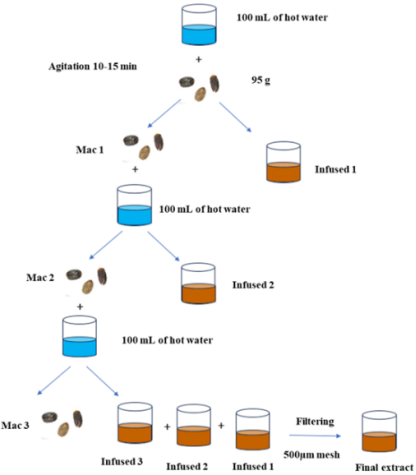
Ninety-five (95) g of Balanites aegyptiaca fruit without their shells were infused in a beaker containing 100 ml of boiling water. Under constant stirring with a spatula, the mixture was left to infuse for 10 to 15 minutes to remove much of the pulp. Next, the seeds were removed and placed in a second beaker with 100 ml of boiling water, to be crushed for 5 minutes to remove the remaining pulp. In a third beaker, the seeds were rinsed with 50 mL of boiling water. The contents of the three beakers were poured into a plastic container, and 30 ml of water was used to rinse the beakers. The extract was filtered with a 500 μm sieve. Twenty (20) ml of water was added to the residue, which was then mixed with the filtered extract, which was filtered again. Finally, the final extract was freeze-dried using an ALPHA 1-2 LO type freeze dryer. The extraction yield was determined. The extraction process is illustrated in Figure 1.
Figure 1. Method of extracting the plant drug by infusion.
2.2.2. Physico-Chemical Activity
1) Macroscopic and organoleptic characteristics
The organoleptic and macroscopic characteristics of the fruit pulp and the freeze-dried extract, namely color, taste, odor, and texture, were evaluated .
2) pH determination
The pH was determined by immersing the pH meter electrode in aqueous solutions containing 1% (w/v) of the extract (0.1g/10ml). The trial was performed 3 times, and the mean and standard deviation were calculated .
3) Residual moisture content (RMC)
A 0.5g sample of powder is placed in a halogen desiccator at 105°C for 15 minutes. The desiccator displayed the RMC value after the beep. The trial was performed 3 times, and the mean and standard deviation were calculated .
4) Hygroscopicity
A mass of extract (m2) after loss on drying was placed in a previously weighed watch glass (m1). The watch glass is then placed in a crystallizing dish at 25°C with a saturated ammonium chloride solution for 24 hours. After the allotted time, the watch glass was retrieved and weighed (m3). The percentage increase in mass was calculated .
5) Measurement of the metabolite of interest: saponosides
Saponosides were measured according to the method of Uematsu et al. . A 1 mL volume of solution A (0.5 mL of p-anisaldehyde and 99.5 mL of ethyl acetate) and solution B (50 mL of concentrated sulfuric acid and 50 mL of ethyl acetate) were added. The mixture was placed in a water bath at 60°C for 10 min, then cooled to room temperature for 10 min. The absorbance of the colored solution was measured, with methanol serving as a control. A calibration curve was obtained using solutions containing 2 mL of diosgenin and 2 mL of methanol. The saponin concentration of the extract was calculated.
2.2.3. Formulation of the Lozenges
Two (2) formulation strategies for the lozenge bases were carried out, and the extract was incorporated into the most stable base.
1) First formulation strategy
Its objective was to use gum arabic and/or gelatin as gelling and/or thickening agents to obtain lozenge formulations that met the requirements of the 11th edition of the European Pharmacopeia. To make the pastilles, gelatin and gum arabic were varied in proportions from 10 to 30% and sucrose from 30 to 60% in the different formulations (Table 1).
Table 1. Quantitative and qualitative formulation of the lozenges.

Composition

Role

F1

F2

F3

F4

F5

F6

F7

F8

F9

F10

Gelatin

Gelling and thickening agent

20

15

10

-

-

-

10

15

20

30

Gum arabic

Gelling and thickening agent

10

15

20

10

20

30

-

-

-

-

Sucrose

Sweetener

30

30

30

60

45

30

50

45

40

30

Aqua preservans

Antimicrobial preservative

qs

qs

qs

qs

qs

qs

qs

qs

qs

qs

Total (in g)

100

100

100

100

100

100

100

100

100

100

2) Second formulation strategy
Formulations of neutral base lozenges were prepared using sucrose, PEG, HPMC, and water as excipients. The objective of this approach was to develop sucrose-based lozenges stabilized with high-viscosity thickeners. For this purpose, PEG 4000 and HPMC 4000 were chosen for their thickening properties, and sucrose was used as a sweetener and binder. The quantitative and qualitative composition of the formulations is given in Table 2.
Table 2. Quantitative and qualitative formulation of PEG and HPMC 4000-based pellets.

Formulations

Role

F11

F12

F13

F14

F15

Sucrose

Sweetener

80

75

65

75

65

Polyethylene glycol (PEG) 4000

thickening agent

-

5

10

-

-

HPMC 4000

thickening agent

-

-

-

5

10

Aqua preservans

Antimicrobial preservative

qs

qs

qs

qs

qs

Total (in g)

100

100

100

100

100

2.2.4. Manufacturing of the Lozenges
1) Preparation of neutral bases
From the first formulation strategy
Initially, the gelatin was dissolved in the aqua conservans at 70°C, and the gum arabic at room temperature. A simple syrup was prepared hot (110°C) with one third of the weight of sucrose in aqua preservans. Depending on the formulation, gelatin and/or gum arabic have been added to the cooled simple syrup, which was then homogenized. Five (5) minutes later, the mixture was poured into molds previously coated with liquid paraffin. The pellets were removed from the molds 16 hours later and left to air dry.
From the second formulation strategy
The sugar was mixed with the aqua preservans and ascorbic acid, then heated on a hot plate to 150°C. Next, the other excipients were added, namely PEG or HPMC, and mixed. The final mixture was poured into silicone molds and left to cool. Once cooled and solidified, they were unmolded.
2) Incorporating the extract into the best base
The freeze-dried extract was dissolved with aqua preservans, and the syrup was added. Gelatin was added to the mixtures, homogenized, and the resulting preparation was poured into molds. Following the effective dose of the extract in animals , lozenges containing a theoretical mass of 500mg of extract were formulated.
2.2.5. Quality Control of the Tablets
The quality control of the lozenges was carried out by determining macroscopic and organoleptic characteristics, mass uniformity, pH, the quantification of the metabolite of interest (namely, saponins), and in vivo efficacy.
1) Macroscopic and organoleptic characteristics
The organoleptic and macroscopic characteristics of the lozenges were evaluated by assessing their color, taste, odor, and texture in accordance with the European Pharmacopeia .
2) Mass uniformity
Mass uniformity was determined by individually weighing 20 randomly selected units following the European Pharmacopeia procedure for unit forms. The mean and standard deviation were determined .
3) pH determination
The pH of the pellets was measured with a pH meter by immersing the electrode in a 1% pellet suspension .
4) Measurement of the metabolite of interest: saponosides
One pellet was dissolved and diluted to 1mg/mL, and 2 mL of this solution was used for the determination of saponosides in accordance with the method described for the determination of the extract.
2.2.6. Evaluation of the in Vivo Laxative Efficacy of Lozenges
The activity on intestinal transit was performed on adult male and female NMRI strain mice weighing between 20 and 30g .
Gastrointestinal motility test in normal mice: The mice were divided into 05 groups of 06. Lot 1 (normal control) received only 5% charcoal, Lot 2 (positive control) 0.3ml castor oil, Lot 3 (negative control) 5mg/kg loperamide, Lot 4 the extract at a dose of 200mg/kg and Lot 5 the lozenge at a dose of 200mg/kg. Mice in groups 2, 3 and 4 received 5% charcoal 30 min after administration. Thirty (30) minutes later, the mice were euthanized, and the small intestine of each one was removed. The distance traveled by the coal and the length of the small intestine were measured. The percentage of intestinal transit representing the distance traveled by the charcoal relative to the total length of the small intestine was calculated for each mouse.
% of intestinal transit= (distancetraveledby the coal)/ (total length of the small intestine) *100
Gastrointestinal motility test in mice constipated by Loperamide: Five (5) groups of 6 mice were fasted for 18 hours. Batches 1, 2, and 3 were similar to the previous test. Batch 4 received loperamide at 5 mg/kg 30 minutes before receiving the extract at a dose of 200 mg/kg, and Batch 5 received loperamide at 5 mg/kg 30 minutes before receiving the lozenge at a dose of 200 mg/kg. The rest of the process is similar to that of the previous test.
2.2.7. Statistical Analysis
The data obtained were entered into Microsoft Excel 2016 and presented as mean ± standard deviation. Statistical analysis of the results was performed using GraphPad Prism version 5. A one-way ANOVA followed by Dunnett's test was used as the statistical analysis. Differences were considered statistically significant when the probability of error (p) was less than 0.05 (p < 0.05).
2.2.8. Ethical Considerations
The protocols for in vivo studies and experiments were carried out in compliance with the protocols already approved by the Institute of Health Sciences Research (IRSS, BURKINA FASO) and in accordance with the international standards in force (guidelines established by the European Union on the protection of animals (EC Council 86/609).
3. Results
3.1. Physicochemical Properties of the Extract
3.1.1. Macroscopic and Organoleptic Characteristics
The results of the macroscopic and organoleptic characteristics are shown in Table 3.
Table 3. Macroscopic and organoleptic characteristics of the fruit pulp and freeze-dried extract of Balanites aegyptiaca.

Features

Fruit pulp

Freeze-dried extract

Color

Brown

Yellow

Odor

Fruity

Fruity

Taste

Sweet and bitter

Sweet and bitter

Texture

Pasty

Thin and dry

The pulp of the Balanites aegyptiaca fruit was brown, had a fruity smell, a sweet and bitter taste, and a fine texture. The freeze-dried extract had the same fruity smell and the same sweet and bitter taste as the pulp, but with a yellow color and a fine, dry powder texture.
3.1.2. Physicochemical Characteristics of the Extract
The results of the physico-chemical characteristics (yield, pH, RMC, and hygroscopicity) are shown in Table 4.
Table 4. Physico-chemical characteristics of the extract.

Parameter evaluated

Values

Yield

33.71% ±1.03

pH

5.56 ± 0.02

RMC

1.16% ± 0.49

Hygroscopicity

25.31 ± 0.46

Saponosides

2.76 ± 0.13 mg DE/g

* DE: Equivalent Diosgenin
The extraction yield was 33.71% ±1.03. The pH of the extract was 5.56 ± 0.02, and the RMC was 1.16% ± 0.49. The hygroscopicity assessment gave a value of 25.31 ± 0.46. This value increased by more than 15%. The saponoside content was 2.76±0.13 mgDE/g.
3.2. Quality Control of the Tablets
The quality control of the lozenges included determination of macroscopic and organoleptic characteristics, mass uniformity, pH, saponin content, and in vivo efficacy.
3.2.1. Macroscopic and Organoleptic Characteristics
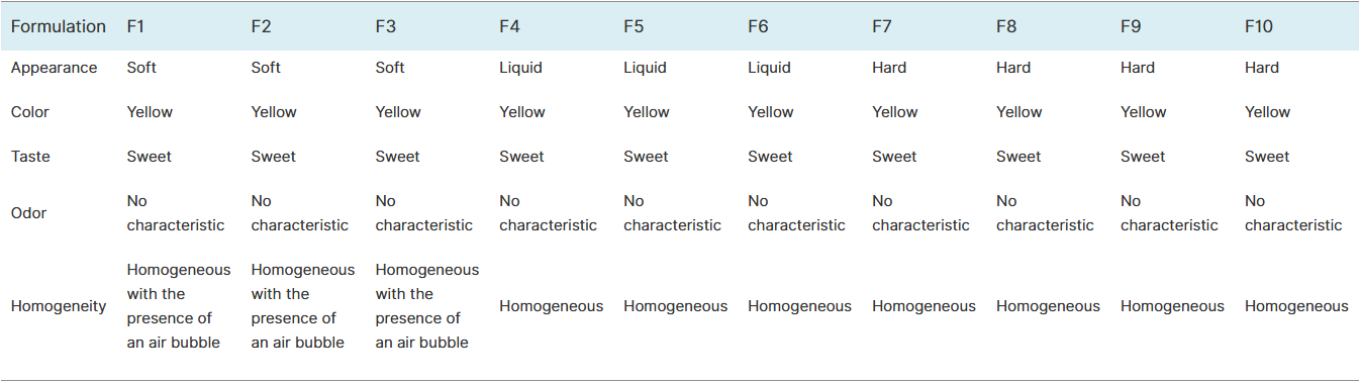
The results of the macroscopic and organoleptic characteristics are recorded in Table 5 and Table 6.
Table 5. Macroscopic and organoleptic characteristics of the lozenges.
Table 6. Macroscopic and organoleptic characteristics of the lozenges.

Formulation

F11

F12

F13

F14

F15

Appearance

Hard

Hard

Hard

Hard

Hard

Color

Orange

Orange

Orange

Orange

Orange

Taste

Sweet

Sweet

Sweet

Sweet

Sweet

Odor

No-characteristic

No-characteristic

No-characteristic

No-characteristic

No-characteristic

Homogeneity

Homogeneous

Homogeneous

Homogeneous

Not homogeneous

Not homogeneous

The formulations of the first strategy (F1 to F10) were yellow in color, had a non-characteristic odor, and had a sweet taste. Formulations F1 to F3 were soft, with air bubbles present. Formulations F4 to F6 remained liquid and homogeneous. Formulations F7 to F10 were hard and homogeneous.
The formulations of the second strategy (F11 to F15) were hard in appearance, orange in color, with a non-characteristic odor and a sweet taste. The only distinctive feature was homogeneity. Formulations F12 and F13 melted 3 days after formulation, and F14 and F15 were not homogeneous.
The F7 lozenges, after incorporation of the active ingredient, were brown in color, sweet in taste, hard in appearance, and had no characteristic odor. The F8 tablets had become pasty.
3.2.2. PH, Mass Uniformity and Saponoside Content
The characteristics of the pellets, including mass uniformity, pH, and saponoside content, are presented in Table 7.
Table 7. Results of the quality control of the pellets.

Parameter evaluated

Values obtained

Mass uniformity

1.95 ± 0.04 g

pH

5.85 ± 0.07 g

Saponosides content

2.01 ± 0.26 μgED/mg

* DE: Equivalent Diosgenin
The pellets had uniform masses of 1.95 ± 0.04 g, a pH of 5.85 ± 0.07, and a saponoside content of 2.01 ± 0.26 μgED/mg.
3.3. Laxative Effect in Vivo of Lozenges
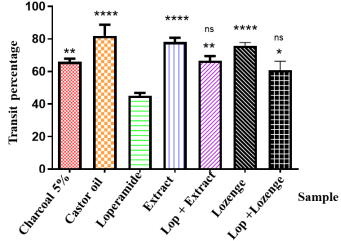
The percentages of intestinal transit are illustrated in Figure 2.
The percentage of normal transit was 65.94±3.33%. Castor oil (positive control), as well as the extract and the lozenge, accelerated transit with respective percentages of 81.84±9.46%, 78.10±4.32%, and 75.74±3.22%. Statistical analysis showed no significant difference in activity between castor oil, the 200mg/kg extract, and the lozenges. Loperamide (negative control) slowed intestinal transit by 45.24±2.38%. After loperamide reduced transit, the extract (66.6±3.86%) and the lozenges (60.84±7.13%) restored transit to normal (65.94±3.33%). There was no significant difference between the percentage of normal transit and that of loperamide + extract, as well as that of loperamide + lozenge.
Figure 2. Effect of the samples on normal transit.
ns: no-significant difference compared to normal transit (charcoal)
*, **, ****: significant difference compared to the negative control (Loperamide), P < 0.05, P < 0.004, P < 0.0001
4. Discussion
4.1. Physicochemical Properties of the Extract
The determination of macroscopic and organoleptic characteristics demonstrated that the dry extract of Balanites aegyptiaca had a yellow color, a fruity odor, a sweet and bitter taste, and a fine, dry texture. These results are similar to those reported by Moyenga . These characteristics allow us to differentiate the plant from other plants .
The extraction yield was 33.71% ± 1.35, comparable to that reported by Messiheddine et al. (37.5%) . The extraction yield would reflect both the efficiency of the extraction process and the likely concentration of secondary metabolites in the plant . The high yield would reflect the presence of extractable metabolites.
The residual moisture content (RMC) of the lyophilized extract was 1.16% ± 0.49, less than 10%, meeting the requirements of the 11th edition of the pharmacopeia. The results are in agreement with those of Messiheddine et al., who had found a RMC value of 5.43% , less than 10%. Evaluating residual moisture content is a key criterion for judging the effectiveness of a drying method . Indeed, high RMC values would promote the proliferation of microorganisms and certain enzymatic reactions, potentially altering the quality of the powder during storage .
The hygroscopicity evaluation of the extract yielded a value of 25.31 ± 0.46, exceeding 15%. According to the 11th edition of the pharmacopeia, the lyophilized infusion extract of Balanites aegyptiaca is highly hygroscopic . This means it can absorb moisture from the air during handling and storage. Therefore, it is necessary to store it in airtight containers .
The saponoside content was 2.76±0.13 mgDE/g. According to Traore et al. in their studies, saponosides would increase stool volume by retaining water in the intestine , which would facilitate intestinal transit. Kim et al. also demonstrated the effect of Aloe ferox saponins on transit by stimulating peristalsis and mucin secretion . These phytochemical compounds, which affect intestinal transit, could be considered secondary metabolites of interest for the continuation of the study.
4.2. Characteristics of the Formulated Lozenges
Formulations F1, F2, and F3 were soft, yellow in color, sweet in taste, and had an uncharacteristic odor. The presence of air bubbles, which represents an upper limit in these formulations, was probably due to the preparation process, particularly agitation. Indeed, agitation speed is a parameter that influences the manufacturing process, as at high speeds, agitators draw in air bubbles that can interfere with certain industrial processes .
Formulations F4, F5, and F6 remained liquid. This could be explained by the weak interaction between the gum macromolecules in solution (water), which increases the solution's viscosity without making it solid . Indeed, a too-high percentage of gum arabic would contribute to a softer, even liquid, and less fluffy texture . Also, gum arabic is said to have a thickening rather than a gelling property , which could explain the liquid aspect of the formulations.
Formulations F7, F8, F9, and F10 were hard, homogeneous pellets. This could be due to the temperature at which the gelatin was incorporated (70°C). Indeed, gelatin begins to lose its gelling properties when heated in solution above 60°C . Also, the mixture of sucrose syrup and gelatin would make the lozenges harder , which could explain their hardness. The sucrose syrup at 70°C, when mixed with the gelatin solution, may have affected the texture of the lozenges after cooling .
The F12 and F13 lozenge formulations were not stable; they melted 3 days after formulation. This could be explained by the denaturation of PEG 4000 at 80°C . Indeed, the thickening property of PEG, which can be denatured by high temperatures, and its hygroscopic nature could be the cause of the pellets' deliquescence after formulation . Formulations F14 and F15 were not homogeneous. HPMC has higher solubility in water at low temperatures, facilitating hydration and chain dispersion via hydrogen bonding between the polymer's hydrophilic groups and water molecules . Adding HPMC at a temperature above 70°C resulted in thermal degradation of the polymer and its functional properties. Indeed, at high temperatures, the hydrophobic interactions between the substituted polymer segments become more pronounced, decreasing solubility and thus promoting intermolecular association, ultimately leading to thermal gelation, which requires cooling for the polymer to fully hydrate and develop its viscosity . Consequently, high temperatures are required for the formation of hard pellets but often lead to depolymerization and/or hydrolysis .
Of all the formulations produced, the F7 and F8 pellets had given the desired characteristics. However, after incorporating the extract, the F8 had a pasty appearance that more closely resembled the definition of oral pastes than that of lozenges. The F7 lozenges met the European Pharmacopeia standards for hard lozenges .
4.3. Quality Control of the Tablets
The pH of the lozenges was 5.85 ± 0.07, and that of the extract was 5.56 ± 0.02. This shows that the formulation of the lozenges did not have too significant an impact on the pH of the extract. Furthermore, it has been observed that the lozenges are generally acidic, as shown by the formulations of Bedse et al. who formulated 3 lozenges with different appearances but an average pH of 6.67 . Also, since the slightly acidic pH of the formulated lozenges is higher than the stomach's pH, their absorption and bioavailability may not be affected by gastrointestinal pH .
The mass of the pellets was 1.95 ± 0.04 g. This mass is consistent with that of hard pellets, which generally range from 1.5 to 4.5 g . The standard deviation of the formulated lozenges is within the limits authorized by the European Pharmacopeia 11th edition, set at 5% .
Saponosides, the secondary metabolite of interest measured in the lozenge, had a content of 2.01 ± 0.26 μgDE/mg. This result indicates that the formulation did not denature or alter the phytochemical compound in the extract, which had a content of 2.76±0.13 mgDE/g. Therefore, it could be used as a tracer to ensure the quality of raw materials and of intermediate and finished products derived from the extract .
4.4. Laxative Effect in Vivo of Lozenges
With normal intestinal transit at 65.94%, castor oil accelerated it to 81.84%, while loperamide slowed it to 45.24%. Castor oil is used as a reference compound to induce and accelerate intestinal transit in animal models. Indeed, castor oil releases ricinolein, which binds to its specific EP3 receptor for prostaglandin E2 (PGE2) on the intestinal wall, leading to stimulation of intestinal smooth muscles . This stimulation results in accelerated peristalsis and increased secretion of fluids and electrolytes into the intestinal lumen, while inhibiting water reabsorption in the colon, causing mild irritation . While loperamide, a synthetic morphine-based agonist of µ-opioid receptors in the gastrointestinal tract, is thought to act by binding to these receptors, slowing colonic transit, and causing an increase in segmental contractions . Furthermore, it exerts an antisecretory effect by increasing hydroelectrolytic flow from the intestinal lumen to the enterocyte while decreasing the reverse flow .
The extract increased normal transit by 78.10%. Statistical analysis shows that there was no significant difference in the percentage of transit between the extract and castor oil (81.84%). The extract is said to act through the same mechanism as castor oil. Indeed, Traore et al. found that the extract could have an irritant and stimulant laxative effect, similar to that of castor oil, through its action on EP3 receptors, which induces peristalsis .
The formulated lozenge had an intestinal transit rate of 75.74%. Statistical analysis showed no significant difference in the transit rate of the lozenge compared with that of the extract and castor oil (81.84%). These results suggest that the formulation and excipients did not interfere with the extract's action.
After slowing intestinal transit with loperamide, the extract and the formulated lozenge restored intestinal transit to normal. There was no significant difference between the percentage of normal intestinal transit (65.94%) and those of loperamide + extract (66.6%) and loperamide + lozenge (60.84%). Indeed, the extract and the lozenge neutralized the inhibitory effect of loperamide on transit (45.24%), restoring it to normal. Thus, the extract and the formulated tablet would act as antagonists of loperamide or as inhibitors of its binding to μ receptors .
5. Conclusions
The fruits of Balanites aegyptiaca L. Del. are traditionally used by suction to treat constipation. This is how scientific studies have justified their laxative properties. It is in this context that the present study aimed to propose a form of use adapted to conventional formulations by developing lozenges based on the mesocarp of the fruit of Balanites aegyptiaca. Thus, 15 basic lozenge formulations were produced, the best of which was Formulation F7, made up of 10% gelatin. This base was used for incorporating the extract. The quality control carried out confirmed that the lozenges were manufactured in accordance with the European Pharmacopeia standards. The in vivo evaluation of the manufactured lozenges showed results comparable to those of castor oil (reference used), confirming their laxative efficacy. The formulated lozenges would provide a scientific database for the formulation of herbal medicines for the management of constipation.
Abbreviations

RMC

Residual Moisture Content

PEG

Polyethylene glycol

HPMC

Hydroxypropyl Methylcellulose

Author Contributions
Ouedraogo Salfo: Conceptualization, Formal Analysis, Funding acquisition, Investigation, Methodology, Project administration, Resources, Software, Supervision, Validation, Visualization, Writing – original draft, Writing – review & editing
Traore Tata Kadiatou: Data curation, Formal Analysis, Investigation, Methodology, Resources, Software, Supervision, Validation, Visualization, Writing – original draft, Writing – review & editing
Boly Abdoul Gilchrist Laurent: Investigation, Methodology, Supervision, Validation, Visualization, Writing – original draft
Tapsoba Angelina Carine: Data curation, Methodology, Validation, Visualization
Millogo Jacqueline Olivia: Data curation, Methodology, Validation, Visualization
Atchade Bolade Constantin: Methodology, Validation, Visualization
Kabore Donacienne: Methodology, Validation, Visualization
Traore Safiatou: Investigation, Methodology, Validation
Goumbri Wendinmi Bertrand Florent: Methodology, Validation
Traore Aristide: Conceptualization, Funding acquisition, Project administration, Resources, Validation, Visualization
Ouedraogo Sylvin: Conceptualization, Funding acquisition, Project administration, Resources, Validation, Writing – review & editing
Semde Rasmane: Conceptualization, Funding acquisition, Project administration, Resources, Validation, Writing – review & editing
Acknowledgments
The authors are grateful to the Department of Traditional Medicine and Pharmacopeia Pharmacy of the Research Institute of Health Sciences (IRSS).
Conflicts of Interest
The authors declare no conflicts of interest.
References
[1] Sehonou, J., Sokpon, C. N. M., Kpossou, A. R., Azandjeme, C., Cataria, H., & Vignon, R. K. [Functional constipation in the general population of Cotonou (Benin): clinical features and factors influencing dietary behaviours]. Pan Afr Med J, 2019. 34, 210.
[2] Sehonou, J., Kpossou, A. R., Sokpon, C. N. d. M., Cataria, H., Azandjeme, C., & Vignon, K. R. Functional constipation in the general population in Cotonou: prevalence and associated socio-demographic factors. Open Journal of Gastroenterology, 2018. 8(09), 306.
[3] Camara, B., Constipation. Medicine from Black Africa, 1999. 46(4): p. 244-247.
[4] Cirillo, C. and R. Capasso, Constipation and botanical medicines: an overview. Phytotherapy Research, 2015. 29(10): p. 1488-1493.
[5] Mohamed, J. S M. Serious complications of constipation in psychiatric patients. Thesis, University of Paris Diderot - Paris 7. 2015. P 123.
[6] Salari, N., Ghasemianrad, M., Ammari-Allahyari, M., Rasoulpoor, S., Shohaimi, S., & Mohammadi, M. Global prevalence of constipation in older adults: a systematic review and meta-analysis. Wiener Klinische Wochenschrift, 2023. 135(15): p. 389-398.
[7] Sayuk, G. S., Q. T. Yu, and C. Shy, Management of Constipation in Hospitalized Patients. J Clin Med, 2023. 12(19).
[8] Gueye, M., et al., Ethnobotanical study of plants used against constipation among the Malinke of the rural community of Tomborenkoto, Kédougou (Senegal). International Journal of Biological and Chemical Sciences, 2012. 6(2): p. 773-781.
[9] Ndam, A. N., et al., Chronic functional constipation in adults: what's new? Hepato-Gastro & Oncologie Digestive, 2017. 24(7).
[10] Abdullahi, A. A., Trends and challenges of traditional medicine in Africa. Afr J Tradit Complement Altern Med, 2011. 8(5 Suppl): p. 115-23.
[11] Shinde, A. S., Ingole, V. V., Rasale, S. P., & Katade, S. R., Balanites aegyptiaca (L.) Delile: a review of its traditional uses, phytochemistry and biological activities. Phytomedicine Plus, 2025. 5(3): p. 100848.
[12] Traore, T. K., Ouedraogo, S., Boly, A. G. L., Millogo, J. O., Tapsoba, A. C., & Ouedraogo, N., Evaluation of the laxative activity of extracts from the fruit pulp of Balanites aegyptiaca (L.) Delile (Zygophyllaceae). Asian Journal of Pharmacy and Pharmacology, 2026. 12(3): p. 8.
[13] Ph. Eur., European Pharmacopoeia, 11th edition. EDQM (Council of Europe). 11th ed. European Pharmacopoeia, 11th edition. 2023.
[14] Uematsu, Y., Hirata, K., Saito, K., & Kudo, I., Spectrophotometric determination of saponin in Yucca extract used as food additive. Journal of AOAC International, 2000. 83(6): p. 1451-1454.
[15] Nair, A. B. and S. Jacob, A simple practice guide for dose conversion between animals and human. J Basic Clin Pharm, 2016. 7(2): p. 27-31.
[16] de l'Anses, A., of the French Agency for Food, Environmental and Occupational Health & Safety, Scientifique, Editor. 2017: Scientifique. p. 186.
[17] Hsu, W. H., Xylazine-induced delay of small intestinal transit in mice. European Journal of Pharmacology, 1982. 83(1-2): p. 55-60.
[18] Tessema, M. Y., Z. B. Wubneh, and A. B. Asrie, Laxative activities of 80% methanolic extract of the leaves of grewia ferruginea hochst ex a rich in mice. Journal of Evidence-based Integrative Medicine, 2020. 25: p.
[19] Moyenga, F., In vitro study of the anthelmintic properties of aqueous and hydroethanolic macerates of the mesocarp of the fruit of Balanites aegyptiaca (l.) Delille (Zygophyllaceae), a plant used in traditional medicine in Burkina Faso. [Ouagadougou]: Joseph KI-ZERBO University; 2022. 2022, Joseph KI-ZERBO University/Ouagadougou: Ouagadougou. p. 136.
[20] Belemlilga, M. B., Moyenga, F., Boly, A. G. L., Ouédraogo, H., Compaoré, S., Yoda, J., Traoré, A., Phytochemical and in vitro anthelmintic properties of mesocarp of fruit extracts from Balanites aegyptiaca (L.) Delile (Zygophyllaceae). J Herbmed Pharmacol, 2024. 13(1): p. 144-152.
[21] Ouedraogo, S., et al., Production of raw materials and manufacturing of herbal medicines. International Journal of Biological and Chemical Sciences, 2021. 15(2): p. 750-772.
[22] Messiheddine, M., Balla, N., Kalloum, F., & Nani, A., Study of the antioxidant capacity and antidiabetic effect of Balanites aegyptiaca (L.) Delile mesocarp infusion in Wistar rats. 2022, Ahmed Draïa-Adrar University. p. 110.
[23] Kone, K. P. F. O., Y. Soro, and S. Siaka, Determination of parameters influencing the hydro-alcoholic extraction yield of secondary metabolites from Alchornea cordifolia (Euphorbiaceae) and Tridax procumbens Linn (Asteraceae). Journal of the West African Chemical Society, 2017. 44: p. 15-22.
[24] Chanda, S., Importance of pharmacognostic study of medicinal plants: An overview. Journal of Pharmacognosy and Phytochemistry, 2014. 2(5): p. 69‑73.
[25] Kim, J. E., Park, J. W., Kang, M. J., Choi, H. J., Bae, S. J., Choi, Y. S., Hwang, D. Y., Anti-inflammatory response and muscarinic cholinergic regulation during the laxative effect of Asparagus cochinchinensis in loperamide-induced constipation of SD rats. International Journal of Molecular Sciences, 2019. 20(4): p. 946.
[26] Bhattacharya, S., D. Hebert, and S. M. Kresta, Air Entrainment in Baffled Stirred Tanks. Chemical Engineering Research and Design, 2007. 85(5): p. 654-664.
[27] Saidou, C., Physico-chemical and functional properties of hydrocolloid gums from the bark of Triumfetta cordifolia and Bridelia thermifolia. 2012, University of Grenoble; University of Ngaoundéré (Cameroon).
[28] Zainol, M., Che-Esa, N., Azlin-Hasim, S., Zamri, A., Mohd Zin, Z., & Abdul Majid, H., The ramification of Arabic gum and gelatine incorporation on the physicochemical properties of Belimbing Buluh (Averhoa belimbi) fruits pastilles. Food Research, 2020. 4(2): p. 532-538.
[29] Saha, D. and S. Bhattacharya, Hydrocolloids as thickening and gelling agents in food: a critical review. J Food Sci Technol, 2010. 47(6): p. 587-97.
[30] Avallone, P. R., et al., Effect of Sugars on Gelation Kinetics of Gelatin Gels. Fluids, 2022. 7(5): p. 163.
[31] Schrieber, R. and H. Gareis, Gelatine handbook: theory and industrial practice. 2007: John Wiley & Sons.
[32] Rowe, R. C., P. J. Sheskey, and M. E. Quinn, Handbook of pharmaceutical excipients. Vol. 6. 2009: Pharmaceutical Press and American Pharmacists Association. 917.
[33] Lai, W.-C. and W.-B. Liau, Thermo-oxidative degradation of poly (ethylene glycol)/poly (L-lactic acid) blends. Polymer, 2003. 44: p. 8103-8109.
[34] Sabale Sagar Nanasaheb, Rohokale Sanskruti Manohar, Raut Sakshi Ashok, Raut Mahesh Sanjay, & Bharat, Y. M., A Clove Lozenges –A Natural Approach To Throat Relief. World Journal of Pharmaceutical and Life Science, 2025. 11(11): p. 367–372.
[35] Matilla, S., et al., Exploring the Versatility and Sustainability of Hydroxypropyl Methylcellulose (HPMC) in Modern Chemical Industry. Polymers, 2026. 18(9): p.
[36] Chandrawanshi Mayuri, J., Sakhare, R., Dr Nagoba Shivappa, N., & Bhalekar Rohini, V. A review on medicated lozenges. World Journal of Pharmaceuticals Research, 2019. 8(2): p. 396-412.
[37] Choursiya, S. and D. Andheriya, Review on Lozenges. Journal of Drug Delivery & Therapeutics, 2018. 8(6A): p. 124.
[38] Pothu, R. and M. R. Yamsani, Lozenges formulation and evaluation: A review. International Journal of Advances in Pharmaceutical Research, 2014. 5(5): p. 290-298.
[39] Ph. Eur., European Pharmacopoeia, 6th edition, Council of Europe. 2008, Strasbourg.
[40] Bedse, A., Nalawade, A., Dhamane, S., Kachave, R., Wagh, V., Tare, H., & Ghangale, G., Formulation and evaluation of herbal remedy for cough. Int. J. Pharm. Qual. Assur, 2023. 14(3): p. 762-766.
[41] Abuhelwa, A. Y., et al., Food, gastrointestinal pH, and models of oral drug absorption. European Journal of Pharmaceutics and Biopharmaceutics, 2017. 112: p. 234-248.
[42] Li, S., Han, Q., Qiao, C., Song, J., Lung Cheng, C., & Xu, H. Chemical markers for the quality control of herbal medicines: an overview. Chinese Medicine, 2008. 3(1): p. 7.
[43] Tunaru, S., Althoff, T. F., Nüsing, R. M., Diener, M., & Offermanns, S. Castor oil induces laxation and uterus contraction via ricinoleic acid activating prostaglandin EP3 receptors. Proc Natl Acad Sci U S A, 2012. 109(23): p. 9179-84.
[44] Koh, E.-J., Shin, K.-S., Sunwoo, I. Y., Kim, J., & Choi, W.-Y. Brown seaweed byproduct extracts improve intestinal motility and auto-inflammation in mice with loperamide-induced constipation. Foods, 2024. 13(13): p. 2037.
[45] Kim, J. E., Park, J. W., Kang, M. J., Choi, H. J., Bae, S. J., Choi, Y., Hwang, D. Y. Laxative effect of spicatoside A by cholinergic regulation of enteric nerve in loperamide-induced constipation: ICR mice model. Molecules, 2019. 24(5): p. 896.
Cite This Article
  • APA Style

    Salfo, O., Kadiatou, T. T., Laurent, B. A. G., Carine, T. A., Olivia, M. J., et al. (2026). Development of Lozenges from Fruit Extract of Balanites aegyptiaca (L) Delile (Zygophyllaceae) for the Treatment of Occasional Constipation. Pharmaceutical Science and Technology, 10(2), 32-41. https://doi.org/10.11648/j.pst.20261002.12

    Copy | Download

    ACS Style

    Salfo, O.; Kadiatou, T. T.; Laurent, B. A. G.; Carine, T. A.; Olivia, M. J., et al. Development of Lozenges from Fruit Extract of Balanites aegyptiaca (L) Delile (Zygophyllaceae) for the Treatment of Occasional Constipation. Pharm. Sci. Technol. 2026, 10(2), 32-41. doi: 10.11648/j.pst.20261002.12

    Copy | Download

    AMA Style

    Salfo O, Kadiatou TT, Laurent BAG, Carine TA, Olivia MJ, et al. Development of Lozenges from Fruit Extract of Balanites aegyptiaca (L) Delile (Zygophyllaceae) for the Treatment of Occasional Constipation. Pharm Sci Technol. 2026;10(2):32-41. doi: 10.11648/j.pst.20261002.12

    Copy | Download

  • @article{10.11648/j.pst.20261002.12,
      author = {Ouedraogo Salfo and Traore Tata Kadiatou and Boly Abdoul Gilchrist Laurent and Tapsoba Angelina Carine and Millogo Jacqueline Olivia and Atchade Bolade Constantin and Kabore Donacienne and Traore Safiatou and Goumbri Wendinmi Bertrand Florent and Traore Aristide and Ouedraogo Sylvin and Semde Rasmane},
      title = {Development of Lozenges from Fruit Extract of Balanites aegyptiaca (L) Delile (Zygophyllaceae) for the Treatment of Occasional Constipation},
      journal = {Pharmaceutical Science and Technology},
      volume = {10},
      number = {2},
      pages = {32-41},
      doi = {10.11648/j.pst.20261002.12},
      url = {https://doi.org/10.11648/j.pst.20261002.12},
      eprint = {https://article.sciencepublishinggroup.com/pdf/10.11648.j.pst.20261002.12},
      abstract = {Balanites aegyptiaca (L.) Del. is a plant whose fruit pulp is traditionally used to treat constipation. They possess inherent laxative properties. This study aimed to improve upon the traditional method of use by developing lozenges with these laxative properties. An infusion was performed, and the physicochemical characteristics of the lyophilized extract were determined. The lozenges were formulated from the extract, and their quality and laxative efficacy in vivo were controlled in NMRI strain mice. The extract was yellow, had a bitter-sweet taste, a characteristic smell, and a fine texture. The pH was 5.56, and the RMC was 1.16%. The powder was highly hygroscopic, and the extraction yield was 33.71%, with a saponoside content of 2.76 μgED/mg. Fifteen (15) formulations were prepared, and formulation F7 was selected for the incorporation of the extract. The F7 was yellow, sweet, with an uncharacteristic odor and a hard appearance. The lozenges were uniform (1.95±0.04 g), with an average pH of 5.85±0.07 and a saponoside content of 2.01±0.26 μgED/mg. The lozenges had an accelerated intestinal transit percentage of 75.74±3.22%, comparable to that of the extract (78.10±4.32%) and castor oil (81.84±9.46%). After slowing down transit with loperamide (45.24±2.38%), the lozenges (60.84±7.13%) brought the percentage close to normal transit (65.94±3.33%). This study highlighted the laxative efficacy of lozenges made from Balanites aegyptiaca fruit pulp extract.},
     year = {2026}
    }
    

    Copy | Download

  • TY  - JOUR
    T1  - Development of Lozenges from Fruit Extract of Balanites aegyptiaca (L) Delile (Zygophyllaceae) for the Treatment of Occasional Constipation
    AU  - Ouedraogo Salfo
    AU  - Traore Tata Kadiatou
    AU  - Boly Abdoul Gilchrist Laurent
    AU  - Tapsoba Angelina Carine
    AU  - Millogo Jacqueline Olivia
    AU  - Atchade Bolade Constantin
    AU  - Kabore Donacienne
    AU  - Traore Safiatou
    AU  - Goumbri Wendinmi Bertrand Florent
    AU  - Traore Aristide
    AU  - Ouedraogo Sylvin
    AU  - Semde Rasmane
    Y1  - 2026/08/10
    PY  - 2026
    N1  - https://doi.org/10.11648/j.pst.20261002.12
    DO  - 10.11648/j.pst.20261002.12
    T2  - Pharmaceutical Science and Technology
    JF  - Pharmaceutical Science and Technology
    JO  - Pharmaceutical Science and Technology
    SP  - 32
    EP  - 41
    PB  - Science Publishing Group
    SN  - 2640-4540
    UR  - https://doi.org/10.11648/j.pst.20261002.12
    AB  - Balanites aegyptiaca (L.) Del. is a plant whose fruit pulp is traditionally used to treat constipation. They possess inherent laxative properties. This study aimed to improve upon the traditional method of use by developing lozenges with these laxative properties. An infusion was performed, and the physicochemical characteristics of the lyophilized extract were determined. The lozenges were formulated from the extract, and their quality and laxative efficacy in vivo were controlled in NMRI strain mice. The extract was yellow, had a bitter-sweet taste, a characteristic smell, and a fine texture. The pH was 5.56, and the RMC was 1.16%. The powder was highly hygroscopic, and the extraction yield was 33.71%, with a saponoside content of 2.76 μgED/mg. Fifteen (15) formulations were prepared, and formulation F7 was selected for the incorporation of the extract. The F7 was yellow, sweet, with an uncharacteristic odor and a hard appearance. The lozenges were uniform (1.95±0.04 g), with an average pH of 5.85±0.07 and a saponoside content of 2.01±0.26 μgED/mg. The lozenges had an accelerated intestinal transit percentage of 75.74±3.22%, comparable to that of the extract (78.10±4.32%) and castor oil (81.84±9.46%). After slowing down transit with loperamide (45.24±2.38%), the lozenges (60.84±7.13%) brought the percentage close to normal transit (65.94±3.33%). This study highlighted the laxative efficacy of lozenges made from Balanites aegyptiaca fruit pulp extract.
    VL  - 10
    IS  - 2
    ER  - 

    Copy | Download

Author Information
  • Research and Development Laboratory for Phytomedicines and Drugs (LR-D/PM), Institute for Research in Health Sciences (IRSS/CNRST), Ouagadougou, Burkina Faso; Laboratory of Drug Development (LADME), Joseph Ki-Zerbo University, Ouagadougou, Burkina Faso

  • Research and Development Laboratory for Phytomedicines and Drugs (LR-D/PM), Institute for Research in Health Sciences (IRSS/CNRST), Ouagadougou, Burkina Faso

  • Research and Development Laboratory for Phytomedicines and Drugs (LR-D/PM), Institute for Research in Health Sciences (IRSS/CNRST), Ouagadougou, Burkina Faso

  • Faculty of Health Sciences, Saint Thomas Aquinas University (USTA), Ouagadougou, Burkina Faso

  • Faculty of Health Sciences, Saint Thomas Aquinas University (USTA), Ouagadougou, Burkina Faso

  • Research and Development Laboratory for Phytomedicines and Drugs (LR-D/PM), Institute for Research in Health Sciences (IRSS/CNRST), Ouagadougou, Burkina Faso

  • Research and Development Laboratory for Phytomedicines and Drugs (LR-D/PM), Institute for Research in Health Sciences (IRSS/CNRST), Ouagadougou, Burkina Faso

  • Research and Development Laboratory for Phytomedicines and Drugs (LR-D/PM), Institute for Research in Health Sciences (IRSS/CNRST), Ouagadougou, Burkina Faso; Laboratory of Drug Development (LADME), Joseph Ki-Zerbo University, Ouagadougou, Burkina Faso

  • Research and Development Laboratory for Phytomedicines and Drugs (LR-D/PM), Institute for Research in Health Sciences (IRSS/CNRST), Ouagadougou, Burkina Faso

  • Research and Development Laboratory for Phytomedicines and Drugs (LR-D/PM), Institute for Research in Health Sciences (IRSS/CNRST), Ouagadougou, Burkina Faso

  • Research and Development Laboratory for Phytomedicines and Drugs (LR-D/PM), Institute for Research in Health Sciences (IRSS/CNRST), Ouagadougou, Burkina Faso

  • Laboratory of Drug Development (LADME), Joseph Ki-Zerbo University, Ouagadougou, Burkina Faso

  • Abstract
  • Keywords
  • Document Sections

    1. 1. Introduction
    2. 2. Materials and Methods
    3. 3. Results
    4. 4. Discussion
    5. 5. Conclusions
    Show Full Outline
  • Abbreviations
  • Author Contributions
  • Acknowledgments
  • Conflicts of Interest
  • References
  • Cite This Article
  • Author Information