Abstract
The increasing embrace and utilization of artificial intelligence (AI) within higher education has expressively altered the ways academic knowledge is created, retrieved, and shared. AI-powered tools have become common resources for both students and teachers. The tools generate clear explanations, summarized work, and good-looking content. While these tools provide notable, the growing overdependence upon them has greatly eroded scholarly practices of both students and teachers. The key challenge is the lack of AI content verification practices. In many university settings, the accessibility of AI tools through internet-enabled devices has reduced the need to consult libraries or engage with multiple scholarly sources because users find AI-generated responses so swift, with ready-made content that does not overwork them. The study investigated the growing use of artificial intelligence and the decline of knowledge verification practices among students and teachers in higher education institutions in mid-western Uganda. It explores how AI tools are influencing academic habits, including reduced library engagement, increased reliance on instant digital responses, and the growing perception that information obtained from the internet is fundamentally correct. On the contrary, some content may contain incomplete, misleading, or contextually inappropriate information based on the prompts or instructions given to the system, available training data, or algorithmic limitations. Using a mixed-methods approach involving questionnaires and interviews, the study examined the extent to which students and teachers verify AI-generated content before incorporating it into academic work. The findings of this study highlight the emerging culture of unquestionable trust in AI and its implications for scholarly rigor, critical thinking, and academic integrity in Ugandan universities. The study contributes to ongoing debates on artificial intelligence and digital transformation in higher education in Uganda and globally.
|
Published in
|
Science Discovery Artificial Intelligence (Volume 1, Issue 4)
|
|
DOI
|
10.11648/j.sdai.20260104.11
|
|
Page(s)
|
130-146 |
|
Creative Commons
|

This is an Open Access article, distributed under the terms of the Creative Commons Attribution 4.0 International License (http://creativecommons.org/licenses/by/4.0/), which permits unrestricted use, distribution and reproduction in any medium or format, provided the original work is properly cited.
|
|
Copyright
|
Copyright © The Author(s), 2026. Published by Science Publishing Group
|
Keywords
Academic Integrity, Artificial Intelligence, Cognitive Offloading, Digital Literacy, Higher Education, Source Verification
1. Introduction
1.1. Study Background
Today, the world is being governed by technological advancements. Every aspect of life, be it trade, production, governance, all now thrive on technology. In higher education, technological advancements have greatly influenced the evolution of knowledge production and dissemination. Right from the time of the introduction of the first printing press to the development of digital libraries and internet-based learning resources
| [23] | Nakaziba, S., Abong, K., Namuguzi, M., Namugera, L., Tamale, D., Namukasa, S., Nayebare, D., Mwanzu, A., Namukwaya, C., & Sarki, A. (2026). Application of artificial intelligence in academic libraries in low- and middle-income countries: A scoping review. Discover Education, 5, Article 292. https://doi.org/10.1007/s44217-026-01308-0 |
[23]
, higher education has continually adapted and adopted these emerging technologies to shape academic practices. In the recent past, artificial intelligence was introduced, taking one of the most transformative innovations influencing teaching, learning, and research today. AI-powered tools are now capable of generating text, answering questions, summarizing complex concepts, and even assisting with academic writing. These tools have become widely accessible to students and their lecturers using internet-enabled devices,
.
The ways in which man accessed, processed and utilized knowledge has greatly been altered by the introduction and integration of artificial intelligence in modern academic environments. The availability of artificial Intelligence (AI) tools on digital devices like smartphones, laptops; students quickly access to large volumes of information without necessarily consulting traditional academic sources like books, journals and resource persons. Given these circumstances, both students and their teachers have increasingly become very dependent on AI platforms to obtain explanations, generate academic content, and support research activities. This convenience has led to the perception that one can effectively carry an entire library in a handheld digital device. Yes, this may be true but quality matters. The fact that AI depends on what is in the cloud, there are higher chances of landing on inappropriate content which the user may take as facts
| [1] | Abiri, G. (2025). Digital Media Platforms and GenAI: A Case for Domain-Specific Regulation. German Law Journal, 26(7), 1320–1340. https://doi.org/10.1017/glj.2026.10184 |
| [2] | Abubakar, S., Jeilani, A., & Yusuf, M. (2025). The role of over-reliance on AI in the negative consequences of student learning: The moderating effects of ethical concerns and institutional policies. Cogent Education, 12(1).
https://doi.org/10.1080/2331186X.2025.2591503 |
| [7] | Bagonza, G., Kaahwa, M. G., & Mbabazi, E. G. M. (2021). Graduates’ Employability: Has the Expansion of the University Sector in Uganda improved Employment Prospects for Graduates? ‘Employers’ and Lecturers’ Perspective’. International Journal of Educational Administration and Policy Studies, 13(1), 66-71. |
[1, 2, 7]
.
The traditional way of searching, processing and making use of knowledge, where universities emphasized rigorous scholarly practices that required students and researchers to engage with multiple academic sources, consult books from different libraries and different authors, analyze information critically, and verify the credibility of knowledge before incorporating it into academic work has reduced so much. Maina Charles Kamau
| [18] | Llerena-Izquierdo, J., & Ayala-Carabajo, R. (2025). Ethics of the Use of Artificial Intelligence in Academia and Research: The Most Relevant Approaches, Challenges and Topics. Informatics, 12(4), 111.
https://doi.org/10.3390/informatics12040111 |
[18]
puts it clearly that traditional knowledge and practice prevalence is on an overall decline. Libraries traditionally served as central places for intellectual inquiry, providing access to edited or peer-reviewed materials, scholarly databases, and first-class academic resources. It was upon these practices that scholars cultivated critical thinking, intellectual discipline, and academic integrity among themselves.
Today, the rapid expansion and use of artificial intelligence tools seem to be changing these traditional academic habits. The ability that AI tools have shown in instantly producing information that seem to be authoritative has reduced the need to consult library materials or verify information across multiple sources. Many students and some lecturers increasingly depend on AI-generated outputs without undertaking thorough verification processes. This growing reliance is often accompanied by the assumption that information got from the internet or AI systems is fundamentally accurate and reliable. Saidi Abubakar, et al.
| [2] | Abubakar, S., Jeilani, A., & Yusuf, M. (2025). The role of over-reliance on AI in the negative consequences of student learning: The moderating effects of ethical concerns and institutional policies. Cogent Education, 12(1).
https://doi.org/10.1080/2331186X.2025.2591503 |
[2]
noted that as students increasingly depend on AI tools, potential risks to critical thinking and engagement may arise. This is common among lower and middle-class academics. There is left a small proportion of scholars at the top in academia who do not fully trust the internet, and consequently AI.
In spite of the usefulness of AI, not all of its responses are always accurate. The quality of AI outputs largely depends on the prompts provided by users, the context in which questions are asked, but also, the limitations of the data used to train these systems. So, AI tools may sometimes generate incomplete explanations, oversimplified interpretations, or even inaccurate information. When users accept such outputs without double checking them, there is a risk of introducing errors, shallow analysis, and misinformation into academic work
| [4] | Bolarinwa, T.. (2026). The impact of artificial intelligence on students’ academic development, critical thinking, cognitive skills, and learning outcomes. International Journal of Applied Resilience and Sustainability, 2(2), 1097-1129.
https://doi.org/10.70593/deepsci.0202045 |
[4]
.
In Uganda, where universities are increasingly integrating digital technologies into teaching and learning processes, the use of artificial intelligence tools among students and lecturers is growing rapidly. Yes, institutional frameworks guiding responsible AI use and digital literacy practices are still developing. Whereas AI has the potential to improve learning and research efficiency, taking its content for granted is more likely to undermine important scholarly traditions like evidence verification, library-based research, and critical engagement with academic sources.
It is therefore essential to understand how artificial intelligence is influencing knowledge verification practices among both students and lecturers if academics are to safeguard the quality and credibility of academic work in Uganda’s higher education institutions.
1.2. Statement of the Problem
Globally, higher education institutions emphasize rigorous scholarly practices that require students and lecturers to consult peer-reviewed literature, compare multiple sources, and verify information credibility before integrating it into academic work. Such practices ensure data reliability, foster critical thinking, intellectual independence and critical understanding of the content by the researcher. Today, however, the rapid spread of artificial intelligence (AI) tools, like ChatGPT, Google Gemini, Meta AI, Claude, and Perplexity has fundamentally altered traditional approaches to knowledge acquisition
| [28] | Rodafinos, A. (2025). The Integration of Generative AI Tools in Academic Writing: Implications for Student Research. Social Education Research, 6(2), 250–258.
https://doi.org/10.37256/ser.6220256517 |
[28]
. With internet-enabled devices at Wifi connected university communities, there is now immediate access to platforms capable of generating large volumes of information within seconds. Students love these tools so much for they make their work less tiresome.
Notwithstanding these benefits, the growing reliance on AI tools appears to be weakening the traditional culture of academic source verification, especially before the proliferation of AI tools. In addition, “excessive dependence on these systems can diminish essential cognitive skills such as critical thinking, decision-making, and problem-solving abilities among students”
| [2] | Abubakar, S., Jeilani, A., & Yusuf, M. (2025). The role of over-reliance on AI in the negative consequences of student learning: The moderating effects of ethical concerns and institutional policies. Cogent Education, 12(1).
https://doi.org/10.1080/2331186X.2025.2591503 |
[2]
Many students and lecturers increasingly accept AI-generated outputs at face value without undertaking independent cross-checking
| [7] | Bagonza, G., Kaahwa, M. G., & Mbabazi, E. G. M. (2021). Graduates’ Employability: Has the Expansion of the University Sector in Uganda improved Employment Prospects for Graduates? ‘Employers’ and Lecturers’ Perspective’. International Journal of Educational Administration and Policy Studies, 13(1), 66-71. |
[7]
. This trend is driven by a widespread, uncritical assumption that AI-generated work is inherently accurate, in spite of the documented evidences of these systems misinterpreting contexts and eventually provide questionable data. Consequently, this shift has contributed to a noticeable decline in the engagement with traditional library resources, physical archives, and established scholarly databases.
In many universities in East Africa, the use of AI has been encouraged so much with an emphasis that one’s failure to adopt AI will eventually exclude oneself. However, Bjorklund
| [9] | Bamasoud, D. M., Mohammad, R., & Bilal, S. (2025). Adopting Generative AI in Higher Education: A Dual-Perspective Study of Students and Lecturers in Saudi Universities. Big Data and Cognitive Computing, 9(10), 264. https://doi.org/10.3390/bdcc9100264 |
[9]
says that, “The real future will belong to those who can bridge the worlds of humans and AI.” Students have fully adopted AI because it provides instant, nice-looking information that seems reliable on the face value.
If this situation is left unaddressed, the indiscriminate adoption of AI-generated content poses severe risks to academic integrity, the depth of scholarly analysis, and the credibility of university research output
. When lecturers, mandated to guard academic standards, also succumb to this verification decline, the quality of mentorship and institutional knowledge production is heavily compromised. While this digital transition affects universities globally, its specific manifestation in regional, private, and community-based institutions in Uganda remains unexamined.
Higher education institutions in Mid-Western Uganda, like Rwenzori International, Uganda Pentecostal universities, Divine University, African Rural Universities, face distinct realities regarding digital literacy, localized research mandates, and library use. The limited empirical research that existed on how AI adoption has transformed the specific knowledge-verification behaviors of academic communities within this sub-region compelled the researcher to carry out this study. Without localized empirical data from these specific institutional contexts, university administrators and regulators cannot formulate targeted policies to regulate AI integration or safeguard critical thinking.
This study, therefore, sought to investigate the extent to which the use of artificial intelligence tools is contributing to the decline of source verification practices among students and lecturers of selected higher education institutions in Mid-Western Uganda, examining the implications of this trend for library engagement and the quality of scholarly work.
1.3. General Objective
The general objective of this study was to investigate the relationship between the use of Artificial Intelligence tools and the decline of source verification practices among students and lecturers in higher education institutions in Mid-Western Uganda.
1.4. Specific Objectives
The specific objectives of the study were:
1) To assess the prevalence of Artificial Intelligence tool usage and the corresponding source verification practices among students and lecturers in selected universities in Mid-Western Uganda.
2) To examine the effect of AI tools adoption on the utilization of traditional library resources and scholarly databases among academic communities in Mid-Western Uganda.
3) To analyze the implications of AI-driven verification declines on the quality, depth, and academic integrity of scholarly work in Mid-Western Uganda.
1.5. Research Questions
1) What is the prevalence of Artificial Intelligence tool usage and the corresponding source verification practices among students and lecturers in selected universities in Mid-Western Uganda?
2) How has the adoption of AI tools affected the utilization of traditional library resources and scholarly databases among academic communities in Mid-Western Uganda?
3) What are the implications of the AI-driven decline in source verification on the quality, depth, and academic integrity of scholarly work in Mid-Western Uganda?
1.6. Significance of the Study
The findings of this study will act as a guide to different categories of people and institutions in Uganda, helping them formulate the right policies that will protect the academic standards and academic integrity of both students and teachers in the country.
To national council for higher education (NCHE) in Uganda, the study provides empirical data that will help update university quality assurance frameworks. It offers insights into how generative AI impacts academic rigor. This should guide the formulation of national policies on AI integration and academic integrity across Ugandan universities.
The findings of this study will guide top management of the target institutions of Rwenzori International University, Uganda Pentecostal University, Divine University, and African Rural University) in developing internal institutional AI policies. These findings should help institutional administrators to sensitize both students and lecturers on the appropriate use of AI tools but also, help them realize the use of equipping their libraries with books that contain attractive and cutting-edge content.
The study findings will help university librarians to understand the exact causes behind the decline in library engagement, why students no longer borrow books to read or even utilize the library as before.
The study will also create an awareness among teaching staff regarding their critical role as guardians of academic standards.
To future researchers, the study findings contribute to the scarce literature on AI and academic behaviors in regional, resource-constrained higher educational settings in East African.
1.7. Scope of the Study
1.7.1. Content Scope
The study was carried out to investigate how the utilization of Artificial Intelligence (AI) platforms: ChatGPT, Google Gemini, Meta AI, influences the academic behaviors of students and lecturers. Specifically, the content focused on assessing the usage of AI tools in generating academic content, changes in the utilization of physical and digital university resources, assessing source and content verification practices, and analyzing how the decline in these verification practices impacts academic integrity and the overall depth of scholarly work in higher education.
1.7.2. Geographical Scope
The study was conducted within selected higher education institutions located in Mid-Western Uganda. This is the Rwenzori and Bunyoro sub-regions, where, data was specifically collected from students and lecturers of Rwenzori International University in Kasese Municipality, Uganda Pentecostal University, in Fort Portal Tourism City, Divine International University in Fort Portal City, and African Rural University in Kagadi town.
1.7.3. Time Scope
The study was carried out within a period of four months from February to June 2026. This rapid timeline was structured to capture a cross-sectional snapshot of the current student and lecturer behaviors during active semester coursework and research evaluation.
1.8. Conceptual Framework
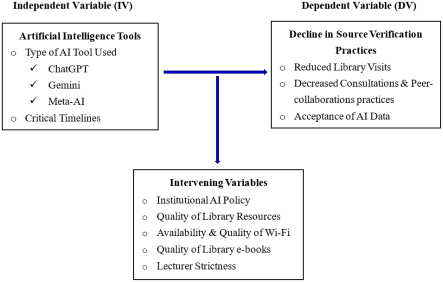
The framework below theorized that the growing use of Artificial Intelligence tools (Independent Variable) directly drives the decline of source verification practices (dependent variable) among students and lecturers in higher education. This relationship was further modified by Intervening Variables, which included institutional factors like university policies, internet availability, and library funding.
Figure 1. The Conceptual Framework.
1.9. Operational Definition of Terms
1) Artificial Intelligence (AI) Tools: The user-friendly generative text platforms like ChatGPT, Google Gemini, Meta AI, Claude, and Perplexity that students and teachers access via smartphones or laptops to search, write, summarize and present academic work.
2) Source Verification: The intentional act of cross-checking, fact-checking, and tracking academic claims or citations to their original peer-reviewed journals, textbook publications, or authenticated institutional repositories.
3) Decline of Verification: A drop in critical verification habits, characterized by zero cross-checking of digital text, reduced manual reading, and a complete reliance on automated AI summaries without checking original authors.
4) Library Engagement: The physical and digital frequency with which students and lecturers visit university library spaces or log into licensed institutional research databases.
5) Academic Rigor: The maintenance of high intellectual standards, logical depth, and empirical accuracy in research essays, assignments, and students’ publications.
2. Literature Review
2.1. Theoretical Review
The study was anchored onto two major theories which directly covered the study objectives. The theories onto which the study was based are Risko & Gilbert’s cognitive offloading theory, and the Parasuraman & Manzey Automation Bias / Complacency Theory
.
2.2. Cognitive Offloading Theory (Risko & Gilbert, 2016)
The cognitive offloading theory by Risko & Gilbert, 2016
, is the primary model upon which the study of the decline in source verification is anchored. According to this theory, physical and digital tools are naturally deployed by individuals to reduce their immediate cognitive load and conserve mental energy. As seen among the causes (independent variables), the quest for meeting critical deadlines can lead to looking for ‘short-cuts’ to the solution of a problem. Besides that, is the level of cognitive engagement a given study may require. If the task is simple, the need for engaging with supplicated sources may reduce. The cognitive offloading theory shows that the human brain instinctively chooses the path of least resistance to execute tasks. As far as this study is concerned, when students and lecturers in higher education turn to the use of AI tools like ChatGPT or Meta-AI, they are shifting the cognitive effort of reading, compiling, and analyzing complex texts onto the software.
Chirayath G. et al,
| [12] | Chirayath G, Premamalini K, Joseph J. Cognitive offloading or cognitive overload? How AI alters the mental architecture of coping. Front Psychol. 2025 Nov 21; 16: 1699320.
https://doi.org/10.3389/fpsyg.2025.1699320 |
[12]
states that the user offloads the tedious work of tracking down physical books, visiting libraries, or logging into scholarly databases, a practice that can, over the time, weaken the habit of independent questioning and cross-checking digital sources. This makes the user becomes accustomed to the use of digital sources only in order to accrue knowledge.
2.3. Automation Bias / Complacency Theory (Parasuraman & Manzey, 2010)
The other theory is the automation bias or complacency theory
that focuses mainly on the acceptance of AI outputs without question. This theory explains the tendency of humans to over-trust automated systems and accept computer-generated indicators at face value, even when they are incorrect or incomplete. In institutions of higher learning, students and lecturers displayed automation bias when they treat an AI-generated paragraph as an inherently accurate authority.
Martín-Moncunill & Alonso Martínez, D.
| [21] | Martín-Moncunill, D., & Alonso Martínez, D. (2025). Students’ Trust in AI and Their Verification Strategies: A Case Study at Camilo José Cela University. Education Sciences, 15(10), 1307. https://doi.org/10.3390/educsci15101307 |
[21]
established that, in higher education today, learning is increasingly shaped by the integration of AI assistants that are currently common classroom experiences. Students’ use of these AI assistants or tools is closely tied to the level of trust placed in these tools, as well as the strategies adopted to critically assess the accuracy of AI-generated content. However, scholarly attention to this dimension remains limited.
2.4. Empirical Review
2.4.1. Prevalence of AI Tool Usage and Source Verification Practices
Many students in higher education rely heavily on the use of artificial intelligence even for simple recall questions. According to a landmark study by Marken
for the Gallup-Lumina Foundation state of higher education project, over half of university students (54%), utilize these tools weekly to summarize complex academic texts and edit draft writing, while 49% rely on it heavily for brainstorming research ideas. While these tools optimize research efficiency, scholars note that they create an immediate dependency loop. Once students begin to use AI tools, they begin to rely on them even for problems they would solve amongst themselves or in their study groups. Stanford center for Human-centered Artificial intelligence
| [31] | Sova, R., Tudor, C., Tartavulea, C. V., & Dieaconescu, R. I. (2024). Artificial Intelligence Tool Adoption in Higher Education: A Structural Equation Modeling Approach to Understanding Impact Factors among Economics Students. Electronics, 13(18), 3632. https://doi.org/10.3390/electronics13183632 |
[31]
noted that Artificial intelligence has become one of the most transformative learning aids in recent years. Instead of simply searching for information, students can now ask AI to explain concepts, analyze text, create customized practice questions, and even design study plans. The same further reports that the seamless design of modern AI toolkits provides all-in-one structures for notes, mind maps, and examination preparations, which directly outcompetes traditional manual compilation.
Within the African continent, this proliferation is equally aggressive but meets a more complex infrastructural landscape. Sova, et al.
| [31] | Sova, R., Tudor, C., Tartavulea, C. V., & Dieaconescu, R. I. (2024). Artificial Intelligence Tool Adoption in Higher Education: A Structural Equation Modeling Approach to Understanding Impact Factors among Economics Students. Electronics, 13(18), 3632. https://doi.org/10.3390/electronics13183632 |
[31]
, noted clearly in a study regarding ‘Artificial Intelligence Tool Adoption in Higher Education’, that ChatGPT was found able to generate inaccurate results, they emphasize the need for having a solid background knowledge on the subject under study to utilize the tool effectively. Yet, according to the Digital College Council research on AI in higher education, there was over 92% adoption level of AI tools in universities and high schools across Latin America,
. In the United Kingdom, the Higher Education Policy Institute (HEPI) published a prominent survey revealing that 92% of university students in the UK actively use generative AI tools in their academic studies,
.
A study on undergraduates at Kampala International University (KIU) established that student dependence on tools like Google Assistant and ChatGPT for everyday learning tasks is exceptionally high, despite institutions lacking structured ICT support frameworks
. This regional baseline is supported by Achanga, Otto, and Kisembo
| [3] | Achanga, P. C., Otto, F., & Kisembo, M. (2025). Artificial intelligence in higher education practice: Experiences from Mountains of the Moon University. International Journal of Advanced Research, 8(1), 58–69. |
[3]
, whose empirical work at Mountains of the Moon University in Fort Portal (the heart of the Mid-Western region) documented that both students and faculty are actively embedding AI frameworks into daily educational practices. However, the central issue lies in the complete disinterest in source verification because many see AI platforms providing quick, natural-sounding arguments which makes them experience deception of competence that actively undermines the development of critical thinking and independent source verification. When users rely on automated tools, they routinely bypass checking the underlying references. Unfortunately, generative platforms at times hallucinate sources or misinterpret local data contexts
| [5] | Alkaissi, H., & McFarlane, S. I. (2023). Artificial hallucinations in ChatGPT: Implications in scientific writing. Cureus, 15(2), Article e35179. https://doi.org/10.7759/cureus.35179 |
| [34] | Topaz, M., Roguin, N., Gupta, P., Zhang, Z., & Peltonen, L.-M. (2026). Fabricated citations: An audit across 2.5 million biomedical papers. The Lancet, 407(10541), 1779–1781.
https://doi.org/10.1016/S0140-6736(26)00603-3 |
[5, 34]
.
Within the context of Ugandan universities, Mugambe Saqib and Zia
| [29] | Saqib, M. B., & Zia, S. (2025). Evaluation of AI content generation tools for verification of academic integrity in higher education. Journal of Applied Research in Higher Education, 17(4), 1430–1440. https://doi.org/10.1108/JARHE-10-2023-0470 |
[29]
notes the absence of verification safeguards which have directly escalated instances of academic dishonesty, data fabrication, and plagiarism. Even with this known crisis, there remained an acute lack of empirical investigation regarding how students and lecturers specifically cross-check or fail to verify AI content within regional, private, and community-based environments, which this study has addressed.
2.4.2. AI Tool Adoption and the Utilization of Traditional Library Resources
The intersection of generative artificial intelligence and university library support marks one of the most disruptive operational shifts in modern higher education history
| [14] | Estlund, Karen, and Cynthia Hudson Vitale. Strategic Implications of AI Futures for Research Libraries: Workshop Report. Washington, DC: Association of Research Libraries and Coalition for Networked Information, March 2026.
https://doi.org/10.29242/report.futurescape2026 |
[14]
. Traditional academic libraries face a profound structural behavioral pivot of shifting away from being collection-centric storehouses of print into people-centric hubs. This kind of global shift is rewriting the relationship between libraries and the communities they serve. Users now prioritize flexible, technology-enabled collaborative spaces over physical archives, and demand instant digital access to scholarly communication over traditional circulation
. According to the Clarivate’s Pulse of the Library
, while generative AI tools are changing the landscape of education and research
| [32] | Stanford Institute for Human-Centered Artificial Intelligence. (n.d.). Stanford HAI. Stanford University. Retrieved July 20, 2026, from https://hai.stanford.edu/ |
[32]
, enhancing efficiency and precision, and freeing up time for more strategic and creative tasks, they have also introduced new challenges, ranging from questions of trust and integrity to concerns around skills, ethics and governance. The report indicated that 72% of academic libraries are racing to embed AI research assistants directly into their discovery systems to stay relevant.
When talking about Traditional knowledge management and preservation, Charles Kamau Maina
| [19] | Maina, C. K. (2012). Traditional knowledge management and preservation: Intersections with Library and Information Science. The International Information & Library Review, 44(1), 13–27. https://doi.org/10.1080/10572317.2012.10762911 |
[19]
says that, “libraries are potential custodians of traditional knowledge”. That they ought to be preserved and be used hand-in-hand with digital spaces and artificial intelligence that seems to be taking the show in modern times.
Marzuki, M. et al.
| [22] | Marzuki, M., Azero, S. F. Z., Zamzuri, N. A. A. M., & Kadir, M. R. A. (2025). A systematic literature review of user behavior and personalization in digital libraries. International Journal of Research and Innovation in Social Science, 9(1), 4830–4842. |
[22]
highlights a profound shift in student behaviors, with many choosing algorithmic convenience over physical or structured digital library systems. Generative tools provide direct, seeming clear response summaries and immediate text generation, which eventually makes students ignore visiting libraries, reading books because of the ready-to-use finished work. Reading is becoming less often a solitary exchange between reader and text. AI tools are progressively stepping in to summarize, interpret, and even read for people.
In low- and middle-income countries (LMICs), library systems navigating the AI transition face severe infrastructural and funding disparities. A landmark scoping review by Nakaziba et al.
| [23] | Nakaziba, S., Abong, K., Namuguzi, M., Namugera, L., Tamale, D., Namukasa, S., Nayebare, D., Mwanzu, A., Namukwaya, C., & Sarki, A. (2026). Application of artificial intelligence in academic libraries in low- and middle-income countries: A scoping review. Discover Education, 5, Article 292. https://doi.org/10.1007/s44217-026-01308-0 |
[23]
highlights that while global institutions leverage advanced AI like smart chatbots and automated cataloging, regional facilities struggle to adopt these capital-intensive tools due to chronic budget limits. This resource gap creates an operational imbalance; as students in regional Ugandan universities bypass underfunded institutional infrastructures to access advanced text-generators on their personal mobile devices, the domestic culture of formal source verification rapidly declines.
Within the Ugandan context, this problem of low library use is uniquely complex. Academic institutions in Mid-Western Uganda like Rwenzori International University, Uganda Pentecostal University, Divine University, and African Rural University operate in environments with varied campus-wide Wi-Fi stability but with less equipped libraries hence fluctuating access to physical text updates. Local librarians are trying to use soft skills and open access resources to draw users back. However, National Council for Higher Education (NCHE) in Uganda as cited by Odong
| [25] | Odong, P., Magara, E., & Nabutto, C. L. (2025). The state library funding compliance by university libraries in Uganda. African Social Science and Humanities Journal, 6(3), 1–15. |
[25]
dictates that establishing a higher education library requires good funding for a physical facility that stocks hard-copy materials, alongside meeting strict benchmarks for funding, seating space, and student-to-book ratios.
Existing literature points to a global trend of dropping library use, yet there remains an empirical gap regarding how this shift unfolds across smaller private and community-focused universities in Uganda. Most local studies focus heavily on major public universities in urban centers, ignoring how AI adoption alters library usage in regional, resource-constrained environments. This study addresses that specific gap by gathering localized data from academic communities in Mid-Western Uganda.
2.4.3. Implications of AI-driven Verification Declines on Scholarly Quality and Academic Integrity
The systematic erosion of source verification practices among university communities has severe ethical implications on the long-term credibility of higher education
| [15] | Habbal, F. (2023). The implications and efficacy of online verification tools in scientific research and citation practices. International Journal of Automation and Digital Transformation, 2(1), 4–14. |
[15]
. When scholars and learners shift away from rigorous verification, the intellectual quality of institutional research output undergoes a documented decline. The uncritical integration of generative AI into writing workflows leads directly to a phenomenon termed the dilution of expertise, where academic papers increasingly rely on generic, monotonous arguments and superficial analyses that fail to expand genuine scientific boundaries.
The most immediate casualty of this verification decline is academic integrity. Generative platforms are prone to generating fabricated citations, non-existent URLs, and imaginary journal volumes. Landmark audits, including an expansive May 2026 review published by Topaz et al. retrieved from
The Lancet Article | [34] | Topaz, M., Roguin, N., Gupta, P., Zhang, Z., & Peltonen, L.-M. (2026). Fabricated citations: An audit across 2.5 million biomedical papers. The Lancet, 407(10541), 1779–1781.
https://doi.org/10.1016/S0140-6736(26)00603-3 |
[34]
confirms a steep increase in fraudulent and hallucinated citations. The study found that by early 2026, roughly 1 in 277 peer-reviewed papers contained at least one fabricated reference, an increase of over 12-fold since 2023. Because users accept these outputs without cross-checking, fake data is easily integrated into the mainstream literature, which compromises the reliability of university research repositories.
This decline heavily weakens the core purpose of university training by reducing critical thinking to basic prompt mechanics. Scholars argue that when students rely on AI to generate literature reviews or analyze data without independent critique, they struggle to develop the cognitive capacity needed to spot biases, identify data gaps, or formulate original solutions,
| [4] | Bolarinwa, T.. (2026). The impact of artificial intelligence on students’ academic development, critical thinking, cognitive skills, and learning outcomes. International Journal of Applied Resilience and Sustainability, 2(2), 1097-1129.
https://doi.org/10.70593/deepsci.0202045 |
[4]
. Taibat
| [4] | Bolarinwa, T.. (2026). The impact of artificial intelligence on students’ academic development, critical thinking, cognitive skills, and learning outcomes. International Journal of Applied Resilience and Sustainability, 2(2), 1097-1129.
https://doi.org/10.70593/deepsci.0202045 |
[4]
adds that when students depend on outsource knowledge from AI, they experience cognitive offloading, bypassing the mental struggle required to build deep analytical skills. This over-reliance risks creating intellectual passivity, leaving learners ill-equipped to challenge assumptions, verify sources, or generate genuinely creative, original solutions. Universities risk producing professionals who rely entirely on digital tools rather than sound professional judgment, compromising the quality of graduates entering the workforce.
In developing regions like Sub-Saharan Africa, this trend threatens the visibility and local relevance of contextual research. A 2026 assessment of intellectual property and academic publishing trends across East Africa notes that most large language models are trained on datasets heavily biased toward Western contexts
| [33] | Tao, Y., Viberg, O., Baker, R. S., & Kizilcec, R. F. (2024). Cultural bias and cultural alignment of large language models. PNAS Nexus, 3(9), Article page 346.
https://doi.org/10.1093/pnasnexus/pgae346 |
[33]
. According to Yan et al.
| [30] | Yan, B., Li, K., Xu, M., Dong, Y., Zhang, Y., Ren, Z., & Cheng, X. (2025). On protecting the data privacy of Large Language Models (LLMs) and LLM agents: A literature review. High Confidence Computing, 5(2), Article 100300. |
[30]
, large language models (LLMs) depend on datasets onto which they are trained. And because they are trained in the west, they often inherit societal biases present in their training data. So, when African scholars adopt AI-generated content without verification, they inadvertently introduce frameworks that may not align with local realities.
Within Uganda, this challenge poses a serious threat to national development goals. Research by the National Council for Higher Education (NCHE) emphasizes that institutional rankings and graduate employability depend heavily on the quality and integrity of university research,
| [8] | Bagonza, G., & Kaahwa, Y. T. (2023). The relationship between academic programme type and student satisfaction with the quality of higher education in Uganda. International Journal of African Higher Education, 10(1), 1-20. |
[8]
.
While the broader literature highlights these risks, there is still need for empirical data regarding the situation in Mid-Western Uganda. Institutions like Rwenzori International University, Uganda Pentecostal University, Divine University, and African Rural University play a vital role in regional development and community-led research. A decline in verification within these specific settings directly undermines localized knowledge systems. This study addresses this gap by investigating the impact of AI tool usage without source verification on knowledge credibility and academic standards within these regional institutions.
3. Research Methodology
3.1. Research Design
This study adopted a cross-sectional, explanatory mixed-methods research design. In this, the quantitative approach was used to measure the prevalence of AI usage and library decline, while the qualitative approach helped in gathering data regarding source verification habits and integrity concerns from lecturers. The cross-sectional approach fits the study timeline perfectly, as data is collected from respondents at a single point in time.
3.2. Target Population
The target population for this study was 361 students and lecturers, where, 345 were undergraduate final-year students and 16 were active teaching lecturers and research evaluators from the four selected universities in Mid-Western Uganda. The final-year students were selected because of their high involvement in research projects, while the specific lecturers were chosen because they were involved in research supervision and evaluation in these universities.
3.3. Sample Size and Selection
To complete data collection within the limited timeframe, a manageable sample size of 275 respondents (259 students and 16 lecturers) was chosen based on Krejcie and D.W. Morgan (1970), as cited by Amin E. (2005) and distributed across the institutions using convenience sampling for students and purposive sampling for lecturers as shown in the sample size table below:
Table 1. Sample Size.
Institution | Category | Target Population | Sample Size | Sampling Technique |
Rwenzori International University (Kasese) | Students | 110 | 86 | Convenience |
Lecturers | 5 | 5 | Purposive |
Uganda Pentecostal University (Fort Portal) | Students | 130 | 97 | Convenience |
Lecturers | 5 | 5 | Purposive |
Divine International University (Fort Portal) | Students | 50 | 44 | Convenience |
Lecturers | 3 | 3 | Purposive |
African Rural University (Kagadi) | Students | 55 | 48 | Convenience |
Lecturers | 3 | 3 | Purposive |
Total Number of Respondents | Students | 345 | 259 | |
Lecturers | 16 | 16 | |
3.4. Data Collection Instruments
3.4.1. Questionnaires
Structured Questionnaires were used to collect data from students. This was a 5-point Likert scale questionnaire that was self-administered to students. It featured specific sections tracking AI platforms used, library visit frequencies, and direct source verification behaviors.
3.4.2. Interview Guides
Key Informant Interview Guides were used to collect data from Lecturers. These were Semi-structured qualitative interview questions used guide the researcher in collecting data and gathering observations from lecturers regarding the quality of student work, AI-generated citations, and the erosion of critical analysis.
3.5. Data Quality Control
3.5.1. Validity
Data collection instruments were tested first to ensure content validity using a pilot institution. The results of the data collected showed its validity by providing responses that were expected, thus qualifying them for administration to other respondents in similar environments.
3.5.2. Reliability
A quick pilot test of the questionnaire was conducted on 10 students at a neighboring institution of higher learning, Liberty College of Management & Journalism in Kasese Municipality, which also offered undergraduate courses as an affiliate of Uganda Pentecostal University. This helped the researcher to check for clarity, and to ensure that Cronbach's alpha internal consistency was met.
3.6. Data Analysis
Quantitative Data from students was cleaned, coded, and analyzed using basic descriptive statistics (percentages, means, and frequencies) using Microsoft Excel.
Qualitative Data from interview responses of the 16 lecturers were transcribed and analyzed using Thematic Analysis to find common patterns matching the study objectives.
3.7. Ethical Considerations
Permission from administration from the students was obtained. Informed consent was also secured from all participants. Respondent anonymity was maintained and data from all respondents was protected by removing personal markers or any identifiers from questionnaires.
4. Data Presentation, Analysis, and Discussion
4.1. Introduction
The purpose of the study was to investigate the relationship between the use of Artificial Intelligence tools and the decline of source verification practices among students and lecturers in higher education institutions in Mid-Western Uganda. In this chapter, the study presents, analyses and interprets the study findings based on the data collected from 275 respondents using structured questionnaires for students and interviews carried out during interactions with fellow lecturers at selected universities.
4.2. Demographic Characteristics of Key Informants (Lecturers)
To gain a holistic view of the academic environment in Mid-Western Uganda, qualitative data was gathered from 16 university lecturers, supervisors, and academic staff across Rwenzori International University, Uganda Pentecostal University, Divine University, and African Rural University.
Table 2. Demographic Profile of Lecturers.
Gender | Frequency (f) | Percentage (%) |
Male | 12 | 75.0% |
Female | 4 | 25.0% |
Total | 16 | 100.0% |
The faculty sample was predominantly male (75.0%), reflecting historical gender distributions among academic staff in regional universities, but it maintained a 25.0% female voice to provide a balanced overview of the institutional landscape.
4.3. Triangulated Analysis for Objective 1: Prevalence of AI Tool Usage and Source Verification Practices
Objective one sought to evaluate the prevalence of AI tool usage and corresponding source verification habits among academic communities in Mid-Western Uganda. Quantitative findings from students were cross-analyzed with qualitative responses from the 16 lecturers.
4.4. Prevalence and Types of AI Tools Used
The quantitative data established a 100% AI usage rate among students, with 75.0% strongly agreeing and 25.0% agreeing that they routinely use AI for academic purposes. While the level and rate at which they use AI differed, data showed that at least all of them have used one or some of these generative tools as shown in
Table 3 below.
Table 3. Triangulation of Student AI Usage Rates.
Data Source | Parameter Measured | Response Category | Frequency (f) | Percentage (%) |
Tool 1: Student Surveys ( N = 259) | Prevalence of Routine AI Use for Academic Tasks | Strongly Agree | 195 | 75.0% |
Agree | 64 | 25.0% |
Neutral / | 0 | 0.0% |
Disagree | 0 | 0.0% |
Total Student Responses | 259 | 100.0% |
Source: Field Data (May-June 2026)
Qualitative data from faculty interviews confirms this high prevalence and identifies the specific platforms or generative tools used by the lecturers, with ChatGPT mostly used by almost every lecturer as shown in the
Table 4 below.
Table 4. Dominant Campus Platforms / AI Tools Used.
| Tool | Frequency | Percentage |
Primary AI Platforms Observed on Campus | ChatGPT & Meta AI (Combined) | 6 | 37.5% |
ChatGPT only | 4 | 25.0% |
Google Gemini, ChatGPT & Meta AI | 4 | 25.0% |
Meta AI only | 2 | 12.5% |
Total | 16 | 100% |
Source: Field Data - Tool 2: Lecturer Interviews (n = 16)
From
Table 4 above, 87.5% of the lecturers have used ChatGPT with other tools, while only 12.5% have not used it. It should be noted that key informants (lecturers) revealed how they do not know the name Google Gemini but describe it behaviorally as the ‘AI inside Google search’. Furthermore, Meta AI usage is heavily driven by its low-cost data accessibility via the WhatsApp application on student smartphones.
4.5. The Deceptive Reality of Source Verification
A critical contradiction emerged between student claims and actual behavioral outputs. In the survey, 25.0% of students claimed they verify citations, while 75.0% could not confirm doing so.
When this reality was tested against faculty observations, the result was absolute. 100% of the interviewed lecturers (16 out of 16) categorically stated that students do not independently verify the facts, quotes, or citations generated by AI. Faculty noted that students possess an uncritical trust in digital text, treating algorithmic answers as absolute truths. This behavior perfectly supports Cognitive Offloading Theory, as the convenience of immediate text generation entirely overrides the cognitive willingness to cross-check claims.
4.6. Triangulated Analysis for Objective 2: Impact of AI Tool Adoption on Library and Database Engagement
The second objective examined how the widespread adoption of AI tools has transformed the way both students and lecturers interact with physical university libraries and institutional electronic databases.
4.7. The Changing Nature of Student Library Visits
While 100% of students quantitatively acknowledged that their physical library visits have dropped (
Table 3), the qualitative interviews revealed that the library is experiencing a shift in purpose rather than complete physical abandonment. Lecturers broke down current student library behavior into three patterns:
Table 5. Lecturer Observations of the Changing Nature of Student Library Visits.
Observational Theme | Behavior Pattern Explained | Frequency (n) | Percentage (%) |
Comfortable Study Spaces Only | Students visit the physical library purely to sit in comfortable furniture while reading AI-generated text on their smartphones or utilizing social media. | 6 | 37.5% |
Accessing Hardware for AI | Students utilize the library facility solely to access university desktop computers and institutional Wi-Fi to load conversational AI tools. | 4 | 25.0% |
Reduced Engagement | Students bypass the library completely, opting to source all academic summaries remotely via personal mobile networks. | 6 | 37.5% |
Total | 16 | 100.0% |
Source: Field Data - The Changing Nature Library Use
From
Table 5 above, the drop in library engagement is not just about fewer people visiting, rather, it is a fundamental shift in why students use the library space. While 37.5% of the observations confirm that students are completely bypassing the library, the remaining 62.5% reveal that students still use the building but have changed their purpose for being there. Instead of consulting physical reference books in the library or curated literature indexes, students visit the library because of the comfortable seating it provides when they decide to read prompts from their smartphones or even to utilize social media (37.5%). Some visit the library to access desktop hardware and Wi-Fi to load generative algorithms (25.0%). This clearly shows that conversational AI has shifted the library from a place of active source verification to a simple workstation.
4.8. The Decline in Faculty Library Engagement
The transition away from formal library sources is not unique to learners. Field data exposes a significant parallel decline among teaching faculty. When asked if lecturers have changed their preparation habits since the arrival of AI, the 16 informants revealed as shown in
Table 6 below:
Table 6. Faculty adaptation and shifting prep habits since AI proliferation.
Behavioral Trait Identifiers | Specific Lesson Preparation & Sourcing Habits | Frequency (n) | Percentage (%) |
Total Institutional Abandonment | Faculty members no longer enter physical library spaces to read or consult paper-based references. | 3 | 18.75% |
Basic Workstation Access | Lecturers enter the library solely to use university computers to run general internet search engines (e.g., Google). | 4 | 25.00% |
Off-Campus Mobile Dependency | Lecturers rely exclusively on personal smartphones to retrieve class notes while resting at home or in private offices. | 4 | 25.00% |
Live Classroom AI Sourcing | Lecturers execute zero traditional lesson planning, choosing to generate real-time lecture content live in front of students via AI prompts. | 4 | 25.00% |
Unverified Peer Behaviors | Informants could not confidently verify the exact preparation habits of colleagues. | 1 | 6.25% |
Total | 16 | 100.0% |
Source: Field Data – AI adaptation
The empirical findings shown in
Table 6 show a thoughtful corresponding shift: the decline in traditional source verification is not unique to learners, but is heavily mirrored among faculty members as well. A combined 68.7% of the interviewed lecturers (n=11) have shifted their work habits completely away from formal university collections, opting instead to search for material using internet browsers (25%), private smartphone connections (25%), or by abandoning physical spaces entirely (18.7%).
A notable 25% of the academic staff openly admit to practicing live searching to outsource content right in classrooms when they fail to prepare due to unavoidable circumstances, including lack of well summarized books, lack of enough time due to a number of faculty responsibilities, or other reasons. A practice that the researcher found unprofessional as far as teaching ethics are concerned. Using active text-generation engines to construct lecture content right during the lecture is not congruent with the teaching profession anywhere on the globe. This behavior confirms that both sides of the educational relationship are experiencing the same shift toward convenient shortcuts. When the instructors responsible for maintaining academic standards rely on unverified digital platforms, it weakens the institutional foundation required to model and enforce rigorous fact-checking practices for students.
4.9. Triangulated Analysis for Objective 3: Implications on Scholarly Quality and Academic Integrity
The third objective analyzed the impact of unverified AI reliance on the overall quality, intellectual depth, and integrity of academic submissions in Mid-Western Uganda.
Table 7 below shows how faculty revealed the presence of algorithmic footprints, the quality shifts and serious trends of plagiarism when evaluating students’ work.
Table 7. The presence of algorithmic footprints or AI symbols, depleted quality and plagiarism.
Evaluative Themes | Specific Marks, Plagiarism Trends, and depleted Quality | Frequency (n) | Percentage (%) |
Unedited work (Copy & Paste) | Students directly copy and transfer large blocks of unedited AI text into take-home course assignments. | 4 | 25% |
Algorithmic Footprints | Text contains visible AI markers (e.g., unusual bolding, long dashes instead of hyphens or colons, a common word, ‘By’ to conclude a point, absence of semicolons in most texts,). | 4 | 25% |
Continuous Detection | Examiners constantly spot automated, repetitive sentence structures and non-local phrasing patterns or advanced language in essays. | 3 | 18.7% |
Superficial Data Extraction | Students adopt surface-level summaries from Meta AI, chat GPT or Google without internalizing or understanding the concepts fully. | 4 | 25% |
Reference Forgery | Submissions include fabricated or invented citations and references likely to have been generated by the algorithm. | 1 | 6.2% |
Total | 16 | 100% |
Source: Field Data - Algorithmic footprints / AI symbols
The data shown in
Table 7 above presents the quantitative student admissions, where 75% acknowledged submitting unchecked AI text to remove unusual text or to see if AI has provided accurate information. Faculty evaluations show that this reliance leaves clear markers in student assignments. Half of the faculty observations showed students’ overdependence on AI by just extracting work, use of unedited copy-and-paste texts (25%) and a quick grab of surface-level facts, definitions, or bullet points without doing any deep reading, independent thinking, or critical analysis (25%).
Furthermore, 25% of the lecturers identified clear structural markers left in printed submissions. These formatting errors include unnecessary bolding, an absence of semicolons, and unusual punctuation marks, like long dashes where a comma, colon, or hyphen belongs; thus, substituting these punctuation marks. Cases of reference forgery was also revealed (6.25%). These findings show that a reliance on automated shortcuts introduces noticeable formatting and integrity issues into academic work within the region.
4.10. Handling AI Hallucinations
When asked about encountering fabricated sources and fake data, the academic staff confirmed its prevalence but revealed a deeply fragmented institutional response as shown in
Table 8 below:
Moreover, “The Digital Education Council’s AI in Higher Education Latin America Survey 2026 reveals that while AI has become a routine part of student learning practices, many remain cautious about its implications in higher education spaces"
.
Table 8. Faculty responses and institutional management of AI hallucinations.
Management Strategy | Behavioral Manifestation & Institutional Approach | Frequency (n) | Percentage (%) |
Grading Leniency out of Resignation | Lecturers grade the compromised scripts anyway, believing that AI tool deployment in homework has become completely unavoidable. | 6 | 37.5% |
Grade Penalization | Lecturers actively lower student marks and penalize submissions when they detect unverified data or fabricated citations. | 4 | 25% |
Aware of AI in Use but no guiding Policy | Lecturers recognize the presence of fake citations and hallucinations but operate without any unified institutional guidelines or policies. | 6 | 37.5% |
Total | 16 | 100.0% |
Source: Field Data - Management of AI hallucinations
The empirical insights shown in
Table 8 above expose a deeply fragmented institutional environment across universities in Mid-Western Uganda in dealing with the consequences of unverified AI use. A combined 75% of the academic staff are split between grading leniency out of utter resignation (37.5%) and the knowledge of how AI is being used by students in the absence of a guiding protocol (37.5%). This means that a total of 12 out of the 16 interviewed lecturers are managing AI hallucinations on an ad-hoc, individual basis without any backing from university policy.
Only a small minority (25%) actively enforce grade penalizations to discourage reference forgery. This lack of a unified response confirms the fact that without clear quality assurance guidelines from university administrations, individual lecturers will continue to tolerate compromised research quality, leading to a decline in the international credibility of degrees granted by regional institutions.
5. Summary, Conclusions, and Recommendations
5.1. Summary of Findings
1) Objective One: Generative AI use is universal (100%) among students in Mid-Western Uganda, with ChatGPT and Meta AI leading adoption. However, a severe verification deficit exists as shown by 100% of lecturers who stated that students never cross-check AI claims, and over half of students openly admit to accepting automated text at face value.
2) Objective Two: Physical library use has changed from a space for traditional text research to a space used for computer hardware accessibility and /or internet connectivity. Furthermore, this transition has affected faculty, with several lecturers bypassing library prep to pull real-time teaching content directly from AI tools during class.
3) Objective Three: Unverified AI adoption has introduced noticeable systemic challenges, including the submission of unedited text, formatting errors, and fabricated references. Institutional responses remain inconsistent, with some faculty members penalizing these submissions while others accept them as an unavoidable trend.
5.2. Discussion of Findings
The experiential evidence from Mid-Western Uganda reveals an academic environment undergoing rapid digital change without clear structural guidelines. The findings demonstrate a high tension between technological convenience and scholarly depth.
According to Fred Davis’s Technology Acceptance Model (TAM), the extreme Perceived Ease of Use of mobile AI engines like Meta AI, ChatGPT has made the traditional role of the library less important. However, this ease of use has introduced widespread Automation Bias, causing students and some faculty members to accept automated text summaries without proper evaluation. The complete lack of verification noted by 100% of the lecturers shows that higher education institutions in mid-western Uganda risk producing graduates who depend entirely on algorithmic shortcuts, thereby limiting their capacity to create original, localized research.
5.3. Conclusions
The study concludes that while artificial intelligence tools offer significant convenience and speed up data retrieval, their unmanaged adoption has led to a noticeable decline in independent source verification across universities in Mid-Western Uganda. This trend has shifted the library's use from formal visits to search books for information and research to merely visiting the library in order to access computers and the internet. Since this reliance affects both students and teaching staff, it poses a long-term challenge to the depth of local research and the overall credibility of regional higher education.
5.4. Recommendations
Based on the field findings, the study proposes the following recommendations for universities in Mid-Western Uganda:
1) Establishing clear institutional AI policies. Universities should move away from ad-hoc responses and set clear rules on acceptable AI usage metrics. They should adopt digital assessment methods like oral defense panels (viva-voces) and invigilated practical assessments to reduce reliance on unverified copy-pasted text.
2) Equipping libraries with modern resource structures. Rather than trying to reverse digital trends, university libraries should be improved by developing curated, easy-to-use digital repositories and summaries. Librarians should plan periodical workshops to teach students how to use AI for initial brainstorming while relying on institutional databases for formal verification.
3) Implementing mandatory plagiarism and verification Standards: Institutional quality assurance departments should provide faculty members with clear, standardized guidelines on handling AI-generated scripts and fabricated citations. This will ensure consistent grading standards and help maintain academic integrity across all departments.
Abbreviations
AI | Artificial Intelligence |
LLMs | Large Language Models |
LMICs | Low- and Middle-Income Countries |
NCHE | National Council for Higher Education |
TAM | Technology Acceptance Model |
Author Contributions
Kimulya Adorable: Conceptualization, Data curation, Formal Analysis, Investigation, Methodology, Writing – original draft, Writing – review & editing
Conflicts of Interest
The author declares no conflict of interest.
Appendix
Appendix I: Structured Questionnaire for Students
My name is Dr. Adorable Kimulya. I am an independent academic researcher investigating how the increasing use of AI tools affects source verification practices and academic quality among university communities (students’ and lecturers) in Mid-Western Uganda. Your responses will remain strictly confidential and anonymous.
Thank you for your time.
Instruction: Please check the option that best reflects your experience.
Section A: Demographic Data
Name of University
Rwenzori International University
Uganda Pentecostal University
Divine International University
African Rural University
Gender: Male Female
Year of Study: Year 3 Year 4
Section B: Ai Tool Usage and Source Verification Practices
Scale: 5 = Strongly Agree (SA), 4 = Agree (A), 3 = Neutral (N), 2 = Disagree (D), 1 = Strongly Disagree (SD)
Table 10. AI Tools Usage and Source Verification.
No. | Parameter | 5 (SA) | 4 (A) | 3 (N) | 2 (D) | 1 (SD) |
| I regularly use AI tools (ChatGPT, Gemini, Meta AI, etc.) to complete assignments and write research drafts. | | | | | |
| I accept AI-generated information as accurate without cross-checking it against external sources. | | | | | |
| I find it faster to copy an AI-generated paragraph than to read full textbooks or journal articles. | | | | | |
| I actively track down and verify the original citations/references provided by an AI tool before using them. | | | | | |
SECTION C: IMPACT ON LIBRARY AND DATABASE ENGAGEMENT |
| Since I started using AI tools, my physical visits to the university library have significantly decreased. | | | | | |
| I prefer using AI platforms over using institutional electronic databases. | | | | | |
| I consult university librarians less frequently because AI answers most of my research questions instantly. | | | | | |
SECTION D: IMPLICATIONS ON SCHOLARLY QUALITY AND INTEGRITY |
| Currently, I rely on AI for summarized work and I do not doubt AI outputs. | | | | | |
| I have submitted assignments and research work that included unverified or unchecked citations generated by AI. | | | | | |
| I believe over-reliance on AI is lowering the overall quality of academic work produced by students. | | | | | |
Thank you.
Appendix II: Key Informant Interview Guide for Lecturers
Target Participants: Academic Staff / Lecturers / Research Supervisors
Introduction & Consent
My name is Dr. Adorable Kimulya. I am an independent academic researcher investigating how the increasing use of AI tools affects source verification practices and academic quality among university communities (students’ and lecturers) in Mid-Western Uganda. Your responses will remain strictly confidential and anonymous.
Thank you for your time.
Interview Guiding Questions
Name of University (Tick silently)
Rwenzori International University
Uganda Pentecostal University
Divine International University
African Rural University
Gender (Tick silently) Male Female
a) Prevalence and Practices
What AI tools do you notice students using most frequently for their coursework and research?
__________________________________________________________________________________________________
In your experience, do students independently verify the facts, quotes, or citations generated by these AI platforms? Why or why not?
__________________________________________________________________________________________________
b) Library Engagement
How has the rise of personal generative AI tools affected student engagement with university’s physical library or institutional electronic databases?
__________________________________________________________________________________________________
Is there a change in how lecturers use library resources for teaching preparation since the adoption of AI? If yes, what is that change?
__________________________________________________________________________________________________
c) Scholarly Quality and Integrity
What specific trends have you noticed in the quality, logical depth, and academic integrity of student scripts or research projects recently?
__________________________________________________________________________________________________
Have you encountered instances of AI hallucinations (fabricated sources, fake data, or non-existent citations) in submissions? How do you handle them?
__________________________________________________________________________________________________
What strategies should universities in Mid-Western Uganda adopt to regulate AI use while preserving traditional academic rigor?
____________________________________________________________________________________________________________________________________________________________________________________________________________
Thank you for your time and beautiful responses.
References
| [1] |
Abiri, G. (2025). Digital Media Platforms and GenAI: A Case for Domain-Specific Regulation. German Law Journal, 26(7), 1320–1340.
https://doi.org/10.1017/glj.2026.10184
|
| [2] |
Abubakar, S., Jeilani, A., & Yusuf, M. (2025). The role of over-reliance on AI in the negative consequences of student learning: The moderating effects of ethical concerns and institutional policies. Cogent Education, 12(1).
https://doi.org/10.1080/2331186X.2025.2591503
|
| [3] |
Achanga, P. C., Otto, F., & Kisembo, M. (2025). Artificial intelligence in higher education practice: Experiences from Mountains of the Moon University. International Journal of Advanced Research, 8(1), 58–69.
|
| [4] |
Bolarinwa, T.. (2026). The impact of artificial intelligence on students’ academic development, critical thinking, cognitive skills, and learning outcomes. International Journal of Applied Resilience and Sustainability, 2(2), 1097-1129.
https://doi.org/10.70593/deepsci.0202045
|
| [5] |
Alkaissi, H., & McFarlane, S. I. (2023). Artificial hallucinations in ChatGPT: Implications in scientific writing. Cureus, 15(2), Article e35179.
https://doi.org/10.7759/cureus.35179
|
| [6] |
Association of College and Research Libraries. (2016, September 13). Designing academic libraries for modern human behavior [Video]. YouTube.
https://www.youtube.com/watch?v=oUpAVLuIcHo
|
| [7] |
Bagonza, G., Kaahwa, M. G., & Mbabazi, E. G. M. (2021). Graduates’ Employability: Has the Expansion of the University Sector in Uganda improved Employment Prospects for Graduates? ‘Employers’ and Lecturers’ Perspective’. International Journal of Educational Administration and Policy Studies, 13(1), 66-71.
|
| [8] |
Bagonza, G., & Kaahwa, Y. T. (2023). The relationship between academic programme type and student satisfaction with the quality of higher education in Uganda. International Journal of African Higher Education, 10(1), 1-20.
|
| [9] |
Bamasoud, D. M., Mohammad, R., & Bilal, S. (2025). Adopting Generative AI in Higher Education: A Dual-Perspective Study of Students and Lecturers in Saudi Universities. Big Data and Cognitive Computing, 9(10), 264.
https://doi.org/10.3390/bdcc9100264
|
| [10] |
Bjorklund, A. (2025, December 13). Leadership is shifting from doing to supervising intelligence. The job is no longer to produce answers. It's to set [Post]. LinkedIn.
https://www.linkedin.com/posts/andersbjorklundzooma_yesterday-i-reflected-on-presence-in-a-digital-activity-7405626116432089088-rAMv
|
| [11] |
Clarivate. (2025). Pulse of the library [Report].
https://clarivate.com/pulse-of-the-library/
|
| [12] |
Chirayath G, Premamalini K, Joseph J. Cognitive offloading or cognitive overload? How AI alters the mental architecture of coping. Front Psychol. 2025 Nov 21; 16: 1699320.
https://doi.org/10.3389/fpsyg.2025.1699320
|
| [13] |
Digital Education Council. (2026, March 12). AI adoption is nearly universal among students, but confidence is not.
https://www.digitaleducationcouncil.com/post/ai-adoption-is-nearly-universal-among-students-but-confidence-is-not
|
| [14] |
Estlund, Karen, and Cynthia Hudson Vitale. Strategic Implications of AI Futures for Research Libraries: Workshop Report. Washington, DC: Association of Research Libraries and Coalition for Networked Information, March 2026.
https://doi.org/10.29242/report.futurescape2026
|
| [15] |
Habbal, F. (2023). The implications and efficacy of online verification tools in scientific research and citation practices. International Journal of Automation and Digital Transformation, 2(1), 4–14.
|
| [16] |
Higher Education Policy Institute. (2025, February 26). Student generative AI survey 2025 (Policy Note).
https://www.universityworldnews.com/post.php?story=20250228175423255
|
| [17] |
Kampala International University. (n.d.). Dr. Olubusayo Fakuade Victor. Retrieved July 20, 2026, from
https://kiu.ac.ug/staff.php?i=1163&sn=meresi-biira
|
| [18] |
Llerena-Izquierdo, J., & Ayala-Carabajo, R. (2025). Ethics of the Use of Artificial Intelligence in Academia and Research: The Most Relevant Approaches, Challenges and Topics. Informatics, 12(4), 111.
https://doi.org/10.3390/informatics12040111
|
| [19] |
Maina, C. K. (2012). Traditional knowledge management and preservation: Intersections with Library and Information Science. The International Information & Library Review, 44(1), 13–27.
https://doi.org/10.1080/10572317.2012.10762911
|
| [20] |
Marken, S. (2026, April 2). AI is routine for college students, despite campus limits. Gallup.
https://news.gallup.com/poll/704090/routine-college-students-despite-campus-limits.aspx
|
| [21] |
Martín-Moncunill, D., & Alonso Martínez, D. (2025). Students’ Trust in AI and Their Verification Strategies: A Case Study at Camilo José Cela University. Education Sciences, 15(10), 1307.
https://doi.org/10.3390/educsci15101307
|
| [22] |
Marzuki, M., Azero, S. F. Z., Zamzuri, N. A. A. M., & Kadir, M. R. A. (2025). A systematic literature review of user behavior and personalization in digital libraries. International Journal of Research and Innovation in Social Science, 9(1), 4830–4842.
|
| [23] |
Nakaziba, S., Abong, K., Namuguzi, M., Namugera, L., Tamale, D., Namukasa, S., Nayebare, D., Mwanzu, A., Namukwaya, C., & Sarki, A. (2026). Application of artificial intelligence in academic libraries in low- and middle-income countries: A scoping review. Discover Education, 5, Article 292.
https://doi.org/10.1007/s44217-026-01308-0
|
| [24] |
National Council for Higher Education. (2005). The Universities and Other Tertiary Institutions (Institutional Standards) Regulations, 2005 (Statutory Instruments 2005 No. 85).
https://unche.or.ug/wp-content/uploads/2023/01/Statutory-Instruments-No.85-2005-Institutional-Standards.pdf
|
| [25] |
Odong, P., Magara, E., & Nabutto, C. L. (2025). The state library funding compliance by university libraries in Uganda. African Social Science and Humanities Journal, 6(3), 1–15.
|
| [26] |
Parasuraman, R., & Manzey, D. H. (2010). Complacency and bias in human use of automation: An attentional Integration. Human Factors, 52(3), 381-410.
https://doi.org/10.1177/0018720810376055
|
| [27] |
Risko, E. F; & Gilbert, S. J. (2016). Cognitive offloading. Trends in cognitive Sciences, 20(9), 676-688.
https://doi.org/10.1016/j.tics.2016.07.002
|
| [28] |
Rodafinos, A. (2025). The Integration of Generative AI Tools in Academic Writing: Implications for Student Research. Social Education Research, 6(2), 250–258.
https://doi.org/10.37256/ser.6220256517
|
| [29] |
Saqib, M. B., & Zia, S. (2025). Evaluation of AI content generation tools for verification of academic integrity in higher education. Journal of Applied Research in Higher Education, 17(4), 1430–1440.
https://doi.org/10.1108/JARHE-10-2023-0470
|
| [30] |
Yan, B., Li, K., Xu, M., Dong, Y., Zhang, Y., Ren, Z., & Cheng, X. (2025). On protecting the data privacy of Large Language Models (LLMs) and LLM agents: A literature review. High Confidence Computing, 5(2), Article 100300.
|
| [31] |
Sova, R., Tudor, C., Tartavulea, C. V., & Dieaconescu, R. I. (2024). Artificial Intelligence Tool Adoption in Higher Education: A Structural Equation Modeling Approach to Understanding Impact Factors among Economics Students. Electronics, 13(18), 3632.
https://doi.org/10.3390/electronics13183632
|
| [32] |
Stanford Institute for Human-Centered Artificial Intelligence. (n.d.). Stanford HAI. Stanford University. Retrieved July 20, 2026, from
https://hai.stanford.edu/
|
| [33] |
Tao, Y., Viberg, O., Baker, R. S., & Kizilcec, R. F. (2024). Cultural bias and cultural alignment of large language models. PNAS Nexus, 3(9), Article page 346.
https://doi.org/10.1093/pnasnexus/pgae346
|
| [34] |
Topaz, M., Roguin, N., Gupta, P., Zhang, Z., & Peltonen, L.-M. (2026). Fabricated citations: An audit across 2.5 million biomedical papers. The Lancet, 407(10541), 1779–1781.
https://doi.org/10.1016/S0140-6736(26)00603-3
|
Cite This Article
-
APA Style
Adorable, K. (2026). Artificial Intelligence and the Decline of Source Verification Practices in Higher Education in Western Uganda. Science Discovery Artificial Intelligence, 1(4), 130-146. https://doi.org/10.11648/j.sdai.20260104.11
 Copy
|
 Download
ACS Style
Adorable, K. Artificial Intelligence and the Decline of Source Verification Practices in Higher Education in Western Uganda. Sci. Discov. Artif. Intell. 2026, 1(4), 130-146. doi: 10.11648/j.sdai.20260104.11
Copy
|
Download
AMA Style
Adorable K. Artificial Intelligence and the Decline of Source Verification Practices in Higher Education in Western Uganda. Sci Discov Artif Intell. 2026;1(4):130-146. doi: 10.11648/j.sdai.20260104.11
Copy
|
Download
-
@article{10.11648/j.sdai.20260104.11,
  author = {Kimulya Adorable},
  title = {Artificial Intelligence and the Decline of Source Verification Practices in Higher Education in Western Uganda},
  journal = {Science Discovery Artificial Intelligence},
  volume = {1},
  number = {4},
  pages = {130-146},
  doi = {10.11648/j.sdai.20260104.11},
  url = {https://doi.org/10.11648/j.sdai.20260104.11},
  eprint = {https://article.sciencepublishinggroup.com/pdf/10.11648.j.sdai.20260104.11},
  abstract = {The increasing embrace and utilization of artificial intelligence (AI) within higher education has expressively altered the ways academic knowledge is created, retrieved, and shared. AI-powered tools have become common resources for both students and teachers. The tools generate clear explanations, summarized work, and good-looking content. While these tools provide notable, the growing overdependence upon them has greatly eroded scholarly practices of both students and teachers. The key challenge is the lack of AI content verification practices. In many university settings, the accessibility of AI tools through internet-enabled devices has reduced the need to consult libraries or engage with multiple scholarly sources because users find AI-generated responses so swift, with ready-made content that does not overwork them. The study investigated the growing use of artificial intelligence and the decline of knowledge verification practices among students and teachers in higher education institutions in mid-western Uganda. It explores how AI tools are influencing academic habits, including reduced library engagement, increased reliance on instant digital responses, and the growing perception that information obtained from the internet is fundamentally correct. On the contrary, some content may contain incomplete, misleading, or contextually inappropriate information based on the prompts or instructions given to the system, available training data, or algorithmic limitations. Using a mixed-methods approach involving questionnaires and interviews, the study examined the extent to which students and teachers verify AI-generated content before incorporating it into academic work. The findings of this study highlight the emerging culture of unquestionable trust in AI and its implications for scholarly rigor, critical thinking, and academic integrity in Ugandan universities. The study contributes to ongoing debates on artificial intelligence and digital transformation in higher education in Uganda and globally.},
 year = {2026}
}
Copy
|
Download
-
TY  - JOUR
T1  - Artificial Intelligence and the Decline of Source Verification Practices in Higher Education in Western Uganda
AU  - Kimulya Adorable
Y1  - 2026/11/12
PY  - 2026
N1  - https://doi.org/10.11648/j.sdai.20260104.11
DO  - 10.11648/j.sdai.20260104.11
T2  - Science Discovery Artificial Intelligence
JF  - Science Discovery Artificial Intelligence
JO  - Science Discovery Artificial Intelligence
SP  - 130
EP  - 146
PB  - Science Publishing Group
SN  - 3071-5385
UR  - https://doi.org/10.11648/j.sdai.20260104.11
AB  - The increasing embrace and utilization of artificial intelligence (AI) within higher education has expressively altered the ways academic knowledge is created, retrieved, and shared. AI-powered tools have become common resources for both students and teachers. The tools generate clear explanations, summarized work, and good-looking content. While these tools provide notable, the growing overdependence upon them has greatly eroded scholarly practices of both students and teachers. The key challenge is the lack of AI content verification practices. In many university settings, the accessibility of AI tools through internet-enabled devices has reduced the need to consult libraries or engage with multiple scholarly sources because users find AI-generated responses so swift, with ready-made content that does not overwork them. The study investigated the growing use of artificial intelligence and the decline of knowledge verification practices among students and teachers in higher education institutions in mid-western Uganda. It explores how AI tools are influencing academic habits, including reduced library engagement, increased reliance on instant digital responses, and the growing perception that information obtained from the internet is fundamentally correct. On the contrary, some content may contain incomplete, misleading, or contextually inappropriate information based on the prompts or instructions given to the system, available training data, or algorithmic limitations. Using a mixed-methods approach involving questionnaires and interviews, the study examined the extent to which students and teachers verify AI-generated content before incorporating it into academic work. The findings of this study highlight the emerging culture of unquestionable trust in AI and its implications for scholarly rigor, critical thinking, and academic integrity in Ugandan universities. The study contributes to ongoing debates on artificial intelligence and digital transformation in higher education in Uganda and globally.
VL  - 1
IS  - 4
ER  -
Copy
|
Download





 Share This Article
 Twitter
 Linked In
 Facebook