
The crayfish optimization algorithm (COA) is competitive in solving continuous optimization problems, but its performance deteriorates in high-dimensional and multimodal environments because random initialization may provide uneven population coverage, exploration relies excessively on the current best solution, and exploitation lacks effective multi-source information interaction. To address these limitations, this study proposes a multi-strategy improved crayfish optimization algorithm (ICOA). First, an enhanced Kent chaotic map with random perturbation is used to initialize the population, thereby improving ergodicity and spatial diversity. Second, an adaptive grid-based multi-cave strategy incorporating Monte Carlo sampling dynamically constructs an elite cave set and assigns target caves according to load-aware probability distributions. This probabilistic mechanism broadens global exploration and reduces premature population aggregation. Third, a multi-source crossover operator combining adaptive frequency rank encoding with chaotic self-attention reconstructs interactions among individuals while preserving the physical scale and boundary feasibility of candidate solutions. The contribution of each strategy is examined through ablation experiments. ICOA is further compared with COA, PSO, GWO, MVO, and BOA on six challenging benchmark functions over 30 independent runs, and statistical significance is evaluated using the Wilcoxon rank-sum test. The proposed method is also applied to tension/compression spring and pressure vessel design problems. Experimental results show that ICOA consistently improves solution accuracy, convergence behavior, robustness, and the ability to escape local optima, while achieving the best optimization results in both constrained engineering applications. These findings demonstrate that the collaborative strategies provide an effective balance between global exploration and local exploitation for complex continuous optimization tasks.
| Published in | Science Innovation (Volume 14, Issue 5) |
| DOI | 10.11648/j.si.20261405.16 |
| Page(s) | 190-202 |
| Creative Commons |
This is an Open Access article, distributed under the terms of the Creative Commons Attribution 4.0 International License (http://creativecommons.org/licenses/by/4.0/), which permits unrestricted use, distribution and reproduction in any medium or format, provided the original work is properly cited. |
| Copyright |
Copyright © The Author(s), 2026. Published by Science Publishing Group |
Crayfish Optimization Algorithm, Chaotic Map, Adaptive Grid, Monte Carlo Sampling, Self-Attention Mechanism, Multi-Source Crossover Operator
 ,优化问题的解空间维度
  。标准的COA算法采用随机分布的方式在给定的搜索空间边界内生成初始种群。第
  只小龙虾在第
  维空间的位置
  初始化数学模型如下:
  (1)
(1) 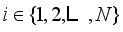 为个体索引,
 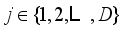 为维度索引;
  和
和  分别代表第
分别代表第  维搜索空间的下界和上界;
  表示(0,1)之间的随机数。
  ,并记录局部最优位置
  ,为后续迭代提供方向引导。
  :
:  (2)
(2)  在20~35℃之间无规则波动。该变量不直接参与坐标计算,而是作为状态切换的核心阈值:当
 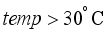 时,触发小龙虾的避暑或竞争行为;当
 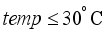 时,触发觅食行为。
 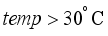 且随机概率
且随机概率 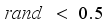 时,小龙虾为了躲避高温会进行大范围迁移寻找洞穴,进入避暑阶段(全局探索阶段)。理想洞穴位置
  由全局最优位置
  和局部最优位置
  共同决定。
共同决定。 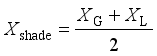 (3)
(3)  (4)
(4)  为当前迭代次数,
  为递减曲线,定义为:
  (5)
(5) 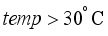 但随机概率
但随机概率  时,表明多个个体同时竞争同一个优质洞穴,进入竞争阶段(开发过渡阶段)。此时,当前个体𝑋𝑖会随机选取种群中的另一竞争个体
  (
( 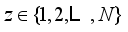 且
且  )作为对抗参考,其位置更新模型为:
  (6)
(6)  的吸引下进行位置重构。
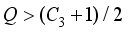
 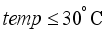 )时,小龙虾群体集中搜寻食物,进入觅食阶段(开发阶段)。此过程为COA深度局部开发的最核心环节。首先,算法将当前全局最优个体位置视为食物源
  :
: 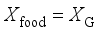 (7)
(7)  ,来决定后续的进食策略:
 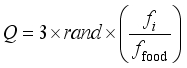 (8)
(8)  和
和  分别为第
分别为第  个体和全局最优个体适应度值。
  ,调控局部开发强度:
 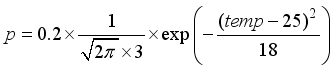 (9)
(9)  执行位置更新:
  时,食物规模过大,个体需先执行撕裂操作。算法通过指数衰减使食物体积在数学上“缩小”:
 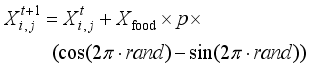 (10)
(10)  时,食物大小适中,个体直接吞咽。此时去除三角函数扰动,简化为快速向目标收敛的模型:
  (11)
(11) 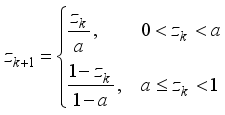 12)
12)  为第
为第  次迭代生成的混沌变量,
  为分段控制参数。
  为简单有理数,系统轨道极易落入短周期循环(即“周期锁相”效应)。这种现象会导致生成的序列丧失随机性,从而削弱对种群多样性的增益效果。
 对标准Kent映射进行改进。引入该随机扰动项后,不仅能有效破坏原有的周期锁相路径,还能增加混沌序列在相空间中的微观跃迁能力。改进后的Kent混沌映射公式如下所示:
 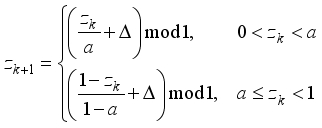 (13)
(13)  为种群规模;
  表示(0,1)之间的随机数;
  为取小数部分操作,旨在确保扰动后的混沌变量
  始终被严格限制在(0,1)的有效定义域内。
  只小龙虾在第
  维空间的位置
  的初始化:
的初始化:  (14)
(14)  的吸引。这种高强度的确定性单一节点引导极易导致种群在迭代前期快速聚集,致使探索范围严重萎缩;一旦
  陷入局部极值,整个种群将面临早熟收敛的风险。
 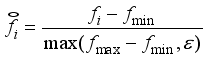 (15)
(15)  为归一化后的第
  个体的目标函数值,其取值映射至区间
 和
和  为当前种群在历史迭代中搜索到的目标函数最小与最大边界值;
  为防零偏置常数。
  :
: 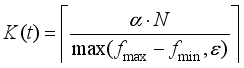 (16)
(16)  为种群总规模;
  为网格划分缩放因子,
  用于控制网格的基础密度。当目标区间宽度逐渐变小(即种群发生收敛)时,会自适应放大以实现网格细化。
  只个体的离散网格编号
  计算模型为:
  (17)
(17)  ,该索引号即为个体对应网格的唯一标识。
  ,仅提取该网格内部适应度最优的个体作为本区域的代表性候选洞穴:
 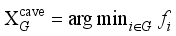 (18)
(18)  为网格
为网格  内的最佳决策向量。遍历所有非空网格提取的候选洞穴,共同构成当前代的全局候选洞穴矩阵
  。
。  实施了基于保留比例指数衰减的动态截断机制。
  随迭代次数呈指数级衰减:
 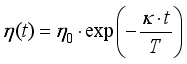 (19)
(19)  (20)
(20)  与
与  为当前迭代次数与最大迭代次数;
  为随迭代次数动态变化的洞穴保留比例;
  为初始保留比例基数,取值区间为[0.4,0.6];
  为当前代候选洞穴集合
  的元素总数;
  为向上取整函数;
  为保障种群多样性的最低保留洞穴数量底线,通常设为
  。
。  。
。  ,本文创新性地引入蒙特卡洛抽样机制为其分配目标洞穴。
  个精英洞穴在归一化空间的欧氏距离
  ,并定义受收缩半径
  约束的局部可见集
  :
:  (21)
(21) 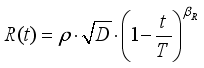 (22)
(22)  为决策维度;
  与
与  分别为初始基数与收缩指数。随后,计算可视域内各洞穴的负载惩罚概率质量函数(PMF):
 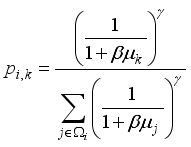 (23)
(23)  为第
为第  个洞穴被选中的概率;
  为记录洞穴当前已被选中次数的负载计数器;
  为拥挤排斥惩罚系数;
  为概率放大指数。
  的避暑洞穴不再依据确定性原则进行指派,而是通过多项式分布(Categorical)进行蒙特卡洛
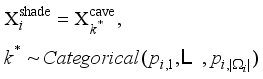 (24)
(24) 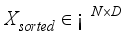 。(其中
。(其中  为种群规模,
  为决策变量的空间维度)。
  沿各特征维度进行极值归一化:
 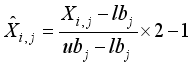 (25)
(25)  表示归一化后第
  个个体在第
个个体在第  维度的标度无关意图表征值;
  为对应的真实物理坐标;
  和
和  分别为第
分别为第  维搜索空间的物理上界与下界。
  )中会引发高维频率极速衰减,导致不同排位精英个体的特征向量趋于常数化。因此,本文提出自适应频率排位编码(Adaptive Frequency Positional Encoding, AFPE),以空间维度D为缩放基底:
  表示排位索引为
  的个体在第
的个体在第  维的编码值;
  将绝对排位映射为相对排位。该分段三角函数确保了不同排位的个体特征在低维隐空间中具有显著的非线性区分度。
  与排位编码矩阵
  进行逐元素叠加,生成输入矩阵
  :
: 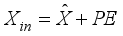 (27)
(27)  后,算法需构建完整的查询(Query)、键(Key)与值(Value)映射体系。受限于启发式算法无法通过反向传播更新网络权重,本文利用混沌映射的遍历性动态生成投影权重方阵
 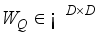 与
与 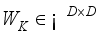 ,进而获取查询矩阵
  与键矩阵
与键矩阵  。
。  (28)
(28)  算得的注意力概率与值矩阵
  进行点积。通常
  。然而,考虑到启发式算法中个体的基因坐标具备严格的物理边界约束,若将其映射至无量纲的隐空间,将彻底破坏交叉后新生个体的物理合法性。为此,本文在值获取通道中强制解除归一化约束,实施物理量纲保真策略,即将值投影矩阵
  设定为恒等单位矩阵
  。由此,值矩阵
  严格等价于种群当前的真实物理坐标矩阵
  :
:  (29)
(29)  矩阵后,本文引入方差缩放机制(以空间维度
  为缩放基底)防Softmax 梯度饱和,执行完整的多亲加权自注意力特征融合。融合后的注意力特征引导矩阵
 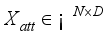 的计算模型如下所式:
 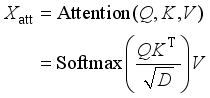 (30)
(30)  视作引导扰动量叠加至个体当前状态,并施加边界反弹约束:
  (31)
(31)  (32)
(32)  为完成交叉重组后的新生代种群;
  为自适应融合因子(
  为当前迭代次数,
  为最大迭代次数),随迭代进程线性减以平衡算法的全局探索与局部开发。max与 min为逐元素极值截断函数,确保新生个体的坐标严格落于物理可行域
  内部。
内部。  ,最大迭代
,最大迭代  ,空间维度
,空间维度  及边界
及边界  和
和  ,目标函数
,目标函数  。
。  及目标值
及目标值  。
。  与局部最优
与局部最优  。
。  do
do 
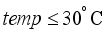 then
then  do
do  。
。 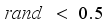 then
then 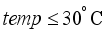 )
)  do
do  与高斯摄食概率
 then
then  。
。  。
。 
 及目标值
及目标值  。
。  ;用于探测全局勘探广度与惩罚边界逃逸能力的高维复杂多峰函数
  ;以及考核深层极值微调与探索开发动态平衡的复合函数
  。精选测试函数的具体数学表达式及参数空间界限详见表1。
  ,最大迭代次数
  。所有算法均在各函数上独立运行 30 次,以平均适应度(Avg)量化寻优精度,标准差(Std)量化鲁棒性。各基线算法的核心超参数均采用原始文献推荐的最佳值,参数配置明细如表2所示。
  中,ICOA2的精度大幅优于基线,证明了基于蒙特卡洛
测试函数 | 维度 | 范围 | 最优值 |
|---|---|---|---|
| 30 | [-100,100] | 0 |
| 30 | [-1.28,1.28] | 0 |
| 30 | [-500,500] | -12569.5 |
| 30 | [-5.12,5.12] | 0 |
| 6 | [1] | -3.32 |
| 4 | [10] | -10.15 |
算法 | 参数设置 |
|---|---|
ICOA |
|
COA |
|
PSO |
|
GWO |
|
MVO |
|
BOA |
|
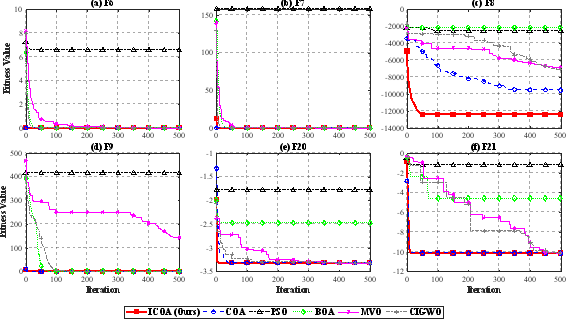
 上,其精度逼近理论极限,印证了自注意力
 与复合函数
与复合函数  中,ICOA取得了跨越对比算法数个量级的代际优势,确凿证明了融入蒙特卡洛
 ,若
,若  值小于0.05,则拒绝性能无差异的原假设,表明 ICOA 显著优于对比算法;若
  (在表5中以下划线标注),或输出 NaN(同时求得理论极值),则判定两者性能无显著差异。
  值几乎全部远小于0.05。这一压倒性的概率证据确凿排除了偶然性干扰,充分印证了引入的混沌初始化、Grid-Caves策略及自注意力交叉算子在底层逻辑上实现了实质性的性能跃升,赋予了ICOA极其卓越的寻优鲁棒性。
 函数 | ICOA | COA | ICOA1 | ICOA2 | ICOA3 | |
|---|---|---|---|---|---|---|
| Ave | 0.00E+00 | 3.94E-01 | 1.39E-03 | 7.34E-07 | 2.86E-05 |
Std | 0.00E+00 | 2.20E-01 | 2.06E-03 | 2.50E-06 | 4.54E-05 | |
| Ave | 3.73E-06 | 8.68E-05 | 8.93E-05 | 4.01E-05 | 5.63E-05 |
Std | 2.74E-06 | 9.90E-05 | 5.95E-05 | 3.63E-05 | 5.89E-05 | |
| Ave | -1.21E+04 | -8.50E+03 | -5.89E+03 | -1.21E+04 | -6.62E+03 |
Std | 2.66E+02 | 8.47E+02 | 6.11E+02 | 2.66E+02 | 5.32E+02 | |
| Ave | 0.00E+00 | 0.00E+00 | 0.00E+00 | 0.00E+00 | 0.00E+00 |
Std | 0.00E+00 | 0.00E+00 | 0.00E+00 | 0.00E+00 | 0.00E+00 | |
| Ave | -3.32E+00 | -3.27E+00 | -3.17E+00 | -3.30E+00 | -3.29E+00 |
Std | 1.50E-08 | 6.99E-02 | 1.12E-01 | 5.36E-02 | 6.16E-02 | |
| Ave | -1.02E+01 | -6.45E+00 | -1.02E+01 | -1.02E+01 | -1.02E+01 |
Std | 7.17E-15 | 2.77E+00 | 2.13E-04 | 1.79E-08 | 7.17E-15 |
函数 | ICOA | COA | PSO | BOA | MVO | GWO | |
|---|---|---|---|---|---|---|---|
| Ave | 0.00E+00 | 5.89E+00 | 6.24E+04 | 6.22E+00 | 2.74E+02 | 2.29E+01 |
Std | 0.00E+00 | 9.82E-01 | 5.57E+03 | 5.46E-01 | 1.15E+02 | 9.19E+00 | |
| Ave | 3.83E-06 | 1.31E-03 | 1.34E+02 | 7.41E-05 | 5.92E-01 | 5.94E-02 |
Std | 2.94E-06 | 9.94E-04 | 2.18E+01 | 8.34E-05 | 1.63E-01 | 2.13E-02 | |
| Ave | -1.23E+04 | -4.21E+03 | -2.71E+03 | -2.48E+03 | -6.99E+03 | -5.31E+03 |
Std | 2.08E+02 | 1.06E+03 | 4.16E+02 | 3.82E+02 | 5.89E+02 | 1.25E+03 | |
| Ave | 0.00E+00 | 0.00E+00 | 4.20E+02 | 2.41E-11 | 2.14E+02 | 7.83E+01 |
Std | 0.00E+00 | 0.00E+00 | 2.57E+01 | 1.88E-12 | 3.59E+01 | 3.87E+01 | |
| Ave | -3.32E+00 | -3.27E+00 | -1.35E+00 | -2.24E+00 | -3.27E+00 | -3.22E+00 |
Std | 2.26E-02 | 6.63E-02 | 5.51E-01 | 3.14E-01 | 7.43E-02 | 1.12E-01 | |
| Ave | -8.05E+00 | -5.54E+00 | -7.94E-01 | -3.99E+00 | --6.28E+00 | -7.48E+00 |
Std | 2.79E+00 | 2.75E+00 | 4.20E-01 | 6.06E-01 | 3.51E+00 | 3.23E+00 |
函数 | COA | PSO | BOA | MVO | GWO |
|---|---|---|---|---|---|
| 1.21e-12 | 1.21e-12 | 1.21e-12 | 1.21e-12 | 1.21e-12 |
| 2.37e-10 | 3.02e-11 | 3.16e-10 | 3.02e-11 | 3.02e-11 |
| 2.86e-11 | 2.86e-11 | 2.86e-11 | 2.86e-11 | 2.86e-11 |
| NAN | 1.21e-12 | 1.21e-12 | 1.21e-12 | 1.21e-12 |
| 7.71e-07 | 1.79e-11 | 1.79e-11 | 1.79e-11 | 1.79e-11 |
| 2.65e-05 | 8.07e-11 | 2.70e-11 | 2.56e-03 | 4.31e-02 |
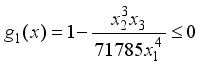
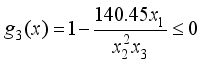
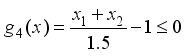
 、平均卷径
、平均卷径  与有效圈数
与有效圈数  的最优组合,从而使弹簧的整体重量(制造成本)最小化。
  ,其相应的搜索空间边界分别为:
 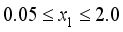 ,
, 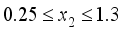 ,
, 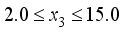 。
。 

算法 | 变量的最优值 | 优化成本 | ||
|---|---|---|---|---|
D | d | N | ||
ICOA | 0.0519 | 0.3609 | 11.0514 | 0.012667 |
COA | 0.0521 | 0.3660 | 10.7781 | 0.012679 |
PSO | 0.0701 | 0.8543 | 3.0331 | 0.021100 |
GWO | 0.0521 | 0.3658 | 10.7886 | 0.012687 |
MVO | 0.0557 | 0.4607 | 7.2100 | 0.013169 |
BOA | 0.0500 | 0.3143 | 14.6252 | 0.013063 |
 、圆柱壳厚度
  、内半径
、内半径  与圆柱体长度
  的最优组合,从而使制造该容器的总成本最小化。
  ,该工程问题的搜索空间物理边界分别为:
 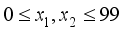 ,
, 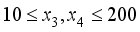 ,且
,且  是
是  0.0625英寸的整数倍。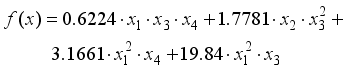




算法 | 变量的最优值 | 优化成本 | |||
|---|---|---|---|---|---|
|
|
|
| ||
ICOA | 0.8125 | 0.4375 | 42.0984 | 176.6367 | 6059.7164 |
COA | 0.8125 | 0.4375 | 42.0963 | 176.6723 | 6060.1921 |
PSO | 4.9375 | 3.5000 | 67.9159 | 13.9993 | 65557.4017 |
GWO | 0.8125 | 0.4375, | 42.0958 | 176.6959 | 6060.6473 |
MVO | 0.8750 | 0.4375 | 45.3041 | 140.6399 | 6095.6847 |
BOA | 1.1875 | 0.6250 | 56.1947 | 56.6265 | 7686.2581 |
| [1] | Jia H, Rao H, Wen C, et al. Crayfish optimization algorithm [J]. Artificial Intelligence Review, 2023, 56(Suppl 2): 1919-1979. |
| [2] | Hu P, Han Y, Zhang Z, et al. A multi-level thresholding image segmentation algorithm based on equilibrium optimizer [J]. Scientific reports, 2024, 14(1): 29728. |
| [3] | Hyperparameter optimization of deep neural network using univariate dynamic encoding algorithm for searches [J]. Knowledge-Based Systems, 2019, 178: 74-83. |
| [4] | Chai X, Zheng Z, Xiao J, et al. Multi-strategy fusion differential evolution algorithm for UAV path planning in complex environment [J]. Aerospace Science and Technology, 2022, 121: 107287. |
| [5] | Kennedy J, Eberhart R. Particle swarm optimization [C] // Proceedings of ICNN'95-international conference on neural networks. ieee, 1995, 4: 1942-1948. |
| [6] | Mirjalili S, Mirjalili S M, Lewis A. Grey wolf optimizer [J]. Advances in engineering software, 2014, 69: 46-61. |
| [7] | Mirjalili S, Mirjalili S M, Hatamlou A. Multi-verse optimizer: a nature-inspired algorithm for global optimization [J]. Neural computing and applications, 2016, 27(2): 495-513. |
| [8] | Arora S, Singh S. Butterfly optimization algorithm: a novel approach for global optimization [J]. Soft computing, 2019, 23(3): 715-734. |
| [9] | Mahdavi S, Rahnamayan S, Deb K. Opposition based learning: A literature review [J]. Swarm and evolutionary computation, 2018, 39: 1-23. |
| [10] | Huang D, Yang J, Yu J. A particle swarm optimization with fitness-distance balance strategy [C] // 2022 18th International Conference on Computational Intelligence and Security (CIS). IEEE, 2022: 336-340. |
| [11] | Davies T K, Mees C C, Milner-Gulland E J. The past, present and future use of drifting fish aggregating devices (FADs) in the Indian Ocean [J]. Marine policy, 2014, 45: 163-170. |
| [12] | Kent R M, Barbosa W A S, Gauthier D J. Controlling chaotic maps using next-generation reservoir computing [J]. Chaos: An Interdisciplinary Journal of Nonlinear Science, 2024, 34(2). |
| [13] | Rubinstein R Y, Kroese D P. Simulation and the Monte Carlo method [M]. John Wiley & Sons, 2016. |
| [14] | Vaswani A, Shazeer N, Parmar N, et al. Attention is all you need [J]. Advances in neural information processing systems, 2017, 30. |
| [15] | Keles F D, Wijewardena P M, Hegde C. On the computational complexity of self-attention [C] // International conference on algorithmic learning theory. PMLR, 2023: 597-619. |
| [16] | Tzanetos A, Blondin M. A qualitative systematic review of metaheuristics applied to tension/compression spring design problem: Current situation, recommendations, and research direction [J]. Engineering Applications of Artificial Intelligence, 2023, 118: 105521. |
| [17] | Moyya S, Thejasree P, Abraham B C, et al. Design and analysis of single and multi-layer pressure vessel [J]. Materials Today: Proceedings, 2023. |
| [18] | Alawida M. Enhancing logistic chaotic map for improved cryptographic security in random number generation [J]. Journal of Information Security and Applications, 2024, 80: 103685. |
| [19] | Akraam M, Rashid T, Zafar S. An image encryption scheme proposed by modifying chaotic tent map using fuzzy numbers [J]. Multimedia Tools and Applications, 2023, 82(11): 16861-16879. |
| [20] | Szegedy C, Ioffe S, Vanhoucke V, et al. Inception-v4, inception-resnet and the impact of residual connections on learning [C]//Proceedings of the AAAI conference on artificial intelligence. 2017, 31(1). |
APA Style
Bo, J., Weimin, W. (2026). An Improved Crayfish Optimization Algorithm with Multi-Strategy Collaboration. Science Innovation, 14(5), 190-202. https://doi.org/10.11648/j.si.20261405.16
ACS Style
Bo, J.; Weimin, W. An Improved Crayfish Optimization Algorithm with Multi-Strategy Collaboration. Sci. Innov. 2026, 14(5), 190-202. doi: 10.11648/j.si.20261405.16
AMA Style
Bo J, Weimin W. An Improved Crayfish Optimization Algorithm with Multi-Strategy Collaboration. Sci Innov. 2026;14(5):190-202. doi: 10.11648/j.si.20261405.16
@article{10.11648/j.si.20261405.16,
  author = {Jin Bo and Wang Weimin},
  title = {An Improved Crayfish Optimization Algorithm with
Multi-Strategy Collaboration},
  journal = {Science Innovation},
  volume = {14},
  number = {5},
  pages = {190-202},
  doi = {10.11648/j.si.20261405.16},
  url = {https://doi.org/10.11648/j.si.20261405.16},
  eprint = {https://article.sciencepublishinggroup.com/pdf/10.11648.j.si.20261405.16},
  abstract = {The crayfish optimization algorithm (COA) is competitive in solving continuous optimization problems, but its performance deteriorates in high-dimensional and multimodal environments because random initialization may provide uneven population coverage, exploration relies excessively on the current best solution, and exploitation lacks effective multi-source information interaction. To address these limitations, this study proposes a multi-strategy improved crayfish optimization algorithm (ICOA). First, an enhanced Kent chaotic map with random perturbation is used to initialize the population, thereby improving ergodicity and spatial diversity. Second, an adaptive grid-based multi-cave strategy incorporating Monte Carlo sampling dynamically constructs an elite cave set and assigns target caves according to load-aware probability distributions. This probabilistic mechanism broadens global exploration and reduces premature population aggregation. Third, a multi-source crossover operator combining adaptive frequency rank encoding with chaotic self-attention reconstructs interactions among individuals while preserving the physical scale and boundary feasibility of candidate solutions. The contribution of each strategy is examined through ablation experiments. ICOA is further compared with COA, PSO, GWO, MVO, and BOA on six challenging benchmark functions over 30 independent runs, and statistical significance is evaluated using the Wilcoxon rank-sum test. The proposed method is also applied to tension/compression spring and pressure vessel design problems. Experimental results show that ICOA consistently improves solution accuracy, convergence behavior, robustness, and the ability to escape local optima, while achieving the best optimization results in both constrained engineering applications. These findings demonstrate that the collaborative strategies provide an effective balance between global exploration and local exploitation for complex continuous optimization tasks.},
 year = {2026}
}
TY  - JOUR
T1  - An Improved Crayfish Optimization Algorithm with
Multi-Strategy Collaboration
AU  - Jin Bo
AU  - Wang Weimin
Y1  - 2026/09/14
PY  - 2026
N1  - https://doi.org/10.11648/j.si.20261405.16
DO  - 10.11648/j.si.20261405.16
T2  - Science Innovation
JF  - Science Innovation
JO  - Science Innovation
SP  - 190
EP  - 202
PB  - Science Publishing Group
SN  - 2328-787X
UR  - https://doi.org/10.11648/j.si.20261405.16
AB  - The crayfish optimization algorithm (COA) is competitive in solving continuous optimization problems, but its performance deteriorates in high-dimensional and multimodal environments because random initialization may provide uneven population coverage, exploration relies excessively on the current best solution, and exploitation lacks effective multi-source information interaction. To address these limitations, this study proposes a multi-strategy improved crayfish optimization algorithm (ICOA). First, an enhanced Kent chaotic map with random perturbation is used to initialize the population, thereby improving ergodicity and spatial diversity. Second, an adaptive grid-based multi-cave strategy incorporating Monte Carlo sampling dynamically constructs an elite cave set and assigns target caves according to load-aware probability distributions. This probabilistic mechanism broadens global exploration and reduces premature population aggregation. Third, a multi-source crossover operator combining adaptive frequency rank encoding with chaotic self-attention reconstructs interactions among individuals while preserving the physical scale and boundary feasibility of candidate solutions. The contribution of each strategy is examined through ablation experiments. ICOA is further compared with COA, PSO, GWO, MVO, and BOA on six challenging benchmark functions over 30 independent runs, and statistical significance is evaluated using the Wilcoxon rank-sum test. The proposed method is also applied to tension/compression spring and pressure vessel design problems. Experimental results show that ICOA consistently improves solution accuracy, convergence behavior, robustness, and the ability to escape local optima, while achieving the best optimization results in both constrained engineering applications. These findings demonstrate that the collaborative strategies provide an effective balance between global exploration and local exploitation for complex continuous optimization tasks.
VL  - 14
IS  - 5
ER  -
School of Computer, Jiangsu University of Science and Technology, Zhenjiang, China

Information


 Share This Article
 Twitter
 Linked In
 Facebook
 。
。  。
。  。
。  。
。 




 Copy
Copy Download