1. Introduction
The relevance of science to the indigenous learners’ lived world and vice versa
| [15] | Jin, Q. (2021). Supporting indigenous students in science and STEM education: A systematic review. Education Sciences, 11(9), 555. |
[15]
is an aspect of science education that has inexhaustibly been critically debated. Particularly discourses in a multicultural context about what indigenous learners learn, how indigenous learners learn mathematical aspects of science, or how they are taught to enhance their understanding of some mathematical concepts in science. In the context of this study, we explore the perception of the teachers and students on learning some science concepts such as geometry. This study further conceptualizes geometry as a concept in mathematics that starts with points (position), lines, line segments and planes (2D surface). It also involves measuring angles with the lens of indigenous knowledge activities such as basket weaving. No doubt, the fabric of the African indigenous context is different from that of the west to the
| [23] | Marovic, Z., & Machinga, M. M. (2017). African shamanic knowledge and transpersonal psychology: Spirits and healing in dialogue. Journal of Transpersonal Psychology, 49(1). |
| [20] | Lim, L (2019). “Culturally relevant pedagogy: Developing principles of description and analysis.” Teaching and Teacher Education. 77, pp. 43-52. |
[23, 20]
. Therefore adapting the learning of mathematical concepts in science through the lens of the learners’ lived world towards better understanding is cogent in achieving quality education in indigenous students. Indigenous learners’ value of the knowledge of science tends to be dependent on the reciprocal value of the learners’ lived world
| [25] | Mazzocchi, F., Simandan, D., Demneh, M. T., Morgan, D. R., Ghazinoory, S., Saghafi, F., & Mirzaei, M. (2018). Why ‘Integrating’Western science and Indigenous knowledge is not an easy task: What lessons could be learned for the future of knowledge. Journal of Futures Studies, 22(3), 19-34. |
[25]
by the teachers. Integrating indigenous knowledge as an approach towards achieveing quality education by understanding and valuing scientific knowledge by indigenous learners are goals of science education in Nigeria and globally.
Quality Education is envisaged in the Sustainable Development Goal 4 of the United Nations (UNESCO, 2030) global project. By 2030, the United Nations expectations is to have achieved an educational ecosystem where there is reduced inequality in the access to quality understanding of mathematical concepts in science especially for minority and less privileged communities in sub-Saharan Africa. In reality, many groups especially in Africa have reduced economic capacities to acquire ICT resources to enhance their learning
| [10] | Dele-Ajayi, O., Fasae, O. D., & Okoli, A. (2021). Teachers’ concerns about integrating information and communication technologies in the classrooms. Plos one, 16(5), e0249703. |
| [16] | Kennedy, G. M. (2023). Challenges of ICT Integration in Teachers’ Education: A Case Study of the College of Education, University of Liberia. International Journal of Social Science and Education Research Studies, 3(5), 860-870. |
[10, 16]
. In essence, the lived world of the learners must be valued and integrated into science teaching
| [17] | Khathi, J. L., Ajani, O. A., & Govender, S. (2022). Exploring Teachers' Lived Experiences on the Integration of Values Education in South African High Schools. Research in Social Sciences and Technology, 7(2), 108-128. |
| [22] | Mavuru, L. (2024). Teaching life sciences while integrating teachers’ and learners’ cultural belief systems. EURASIA Journal of Mathematics, Science and Technology Education, 20(1), em2379. |
[17, 22]
. Curricula in some sub Saharan countries further suggests that teaching is to be practical and activity based and also experiential. These statements primarily asserts that there are various activities in the learners’ lived-world wherein they could be taught some science concepts and that the teachers can allude to with a view to creating a fun filled science learning classroom in or out of the classroom.
Attempts to connect western science with learners traditional experience has garnered some efforts. This was rooted in the fact that there is still a wide gap between learners’ lived experiences and school science experiences.
| [24] | Mawere, M. (2015). Indigenous knowledge and public education in sub-Saharan Africa. Africa Spectrum, 50(2), 57-71. |
| [31] | Sunzuma, G., Zezekwa, N., Zinyeka, G., & Chinyoka, M. (2013). Incorporating religious mathematics in the teaching and learning of formal geometry: a case of the Apostolic Church sector in Zimbabwe. |
[24, 31]
asserts that teachers teach science in ways that are not in resonance and relevant with their lived-experience. Science is taught with approaches foreign to the learners’ background knowledge. Despite the developments of science in all aspects of the global world, some indigenous learners are still not interested in science concepts
| [4] | Cajete, G. (2015). Indigenous community: Rekindling the teachings of the seventh fire. Living Justice Press. |
| [24] | Mawere, M. (2015). Indigenous knowledge and public education in sub-Saharan Africa. Africa Spectrum, 50(2), 57-71. |
| [9] | Dei, G. J. S. (2011b). Indigenous philosophies and critical education: An introduction. In G. J. S. Dei (Ed.), Indigenous philosophies and critical education ((pp. 1-13). New York: Peter Lang Publishing.
https://doi.org/10.1007/978-94-6209-770-4_13 |
[4, 24, 9]
. Another setback to actualization of the UNESCO (2030) goal of quality education for all is that teachers are not enlightened and capacitated to integrate indigenous activities with school science
| [27] | Ogunniyi, M. B. (2004). The challenge of preparing and equipping science teachers in higher education to integrate scientific and indigenous knowledge systems for learners: the practice of higher education. South African Journal of Higher Education, 18(3), 289-304. |
| [29] | Seehawer, M. (2018). South African science teachers' strategies for integrating indigenous and Western knowledges in their classes: Practical lessons in decolonisation. Educational Research for Social Change, 7(SPE), 91-110. |
| [21] | Mandikonza, C. (2019). Integrating indigenous knowledge practices as context and concepts for the learning of curriculum science: a methodological exploration. Southern African Journal of Environmental Education, 35. |
| [7] | Da Silva, C., Pereira, F., & Amorim, J. P. (2023). The integration of indigenous knowledge in school: a systematic review. Compare: A Journal of Comparative and International Education, 1-19. |
[27, 29, 21, 7]
. When science is contextualized and place based, learners tends to be more interested, engaged and become conscious of science activities in their ecosystem.
A panacea to these disconnections according to
| [15] | Jin, Q. (2021). Supporting indigenous students in science and STEM education: A systematic review. Education Sciences, 11(9), 555. |
[15]
is that teachers and learners should strive to increase their consciousness on the cultural impact on learners’ science achievement and positive outcomes. Also there should be efforts towards increased access to science learning through indigenous activities thereby making science learning aligned with learners’ traditional knowledge
| [33] | Wilujeng, I., & Prasetyo, Z. K. (2018). Elaborating indigenous knowledge in the science curriculum for the cultural sustainability. Journal of Teacher Education for Sustainability, 20(2), 74-88. |
[33]
. One of such concepts is geometry. Societal practices can also frame conceptual learning to enable them value the meaningfulness of science
| [30] | Snively, G. & Corsiglia, J (2001): Discovering indigenous science: Implications for science education. Science Education 85 (1): 6-34. |
| [26] | Milne, C. (2015). Cultural influences on science education. In Richard Gunstone (Ed.), Encyclopaedia of science education (pp. 245–248). Dordrecht: Springer
https://doi.org/10.1007/978-94-007-2150-0_307 |
| [13] | Habig, B. Gupta P, Adams JD (2021). Disrupting deficit narratives in informal science education: applying community cultural wealth theory to youth learning and engagement. Cultural Studies of Science Education 16, 509-548.
https://doi.org/10.1007/s11422-020-10014-8 |
[30, 26, 13]
. According to
| [23] | Marovic, Z., & Machinga, M. M. (2017). African shamanic knowledge and transpersonal psychology: Spirits and healing in dialogue. Journal of Transpersonal Psychology, 49(1). |
[23]
, if we critically observe our high school science curriculum, indigenous experiences of the learners have not been unpacked to enhance their understanding of the knowledge of science much less of solving challenges in their environment. It is on this premise that this study unpacks the experiences of teachers and learners on the knowledge of geometry in basket making. Specifically, this research study examines (i) the perceptions of science teachers on the knowledge of science (geometry) in basket making. (ii) the perceptions of science students on the knowledge of science (geometry) in basket making.
2. Background to the Study
This study was conducted in a periurban area in South West, Nigeria. It contextualizes concepts such as angles, lines, planes and shapes which are contents of geometry within a larger study on the knowledge of science in basket making and the use of basket making to teach science concepts of geometry to learners in senior secondary school one and two (grade ten, eleven or twelve). The knowledge of basket making is envisaged to be useful in integrating indigenous knowledge with mathematical concepts in science to strengthen indigenous knowledge. Understanding some basic scientific concepts can be fun while the approach to learning still remained experiential, practical, and transformative and interconnected with the learners experience
| [33] | Wilujeng, I., & Prasetyo, Z. K. (2018). Elaborating indigenous knowledge in the science curriculum for the cultural sustainability. Journal of Teacher Education for Sustainability, 20(2), 74-88. |
[33]
. An eighty one year old traditional weaver facilitated the learning processes outside the school while three students and two teachers signified to be holders of the knowledge of basket weaving also. This they demonstrated in the school premises. The main objective of this study is (i) to unpack the science related to mathematics in the process of basket making. (ii) to help learners learn mathematical concepts with everyday processes in the learners lived world.
2.1. Baskets as Cultural Artefacts
Baskets are invaluable indigenous knowledge artefacts making up the fabrics of the African society. Baskets are everyday tools in the hands of the indigenous people. The knowledge of basket making is fundamental to indigenous peoples’ way of life in Africa and particularly in Nigeria. Indigenous Knowledge is disseminated and preserved through various family histories, taboos, symbols, myths/legends, rituals, sounds/dances, festivals, proverbs, poetry, literature, songs, beads, food, nature, taste, dresses and other cultural artefacts
| [6] | Chilisa, B. (2012). Indigenous research methodologies. Thousand Oaks, CA: SAGE Publications Inc. |
[6]
. The nature of indigenous knowledge systems is specific, local, dynamic, deals with shared beliefs, based on experience, tacit, embedded in practice and disseminated through different forms of artefacts. Indigenous knowledge is a valuable fund of knowledge that remains an endowment for the locals of any community.
posits that indigenous knowledge links the past and present contexts of generations. Learners with this view to life can be called indigenous learners likewise the teachers embodied with this knowledge can be called indigenous teachers. Every knowledge is local to the people who own it. This study is theoretically underpinned by the communities of practice
| [19] | Lave & Wenger, E. (1998). Wenger, E. (1998). Communities of practice: Learning, meaning and identity. Journal of Mathematics Teacher Education. 6(2): 185-194.
https://doi.org/10.1023/A:1023947624004 |
| [3] | Bourdieu, P. (1994). Structures, habitus, power: Basis for a theory for symbolic power. In B. D. Nicholas, E. Geoff, & B. O. Sherry (Eds.), Culture/power/history: A reader in contemporary social theory (pp. 155–199). Princeton, NJ: Princeton University Press.
https://doi.org/10.1017/CBO9780511812507.006 |
[19, 3]
.
2.2. Polygons and Patterns
Geometry is one of the difficult concepts in mathematics for learners from the African origin, (Bhagat et al, 2015). The dimensions and shapes are the focus of geometry. It is a field of mathematics that should be practical
| [5] | Charles-Ogan, G. L. A. D. Y. S., & George, N. R. (2015). Investigating difficult concepts in senior secondary school mathematics curriculum as perceived by students. International Journal of Academic research and reflection, 3(6), 67-74. |
[5]
. The demonstration of forms and polygons is the main focus here. Since mathematics is present in everything we do
| [24] | Mawere, M. (2015). Indigenous knowledge and public education in sub-Saharan Africa. Africa Spectrum, 50(2), 57-71. |
[24]
. Different shapes of polygons can be demonstrated with the basket base framework. This can be done according to the choice of number of frames, either in twos, threes and fours. Polygons of six (hexagon), eight (octagon) and other shapes can be formed.
It can also be aesthetics. Learners’ world will be valued and recognized by this demonstration. The knowledge of angles can also be demonstrated with this basket based activity. Angles 90, 180, 270 and 360 degrees can be demonstrated to the learners as well as angles on a point.
During the process of basket weaving, aesthetics in the patterns emerges, attracts the attention of learners towards the activity, create a sort of emotional reflection. The different emerging colours also can activate the consciousness of some form of colours in the learners as patterns are formed. Embedded in basket weaving are mathematical concepts that can be employed as a hands-on minds-on thereby presenting abstract as reality to the students.
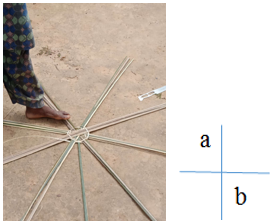
Figure 1. Vertically Opposite Angles.
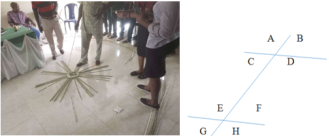
a and b are vertically opposite angles. Before adding the other frames in twos, threes and fours, corresponding and alternate angles can be created for the students to learn because they are already interested in the activity as well as attention captured.
Figure 2. Diagram Illustrating Corresponding and Alternate Angles.
Learners can see for themselves angles A and E, B and F, C and G, are all parallel to each other. According to
| [14] | Juman, Z. A. M. S., Mathavan, M., Ambegedara, A. S., & Udagedara, I. G. (2022). Difficulties in Learning Geometry Component in Mathematics and Active-Based Learning Methods to Overcome the Difficulties. Shanlax International Journal of Education, 10(2), 41-58. |
[14]
, learners’ prior knowledge about geometry is insufficient. According to them learners are involved in insufficient practices in geometry and that teachers do not focus on teaching geometry to learners. Learners answer mathematical questions and leave questions related to geometry. They also argue that learners’ understanding of geometry are not aided by their family members hence, their background remains poor. This is actually not the reality. Learners’ prior knowledge according to this study is adequate and they are involved in practices that can help them understand geometry concepts better. However, the teachers’ role in facilitating learners’ further understanding of geometry is inadequate. In this study, even the science teachers did not have adequate traditional knowledge of basket making but the English teacher. It was after a professional development training for the teachers on basket making that they were able to teach other students.
| [2] | Biber, C., Tuna, A., & Korkmaz, S. (2013). The Mistakes and the Misconceptions of the Eighth Grade Students on the Subject of Angles. European Journal of science and mathematics education, 1(2), 50-59. |
[2]
in the same vein argued that learners especially learners of color have various misconceptions about angles in geometry. Challenges about angles should not be for African learners if it is demonstrated to them. African learners should ideally not be in this state of ineptitude. Some teachers also say that it is horrible teaching mathematics concepts as abstract and memorizing a bunch of formulas.
2.3. The Theoretical Base of the Study
Capitals (cultural, social, cognitive, and even economic) owned by learners can determine their position in the cognitive field
| [3] | Bourdieu, P. (1994). Structures, habitus, power: Basis for a theory for symbolic power. In B. D. Nicholas, E. Geoff, & B. O. Sherry (Eds.), Culture/power/history: A reader in contemporary social theory (pp. 155–199). Princeton, NJ: Princeton University Press.
https://doi.org/10.1017/CBO9780511812507.006 |
[3]
. The capitals owned by teachers and students in this study enabled students become co-tutors and co-assessors while teachers got other students interested in the activity. There was a feeling of how could a western trained teacher know how to weave. While being involved in the activity, the teachers and students showed a level of self –efficacy, confidence and self-belief. This reflected in their determination to learn more concepts surrounding complex angles even when they were not mathematics teachers. Students taught other students because of the confidence they had to teach some other students and teachers. In a positive way, students and teachers also interacted together in a happy atmosphere. There was a sense of shared responsibility as co-learners. In essence, the power dominance of the teachers was managed as students were given power to teach and be seen as co-tutors. Most students’ symbolic capital increased as they further became co-assessors. Again as a means of sustaining the gained capital, the students started to ask meaningful questions that showed that they understood the subject matter. They equally responded to questions meaningfully, attended to assignments promptly and became conscious of the reasons to respect teachers as well as listen to them. Social capital became a determinant for cognitive development in learners. The school (out-of classroom) became a space for learners’ activities and interaction. This space can also be called the community of practice (CoP). This community of practice (CoP) in way is a field where capitals are transformed from a form to another.
Peer tutors are also more knowledgeable others (MKOs). The teacher were not just an (MKO) but willing to assist others to learn for various angles in a more familiar and natural approach. Teachers are motivated to help learners transform their cultural capital (knowledge of basket making) to the learners’ cognitive capital (understanding geometry). According to
learning is a social process and the resulting interaction plays a key role the development of learners’ cognition. When learners and teachers interact, they speak the language that they understand fluently. Teachers and students in this study conversed in both English and Yoruba (learners’ mother tongue).
| [32] | Vygotsky, L. S. (1978). Mind in society: Development of higher psychological processes. Cambridge, MA: Harvard University Press. |
[32]
posits that during interaction, subjects speak their language to understand the world around them. The cognitive use of indigenous language, not just to make unproductive noise reflects purposeful interactions and purposeful use of mothers tongue. In most high schools in Nigeria, the teachers prohibits learners from speaking and learning science subjects with their indigenous language.
In an out-of-classroom activity such as an activity where learners learn angles, lines, properties of a circle, polygons, plane shapes, the learners and teachers are subjects, the object is the goal of the lesson while tools are the artefact used to mediate learning.
| [23] | Marovic, Z., & Machinga, M. M. (2017). African shamanic knowledge and transpersonal psychology: Spirits and healing in dialogue. Journal of Transpersonal Psychology, 49(1). |
[23]
is of the opinion that such interactions has implications individually and collectively. When weaving, learners tends to observe, tends to remember when and where the last place they weaved baskets. This is a sort of place-based learning. This activity provided opportunities to ask questions, opportunities to negotiate tensions among learners if any as the teacher plays the role of a more knowledgeable other.
3. Research Methodology
This research work is indigenous, participatory and a case study.
| [28] | Priya, A. (2021). Case study methodology of qualitative research: Key attributes and navigating the conundrums in its application. Sociological Bulletin, 70(1), 94-110. |
[28]
argues that when searching for the depth of a phenomenon of interest, especially when it is in its natural context, a case study is recommended. In this case we needed to search for the knowledge of basket making in a context whose fabric is already weaved by western ideologies. According to
| [31] | Sunzuma, G., Zezekwa, N., Zinyeka, G., & Chinyoka, M. (2013). Incorporating religious mathematics in the teaching and learning of formal geometry: a case of the Apostolic Church sector in Zimbabwe. |
[31]
, indigenous knowledge is embedded in the life activities (natural context) of the local people hence, when carrying out an indigenous research, the researchers should be respectful and responsible
| [11] | Evans, M., Miller, A., Hutchinson, P., & Dingwall, C. (2014). Decolonizing research practice: Indigenous methodologies, aboriginal methods, and knowledge/knowing. The Oxford handbook of qualitative research, 179. |
[11]
. This research work aims to bring STEM concepts such as geometry that are taught in abstract to reality concretizing STEM concepts in the learners.
posited that culture is a valued piece of fabric of everything we do as Africans, therefore, it embodies attitudes, values, expectations and behaviours. Therefore it is required that the researchers engage with individuals
| [6] | Chilisa, B. (2012). Indigenous research methodologies. Thousand Oaks, CA: SAGE Publications Inc. |
[6]
who know how to weave a basket as co-participants for data collection and interpretation. In this study, some teachers and students, apart from the traditional weaver, show cased their knowledge of basket weaving.
3.1. Participant Selection Criteria
The selection of the basket weaver was purposive as the researchers sought for someone who weaves basket. This skill endeared us to choosing the basket weaver. The schools (public) were purposively selected because their students are much more in number than those in the private schools. The private schools are more expensive than the public schools, hence the increased number of those in the public schools than the private schools. The teachers in the public schools are more experienced, certified academically and more stable in the place of work because they are well paid by the government than the private schools that are run by individuals. In many cases in Nigeria, private schools cannot afford to pay qualified teachers the minimum wage as instructed by the government. So these indices endeared the researchers to seeking public school teachers and students as co-participants in the study. During the basket weaving activity, two teachers and three students signified to have the knowledge of basket weaving which they learnt from their older ones in their homes. These ones showcased their weaving prowess and also participated in the interviews majorly. They also became peer tutors as many students sought to understand the science in basket weaving. This form of sampling is a non-probability volunteer sampling technique.
3.2. Weaving Process
The specific specie of palm used for basket weaving is that which produced the palm oil (Elaeis guineensis). This is preferred to the one that produced local wine because of the longer rachis it possesses. Palm wine is a fermented sap collected by tapping the top of the trunk, it is a type of wine that indigenous people drink from the palm trees of either the raphia palm (raphia hookeri or Raphia vinifera). The coconut palm may also be used (C. Nucifera). From this study, we discovered that the traditional basket weaver, the English teacher and some other science teachers and the students identified the palms by their traditional names. In preparation for the weaving activity, palm fronds were sliced into seven pieces of 1.0 cm width and 7cm long to form the base. This was weaved together by a 0.4 cm piece proceeding from the base to form the shape of a cup or big bowl.
3.3. Data Collection and Analysis
All sessions with the basket weaver and those with the teachers and learners in the schools, from the commencement of the data collection process was audio and video captured for complete interpretation and meaning making as well as member-checking. By member checking, I mean that in ensuring accuracy, validity and reliability of the collection processes, all data collected from respondents during interviews, survey, field notes and focus groups were synergized to remove the errors and retain the correct ones. Polyvices
| [12] | Fakoyede S. J & Otulaja, F. S (2019). Beads and beadwork as cultural artifacts used in mediating learners’ agentic constructs in science classrooms: a case for place-based learning. Cultural Studies of Science Education 15(6).
https://doi.org/10.1007/s11422-019-09911-4 |
[12]
was also adopted to capture the information that one instrument would not have captured. Polyvices is the use of multiple devices for the same purpose in different positions during data collection. For example, the use of different devices of video and audio recorder and cameras to capture the teachers’ teaching methodology in the classroom. The capturing instruments will be placed at different positions during teaching. The use of multiple sources of information was to erode written errors and enhance the validity of the findings. Open ended questionnaires were responded to by the participating teachers and students in the schools. The teachers and students were further involved in short 10-15 minutes interviews to hear their personal views on the science concepts in basket making and how teachers can allude to this to teach angles, lines, polygon, plane and shapes in the classroom. Field notes were collected (during the session with the traditional basket weaver and the sessions with the teachers and students) so that the data can be rich to allude to. Field notes were taken as well to add to the information from respondents on understanding geometry through engagement with processes.
The data collected from the video and audio afforded us data analysis. During data analysis, three themes emerged for the students namely cultural artefacts as mediators, Learners’ lived world and increased learners’ agency while for the teachers, there were two themes namely teachers’ un/consciousness and Symbolic and philosophical. This was coded manually using colour coding. Video analysis afforded us the opportunity to analyse vignettes from selected slides. This process further enabled us to go back and forth the slides for macro and meso analysis of out- of-classroom engagements. The science in basket making was reported here as well as how relevant science is to the learners lived world was also reported here.
4. Findings and Discussion
Research question one looks into the perception of students on mediating the understanding of geometry with cultural artefacts (traditional basket).
4.1. Cultural Artefacts as Mediators
“Sir, this is an angle on a line, which is equal to 180 degrees”. Another, student said “that is angle 90 degrees which is also a right angle triangle”. There are many shapes here, there are many square and triangular shapes” said another student. The teachers tell students to be alert as he places the 0.4 cm piece in a position less than 90 degrees as the whole angle encircles the teacher. The teacher further asks which angle is this. Some students the answer correctly as acute angle while some others mentioned other angles as key were wrong. The teacher corrected them afterwards and went on to demonstrate other angles such as obtuse, right angle, straight angle, reflex and complete geometry. The teacher also went further to teacher other science concepts in geometry.
Surprisingly, the students took up the roles of being a tutor as they became empowered to correct themselves. Other students also, upon hearing that basket was to be employed in teaching science concepts such as geometry, in the classroom, their faces were lightened as they showed that they were at first, surprised and furthermore, became happy participating in the activity. The other students voluntarily came over to participate in the activity. The use of cultural artefacts endears students because they are already familiar with the activity at home. Thereafter, the learners were willing to show others what they know. The artefacts (baskets) appeals to the emotions of the students. It also remind them of special memories of events. When they connect these memories with the knowledge and concepts of science, recalling will not be difficult. Thereafter, the learners were willing to show others what they know i. e the knowledge of basket weaving. In showing, they unconsciously, increased their symbolic capital as one who has something to prove. In summary, cultural artefacts mediate the understanding of scientific concepts through a process that starts with arousing interest in the learners thereby creating the willingness to learn, then empowering them to ask questions especially when curious and finally become empowered to assess themselves.
4.2. Learners’ Lived World
In the indigenous world, both teachers and learners are holders of indigenous knowledge. No doubt, this appear in contrast to the western worldview where the teacher most times, in a traditional centered classroom, is the island of knowledge. No doubt, the younger ones acquired the knowledge from the older ones in their homes through the processes of imitation and demonstration. There appears a bond of love in the fabric that strengthens the processes of imitation and demonstration in the indigenous learners worldview. This is unlike the western science classroom where teachers appear to be the knowledge of science and the learners learn from them, most cases, abstractly. There appears also power struggle in the science classroom unlike the learners’ lived world. Three students and two teachers signified to already have the knowledge of basket weaving. We were unaware that we would find students or teachers with the knowledge of basket weaving. We already came with a traditional knowledge holder to teach us (teachers and students present) the basket activity. This scenario occurs in the classroom where as teachers, many are unaware that learners also have some background knowledge of western science that they learner from their everyday life activities in their homes. When asked how they learnt, they professed to have has the knowledge of basket weaving from their guardian and grandparents. Some learners also taught some teachers present the process of weaving, however, the teachers’ pointed out helped the learners consciously see the science in it. This is the function of a culturally responsive teacher, helping learners discover the knowledge of science from their cultural knowledge. This is an arduous task for teachers according to
| [18] | Krishnamoorthy R & Tolbert S. (2022). On the muckiness of science, ethics, and pre-service teacher education: contemplating the (im) possibilities of a righteous stance. Cultural studies of Science Education 17, 1047-1061.
https://doi.org/10.1007/s11422-022-10132-5 |
[18]
.
4.3. Increased learners’ Agency
Students assumed co-teaching, co-questioning and co-assessing roles. It appeared the energy levels of the learners increased as they tried to expand their agency among their students. In the process of co-assessing, they became empowered to suggest what to do for further improvement. They became agentic in their demonstrations and also reflected self-efficacy and subject mastery in the science classroom. This implies that self-efficacy in learners can be an enabler towards attempting and solving complex science concepts in other aspect of knowledge production. Their mastery of cultural knowledge enabled the students to participate as a master in the science discuss. Find below an excerpt of some discussions between the teacher and the students.
“what is he doing? (One of the teachers asked the other students observing the weaving of beads). “He is exerting pressure on the framework”, the students answered as he began to see an aspect of science in what they do every day in the home. This was when the student started weaving the basket from the base framework. He exerted pressure with his two legs to that the base of the basket becomes sturdy and beautiful. The teacher wanted to bring up the concept of pressure. The next question asked by the physics teacher was “what is pressure”? The students answered “it is a force exerted on an object”. The students were excited to answer the question asked by the teacher. They ensued confidence. Wao! This is what we were taught. I do not need to memorize again”. The student was reflected the enlightenment on the concept of pressure.
From this study, it is obvious that students and teachers have the knowledge and characteristics of the species of palms. Linking these traditional names with the western manes is a role of a culturally responsive teacher. Some teachers and students only were oblivious of the western taxonomy. Learners also conversed in their mother tongue. The indigenous names of palms helped the learners to sort out the description of palms used as materials. The indigenous students’ lived world is also respected and valued. Perhaps their willingness to actively participate in the basket making activity. Without the traditional names, the students and teachers will have been confused. This tends to be a sorting or scaffolding process. Basic processes such as searching, identifying and measuring are part of their everyday lived-world. Owning a certain knowledge is not on account of the level of skills already acquired as it is with the western approach to schooling, but attitudinal. Only those that are willing to learn through is enabled. The students are already conversant with the vegetation. This appears the tendency that students have a memorable experience. In the community,
4.4. Teachers’ Un/Consciousness
During the same learning activity, teachers came along to see for themselves another approach to learning as the approach became enlightening for them. They were in awe of the science in the process of basket making. Teachers were seen engaging in discussions related to the knowledge of science in basket making that can emerge from the lens of their various subject area. One of the teachers said,
“There are a lot in here, we can teach taxonomy of palms as well as arrangement of leaves here”. There is the hexagonal, octagonal and other shapes here. This is geometry. I can remember geometry was a difficult subject for me while in those days when I was in high school. This is more practical for students to learn and it is more interesting they can practice it at home also”. I need to learn more of this.
Knowledge here was not compartmentalized but was wholesome, hence, everyone wanted to learn from the process so that they apply the knowledge back in their classroom. Their attitude was positive towards the learning process. At the time of teaching, pre-service teachers that were in the school at the time also indicated their interest in participating in the professional development on the knowledge of science in basket making. Many of the pre-service teachers especially from the cities professed to not have witnessed the process before while only one of them (thirteen) professed to have a little knowledge of it but does not know how to weave the basket. The English teacher) professed that
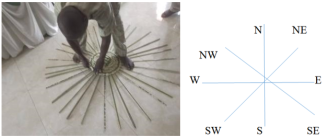
“The first process of arrangement of the 0.4 cm framework can be concretized to teach arithmetic progression. Arithmetic Progression (AP) is a sequence where the differences between every two consecutive terms are the same. For example in this weaving process, when the framework is arranged in fours and fives, after some weaving, it is rearranged to two-two. Further re-arrangement as weaving continues leads to single one. At this stage, the compass direction are found and requires the thought of mathematics or maths related skills. For high school students, there is a scene of arithmetic progression. When we start with the four–four 1.0 piece arrangement, after some weaving in between, it reduces to two-two and then one-one. It is when it is one-one, then it translates to the compass-like diagram”.
The cardinal or compass direction are denoted by NW, N, NE, E, E, SW, S, S, SE and the centre O. The NE, SE, SW and NW are intermediate or ordinal direction.
See below.
Figure 3. Cardinal and Intermediate Points of the Compass.
So the cardinal and ordinal directions can be explained concretely during the process of basket making. This makes learning fun. With this process also, misconceptions about clockwise and anticlockwise directions are explained and concertized. Learners can see, feel and touch learning objects on their own. This has the capacity to enable self-regulation that results in increased self-esteem. By this they optimize physical and mental aspects of learning. They own their learning process. When learners are out of the classroom, they tends to move around as well as communicate more to themselves in their mothers tongue. Learners is said to value their indigenous roots after hegemonic actions towards the indigenous peoples cultures. Learners are allowed to be creative and tends to create imagination learners get used to the experimentation process.
4.5. Symbolic and Philosophical
Cultural artefacts especially baskets are symbolic to indigenous people. This symbolic value has endeared indigenous people towards the cultural use of the relics. In this study, baskets also have cognitive value as learners become interested in engaging with science when basket is the core of the activity. As it relates to this paper, baskets became cognitive realia to teach science as cultural artefacts are employed by indigenous people from generations to another for different purposes. As basket were employed cognitively, learners became surprised and were eager to see what cognitive value may be inherent in basket making. Since learners were seen to have become successful in the task of making baskets, as since success begat success
| [27] | Ogunniyi, M. B. (2004). The challenge of preparing and equipping science teachers in higher education to integrate scientific and indigenous knowledge systems for learners: the practice of higher education. South African Journal of Higher Education, 18(3), 289-304. |
[27]
they were perceived to be able to accomplish other tasks of achieving science concepts. Beliefs of indigenous people affects positively or negatively how students understand science. Science can be influenced by the values and beliefs of the society. The classroom becomes a cognitive field where intersection of beliefs and values occur. A state of self-efficacy suggest the phrase “I can “ rather than being pessimistic as suggested by the word “maybe”. These beliefs and values were carefully deciphered and harnessed by the teacher hence, the teachers’ pedagogy should reflect the cultural beliefs in the context.
Philosophically, Africans tend to make sense of their past, present and future by making connections with nature metaphysically. The base of the basket is weaved together to achieve a solid structure, hence, as a philosophical statement, unity (togetherness) is needed for progress in any endeavour of the people. A solid basket has a solid background. This means that philosophically learners must have a solid background before growth can be achieved. These philosophical statements serve as motivation to the learners. When the baskets were being made with the learners present and some teachers, some of the other teachers told the learners some things in proverbs. They were to motivate them. From the processes of basket making, the teachers mentioned some philosophical statements. Some of the Yoruba language proverbs related to the use of baskets. One of the proverbs says that “you do not put all your eggs in a basket”. Another one is that “Ẹnikan o ni gbin alubosa ko wa ka ẹfọ, oun ti a ba gbin ni a ma ka”. (A person does not plant onions and harvest vegetable, whatever one sows, one will reap). Baskets are used for harvesting. These are philosophical sayings that tends to re-motivate learners who have lost focus on their goals. Another one is that “Owo kan o gbe eru de ori”. This means that no one can grow alone. This proverb emerged from the process of basket weaving. During the weaving process, no one weaves a basket till the end with a 0.1 cm piece. There will always be the need for another piece to be joined together with the last one used.




 Share This Article
 Twitter
 Linked In
 Facebook
 Copy
Copy Download