
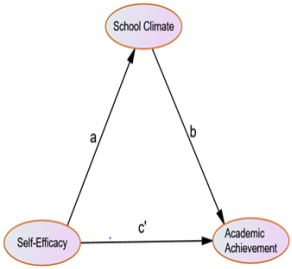
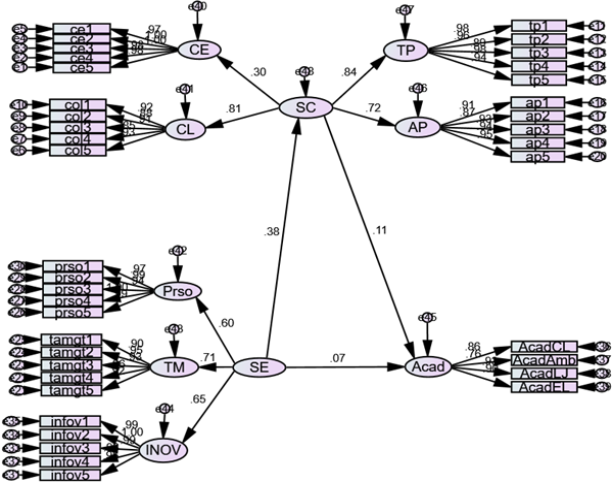
The study investigates the effect of school leaders’ self-efficacy on student academic achievement, while exploring the mediating role of school climate. By analyzing how school leaders’ confidence in their role provision shapes the school environment, and ultimately contributing in boosting student academic achievement. The study employed mixed design by applying AMOS version 23 and SPSS version 25 for data analysis with 235 determined sample using multi stage sampling method and interviews for addressing accountability challenges. The findings revealed that self-efficacy has a direct positive effect on student academic achievement (β = 0.07, p =.001), confirming Hypothesis H1. Leaders self-efficacy also significantly influenced school climate (β = 0.38, p =.001), supporting Hypothesis H2. School climate itself was found to be a significant predictor of student academic achievement (β = 0.11, p =.001), thereby confirming Hypothesis H3. Mediation analysis further demonstrated that school climate partially mediates the relationship between self-efficacy and student achievement, with an indirect effect of β = 0.56, p =.001. Again the results from interview guide found that accountability is compromised by political interference, resource deficiencies, diffusion of responsibility, and socio-economic pressures. Overall, the study underscores the critical role of school leaders’ self-efficacy in shaping positive school climates and driving student success. It highlights the importance of strengthening leadership capacities and accountability as a strategic approach to addressing the current persistent academic achievement decline in public secondary schools.
| Published in | Innovation Education (Volume 1, Issue 2) |
| DOI | 10.11648/j.iedu.20260102.16 |
| Page(s) | 128-141 |
| Creative Commons |
This is an Open Access article, distributed under the terms of the Creative Commons Attribution 4.0 International License (http://creativecommons.org/licenses/by/4.0/), which permits unrestricted use, distribution and reproduction in any medium or format, provided the original work is properly cited. |
| Copyright |
Copyright © The Author(s), 2026. Published by Science Publishing Group |
School Leaders, School Climate, Self-Efficacy, Effect
Item No | Construct to be Measured | Measurement Tools | Literature support |
|---|---|---|---|
1 | Self-Efficacy | Leadership Self-Efficacy Scale | Bandura, A. (1977), Luthans, F., & Youssef, C. M. (2007), Newman, A., et al. (2018), U.S. Department of Education, first developed 2016 and officially launched in 2017 |
2 | School climate | School Climate Survey(SCS) | Thapa, A., Cohen, J., Guffey, S., & Higgins-D’Alessandro, A. (2013), Gregory, A., et al. (2010) |
3 | Student Academic Achievement | Standardized Test Score/National Exam Test, GPA | Hattie, J. (2009) [13] , Woolfolk, A. (2016) |
Demographic Profile | Category | Frequency | Percent |
|---|---|---|---|
Gender | Male | 199 | 84.7 |
Female | 36 | 15.3 | |
Total | 235 | 100.0 | |
Age | 20-30 | 72 | 30.6 |
31-40 | 95 | 40.4 | |
above 41 | 68 | 28.9 | |
Total | 235 | 100.0 | |
Experience | 1-5 | 40 | 17.0 |
6-10 | 68 | 28.9 | |
11-15 | 49 | 20.9 | |
16-20 | 44 | 18.7 | |
above 21 | 34 | 14.5 | |
Total | 235 | 100.0 | |
Level of Education | Diploma | 13 | 5.5 |
BA/B.Sc. | 131 | 55.7 | |
MA/M.Sc. | 91 | 38.7 | |
Total | 235 | 100.0 |
Main Variables | Sub- Dimensions | Items | Mean | Std. Deviation |
|---|---|---|---|---|
SE | Problem solving (prso) μ=3.736 σ=.042 | prso5 | 3.745 | .042 |
prso4 | 3.745 | .042 | ||
prso3 | 3.715 | .043 | ||
prso2 | 3.745 | .042 | ||
prso1 | 3.728 | .042 | ||
Task management(tamgt) μ=3.623 σ=.043 | tamgt5 | 3.634 | .043 | |
tamgt4 | 3.613 | .044 | ||
tamgt3 | 3.617 | .043 | ||
tamgt2 | 3.609 | .044 | ||
tamgt1 | 3.643 | .043 | ||
Influence over (infov) μ=3.581 σ=.043 | infov5 | 3.591 | .043 | |
infov4 | 3.587 | .043 | ||
infov3 | 3.583 | .043 | ||
infov2 | 3.574 | .043 | ||
infov1 | 3.566 | .043 | ||
Academic press (ap) μ=3.770 σ=.054 | ap5 | 3.711 | .055 | |
ap4 | 3.757 | .056 | ||
ap3 | 3.791 | .053 | ||
ap2 | 3.813 | .055 | ||
ap1 | 3.779 | .055 | ||
SC | Collegial leadership (col) μ=3.709 σ=.052 | col5 | 3.715 | .053 |
col4 | 3.698 | .053 | ||
col3 | 3.711 | .053 | ||
col2 | 3.677 | .054 | ||
col1 | 3.745 | .051 | ||
Community engagement(Ce) μ=3.721 σ=.041 | ce5 | 3.711 | .041 | |
ce4 | 3.732 | .041 | ||
ce3 | 3.728 | .041 | ||
ce2 | 3.732 | .041 | ||
ce1 | 3.706 | .042 | ||
Teachers professionalism(tp) μ=3.638 σ=.055 | tp5 | 3.617 | .054 | |
tp4 | 3.613 | .055 | ||
tp3 | 3.706 | .055 | ||
tp2 | 3.651 | .055 | ||
tp1 | 3.604 | .055 | ||
AA | Academic Achievement (acad) μ=32.74 σ=.683 | Acad4 | 32.255 | .644 |
Acad3 | 32.740 | .679 | ||
Acad2 | 31.740 | .613 | ||
Acad1 | 34.243 | .796 |
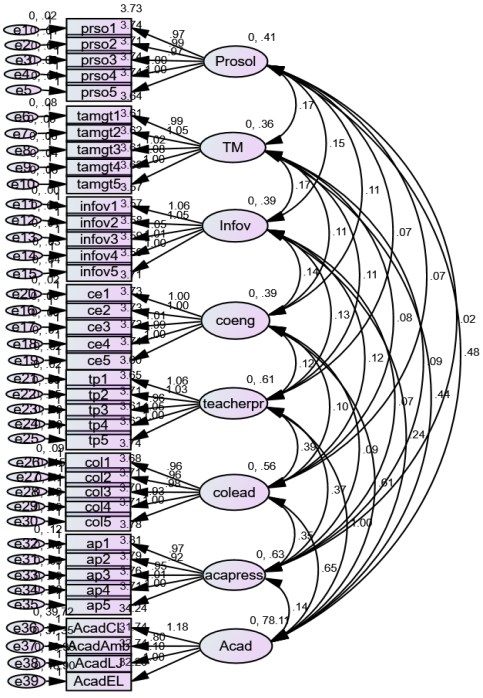
Main Variables in the construct | Factor Loading | Sub -Dimensions | Factor Loading | Items | Reliability |
|---|---|---|---|---|---|
Self-Efficacy (SE) | .60 | -->proso | .991 | -->prso5 | .991 |
.999 | -->prso4 | ||||
.939 | -->prso3 | ||||
.990 | -->prso2 | ||||
.972 | -->prso1 | ||||
.71 | -->tm | .923 | -->tamgt5 | .971 | |
.961 | -->tamgt4 | ||||
.934 | -->tamgt3 | ||||
.946 | -->tamgt2 | ||||
.899 | -->tamgt1 | ||||
.65 | -->infov | .952 | -->infov5 | .991 | |
.963 | -->infov4 | ||||
.986 | -->infov3 | ||||
.995 | -->infov2 | ||||
.995 | -->infov1 | ||||
School Climate(SC) | .50 | -->ce | .980 | -->ce5 | .988 |
.985 | -->ce4 | ||||
.999 | -->ce3 | ||||
.995 | -->ce2 | ||||
.975 | -->ce1 | ||||
.81 | -->cl | .931 | -->col5 | .984 | |
.854 | -->col4 | ||||
.910 | -->col3 | ||||
.880 | -->col2 | ||||
.920 | -->col1 | ||||
.84 | -->tp | .938 | -->tp5 | .992 | |
.978 | -->tp4 | ||||
.889 | -->tp3 | ||||
.958 | -->tp2 | ||||
.984 | -->tp1 | ||||
.72 | -->ap | .945 | -->ap5 | .990 | |
.936 | -->ap4 | ||||
.929 | -->ap3 | ||||
.867 | -->ap2 | ||||
.909 | -->ap1 | ||||
Academic achievement (AA) | .88 | -->acad | .897 | -->Acad4 | .974 |
.933 | -->Acad3 | ||||
.758 | -->Acad2 | ||||
.856 | -->Acad1 |
Sub-Dimensions | Indicators loadings | AVE | CR | TP | CE | Infov | CL | AP | TM | Proso | Acad |
|---|---|---|---|---|---|---|---|---|---|---|---|
TP | .889–.984 | 0.903 | 0.96 | 0.950 | |||||||
CE | .975–.999 | 0.974 | 0.99 | 0.45 | 0.987 | ||||||
Infov | .952–.995 | 0.957 | 0.98 | 0.38 | 0.42 | 0.978 | |||||
CL | .854–.931 | 0.809 | 0.93 | 0.39 | 0.41 | 0.42 | 0.899 | ||||
AP | .867–.945 | 0.842 | 0.95 | 0.40 | 0.43 | 0.41 | 0.44 | 0.917 | |||
TM | .899–.961 | 0.870 | 0.95 | 0.41 | 0.40 | 0.43 | 0.42 | 0.44 | 0.933 | ||
Proso | .939–.999 | 0.957 | 0.98 | 0.41 | 0.42 | 0.40 | 0.43 | 0.42 | 0.46 | 0.978 | |
Acad | .758–.933 | 0.746 | 0.91 | 0.36 | 0.40 | 0.36 | 0.41 | 0.43 | 0.42 | 0.47 | 0.864 |
Measures | Estimate | Threshold | Interpretation |
|---|---|---|---|
CMIN/DF/(χ²/df) | 1.779 | Between 1 and 3 | Excellent |
CFI | 0.969 | >0.95 | Excellent |
TLI | 0.966 | >0.95 | Excellent |
RMSEA | 0.058 | <0.06 | Excellent |
Description | Paths | Hypothesis | Effects | P- Values | Decision | Mediation type |
|---|---|---|---|---|---|---|
Direct effect | SE-->Acad | H1 | .07 | *** | Supported | Partial |
SE-->SC | H2 | .38 | *** | Supported | ||
SC-->Acad | H3 | .11 | *** | Supported | ||
Indirect pass | SE-->SC-->Acad | H4 | .56 | *** | Supported | |
Total Effect | DE+IE | .63 |
AMOS | Analysis of Moment Structure |
KII | Key Informant Interview |
SEM | Structural Equation Modeling |
| [1] | Abu-Bader, S., & Jones, T. V. (2025). Structural equation modeling: Principles, assumptions, and practical application using SPSS Amos. International Journal of Quantitative and Qualitative Research Methods, 13(1), 12–31. |
| [2] | Amsalu, A., & Belay, S. (2024). Analyzing the contribution of school climate to academic achievement using structural equation modeling. SAGE Open, 14(1), 1–11. |
| [3] | Arastaman, G., Bulus, M., Kontaş, H., & Özcan, B. (2024). Understanding the role of cognitive constructs employed in reading in global math and science achievement. Frontiers in Psychology, 15, 1470977. |
| [4] | Bandura, A. (1977). Self-efficacy: Toward a unifying theory of behavioral change. Psychological Review, 84(2), 191–215. |
| [5] | Bandura, A. (1986). Social foundations of thought and action: A social cognitive theory. Englewood Cliffs, NJ: Prentice-Hall. |
| [6] | Benawa, A. (2017). The role of school leadership in character building of students, African Educational Research Journal, 5(2), 82–87. |
| [7] | Chen, Y., & Jin, K. (2024). Educational performance prediction with random forest and innovative optimizers: A data mining approach. International Journal of Advanced Computer Science and Applications, 15(3), 45–52. |
| [8] | Creswell, J. W. (2014). Research design: Qualitative, quantitative, and mixed methods approaches (4th ed.). Thousand Oaks, CA: SAGE Publications. |
| [9] | Creswell, J. W., & Plano Clark, V. L. (2018). Designing and conducting mixed methods research (3rd ed.). Thousand Oaks, CA: SAGE Publications. |
| [10] | Field, A. (2013). Discovering statistics using IBM SPSS statistics (4th ed.). Thousand Oaks, CA: SAGE Publications. |
| [11] | Gottfried, M. A. (2010). Evaluating the relationship between student attendance and achievement in urban elementary and middle schools: An instrumental variables approach. American Educational Research Journal, 47(2), 434–465. |
| [12] | Gregory, A., et al. (2010). The relationship between school climate and academic achievement. Journal of Educational Psychology, 102(4), 859–866. |
| [13] | Hattie, J. (2009). Visible learning: A synthesis of over 800 meta-analyses relating to achievement. Routledge. |
| [14] | Hu, L. T., & Bentler, P. M. (1999). Cutoff criteria for fit indexes in covariance structure analysis: Conventional criteria versus new alternatives. Structural Equation Modeling, 6(1), 1–55. |
| [15] | Kline, R. B. (2023). Principles and practice of structural equation modeling (5th ed.). New York, NY: Guilford Press. |
| [16] | Kumar, R. (2019). Research methodology: A step-by-step guide for beginners (5th ed.). Thousand Oaks, CA: SAGE Publications. |
| [17] | Leithwood, K., & Riehl, C. (2003). What we know about successful school leadership. Philadelphia, PA: Laboratory for Student Success, Temple University. |
| [18] | Louis, K. S., & Wahlstrom, K. (2011). Principals as creators of productive school climate. Educational Administration Quarterly, 47(2), 235–275. |
| [19] | Marzano, R. J., Waters, T., & McNulty, B. A. (2005). School leadership that works: From research to results. Alexandria, VA. |
| [20] | Mohamad, M., Palani, K., Shanmuga Nathan, L., Sandhakumarin, Y., Rakhimova, I., & Ermetova, J. (2023). Educational challenges in the 21st century: A literature review. International Journal of Academic Research in Progressive Education and Development, 12(2), 1307–1314. |
| [21] | Mugenda, O. M., & Mugenda, A. G. (2003). Research methods: Quantitative and qualitative approaches. Nairobi, Kenya: Acts Press. |
| [22] | Petridou, A., Nicolaidou, M., & Williams, J. S. (2014). Development and validation of the school leaders’ self-efficacy scale. Journal of Educational Administration, 52(2), 228–253. |
| [23] | Preacher, K. J., & Hayes, A. F. (2004). SPSS and SAS procedures for estimating indirect effects in simple mediation models. Behavior Research Methods, Instruments, & Computers, 36(4), 717–731. |
| [24] | Röhl, A., Schmidt, L., & Weber, M. (2022). Digital transformation in higher education: A systematic review. International Journal of Educational Technology, 18(3), 45–62. |
| [25] | Salas, N., & Pascual, M. (2023). Impact of school SES on literacy development. PLOS ONE, 18(12), e0295606. |
| [26] | Schrik, P., & Wasonga, T. A. (2019). The role of a school leader in academic outcomes: Between self-efficacy and outcome expectations. International Journal of Educational Leadership and Management, 7(2), 120–145. |
| [27] | Schrik, P., & Wasonga, T. A. (2019). School leadership practices and student achievement: A comparative study. International Journal of Educational Leadership and Management, 7(2), 120–138. |
| [28] | Sila, A., Mutua, J., & Mwangi, P. (2023). School leadership practices and student achievement: Evidence from Kenyan secondary schools. International Journal of Educational Research, 120, 101–115. |
| [29] | Thapa, A., Cohen, J., Guffey, S., & Higgins-D’Alessandro, A. (2013). School climate research, policy, practice, and teacher education. Review of Educational Research, 83(3), 357–385. |
| [30] | Tschannen-Moran, M., & Barr, M. (2004). Fostering student learning: The relationship of collective teacher efficacy and student achievement. Leadership and Policy in Schools, 3(3), 189–209. |
APA Style
Abebe, M. N., Mamo, T. R., Geleta, M. W. (2026). A Mixed Methods Study of School Leaders’ Self-Efficacy, School Climate, Academic Achievement, and Accountability Challenges in Public Secondary Schools of West Shewa, Oromia, Ethiopia. Innovation Education, 1(2), 128-141. https://doi.org/10.11648/j.iedu.20260102.16
ACS Style
Abebe, M. N.; Mamo, T. R.; Geleta, M. W. A Mixed Methods Study of School Leaders’ Self-Efficacy, School Climate, Academic Achievement, and Accountability Challenges in Public Secondary Schools of West Shewa, Oromia, Ethiopia. Innov. Educ. 2026, 1(2), 128-141. doi: 10.11648/j.iedu.20260102.16
AMA Style
Abebe MN, Mamo TR, Geleta MW. A Mixed Methods Study of School Leaders’ Self-Efficacy, School Climate, Academic Achievement, and Accountability Challenges in Public Secondary Schools of West Shewa, Oromia, Ethiopia. Innov Educ. 2026;1(2):128-141. doi: 10.11648/j.iedu.20260102.16
@article{10.11648/j.iedu.20260102.16,
  author = {Mulu Negasa Abebe and Tadesse Regassa Mamo and Mulugeta Wende Geleta},
  title = {A Mixed Methods Study of School Leaders’ Self-Efficacy, School Climate, Academic Achievement, and Accountability Challenges in Public Secondary Schools of West Shewa, Oromia, Ethiopia},
  journal = {Innovation Education},
  volume = {1},
  number = {2},
  pages = {128-141},
  doi = {10.11648/j.iedu.20260102.16},
  url = {https://doi.org/10.11648/j.iedu.20260102.16},
  eprint = {https://article.sciencepublishinggroup.com/pdf/10.11648.j.iedu.20260102.16},
  abstract = {The study investigates the effect of school leaders’ self-efficacy on student academic achievement, while exploring the mediating role of school climate. By analyzing how school leaders’ confidence in their role provision shapes the school environment, and ultimately contributing in boosting student academic achievement. The study employed mixed design by applying AMOS version 23 and SPSS version 25 for data analysis with 235 determined sample using multi stage sampling method and interviews for addressing accountability challenges. The findings revealed that self-efficacy has a direct positive effect on student academic achievement (β = 0.07, p =.001), confirming Hypothesis H1. Leaders self-efficacy also significantly influenced school climate (β = 0.38, p =.001), supporting Hypothesis H2. School climate itself was found to be a significant predictor of student academic achievement (β = 0.11, p =.001), thereby confirming Hypothesis H3. Mediation analysis further demonstrated that school climate partially mediates the relationship between self-efficacy and student achievement, with an indirect effect of β = 0.56, p =.001. Again the results from interview guide found that accountability is compromised by political interference, resource deficiencies, diffusion of responsibility, and socio-economic pressures. Overall, the study underscores the critical role of school leaders’ self-efficacy in shaping positive school climates and driving student success. It highlights the importance of strengthening leadership capacities and accountability as a strategic approach to addressing the current persistent academic achievement decline in public secondary schools.},
 year = {2026}
}
TY  - JOUR
T1  - A Mixed Methods Study of School Leaders’ Self-Efficacy, School Climate, Academic Achievement, and Accountability Challenges in Public Secondary Schools of West Shewa, Oromia, Ethiopia
AU  - Mulu Negasa Abebe
AU  - Tadesse Regassa Mamo
AU  - Mulugeta Wende Geleta
Y1  - 2026/04/02
PY  - 2026
N1  - https://doi.org/10.11648/j.iedu.20260102.16
DO  - 10.11648/j.iedu.20260102.16
T2  - Innovation Education
JF  - Innovation Education
JO  - Innovation Education
SP  - 128
EP  - 141
PB  - Science Publishing Group
UR  - https://doi.org/10.11648/j.iedu.20260102.16
AB  - The study investigates the effect of school leaders’ self-efficacy on student academic achievement, while exploring the mediating role of school climate. By analyzing how school leaders’ confidence in their role provision shapes the school environment, and ultimately contributing in boosting student academic achievement. The study employed mixed design by applying AMOS version 23 and SPSS version 25 for data analysis with 235 determined sample using multi stage sampling method and interviews for addressing accountability challenges. The findings revealed that self-efficacy has a direct positive effect on student academic achievement (β = 0.07, p =.001), confirming Hypothesis H1. Leaders self-efficacy also significantly influenced school climate (β = 0.38, p =.001), supporting Hypothesis H2. School climate itself was found to be a significant predictor of student academic achievement (β = 0.11, p =.001), thereby confirming Hypothesis H3. Mediation analysis further demonstrated that school climate partially mediates the relationship between self-efficacy and student achievement, with an indirect effect of β = 0.56, p =.001. Again the results from interview guide found that accountability is compromised by political interference, resource deficiencies, diffusion of responsibility, and socio-economic pressures. Overall, the study underscores the critical role of school leaders’ self-efficacy in shaping positive school climates and driving student success. It highlights the importance of strengthening leadership capacities and accountability as a strategic approach to addressing the current persistent academic achievement decline in public secondary schools.
VL  - 1
IS  - 2
ER  -
Department of Educational Leadership & Policy, Ambo University, Ambo, Ethiopia
Department of Human Resource Management, Dambi Dollo University, Dambi Dollo, Ethiopia

Information



 Share This Article
 Twitter
 Linked In
 Facebook
 Copy
Copy Download