Research Article | | Peer-Reviewed

Optimizing Black Soldier Fly (Hermetia illucens L.) Larval Production Using Artisanal Ferment-Based Substrates

Received: 25 September 2026     Accepted: 12 October 2026     Published: 16 November 2026
Views:       Downloads:
Abstract

Large-scale production of black soldier fly (BSF) larvae offers a promising approach to reducing competition for raw materials between humans and livestock. Efficient BSF production requires nutrient-rich, low-cost substrates capable of supporting rapid larval growth. Fermentation and microbial inoculation can modify substrate quality, but the use of a low-cost artisanal ferment (rice-washing water fermented with milk and sugar) in fruit-waste substrates has not been evaluated. This study assessed the growth performance of black soldier fly larvae (Hermetia illucens L.; Diptera: Stratiomyidae) reared on spoiled-fruit substrates formulated with increasing levels (0-50%) of artisanal ferment, in comparison with a chicken-feed control (T0). A total of 10,584 six-day-old larvae were allocated in a completely randomized design to seven treatment groups (substrates), with 1,512 larvae per treatment and three replicates per treatment. Data were analyzed using one-way ANOVA and generalized linear models in R software, version 3.6.2. Chemical analysis showed that dry matter, total nitrogen, and total ash contents were significantly higher (p < 0.001) in the control substrate (T0; chicken feed), whereas gross energy content was highest in the 100% spoiled-fruit substrate (T1). Larval performance parameters, including developmental duration, final larval weight, substrate reduction index, survival rate, relative growth rate, and bioconversion rate, differed significantly among treatments (p < 0.001), with the highest overall performance observed in the control substrate (T0; development time 12 days, survival 89.63%, bioconversion rate 14.23%). Among the experimental substrates, T1 (100% spoiled fruit) showed the best overall performance (34 days, 80.73%, and 7.04%, respectively), whereas increasing the ferment proportion progressively reduced performance, with survival falling to about 33% at 40-50% ferment. Under the conditions of this study, the artisanal ferment therefore did not improve larval performance; however, these findings indicate that T1 (100% spoiled fruit) may be a viable low-cost alternative substrate for black soldier fly larval production.

Published in International Journal of Animal Science and Technology (Volume 10, Issue 4)
DOI 10.11648/j.ijast.20261004.12
Page(s) 103-113
Creative Commons

This is an Open Access article, distributed under the terms of the Creative Commons Attribution 4.0 International License (http://creativecommons.org/licenses/by/4.0/), which permits unrestricted use, distribution and reproduction in any medium or format, provided the original work is properly cited.

Copyright

Copyright © The Author(s), 2026. Published by Science Publishing Group

Keywords

Hermetia Illucens, Poultry Feed, Spoiled Fruit, Artisanal Ferment, Larval Production

1. Introduction
The continuous growth of the global human population has increased demand for protein and energy sources , contributing to the scarcity and rising cost of feed raw materials . In animal production, increasing raw-material prices may account for 60-70% of total production costs , partly because of competition between human and animal food systems. To address competition for protein resources, considerable research has focused on insect production and the use of insects in animal feed . Among edible insects, the black soldier fly (Hermetia illucens) has attracted considerable attention because of its tolerance of a wide range of environmental conditions and its cosmopolitan distribution . Importantly, black soldier flies can convert agro-industrial wastes and by-products into biomass rich in nutrients for animal feed .
Black soldier fly larvae can efficiently feed and develop on diverse organic waste streams, including dairy cattle manure , chicken manure , pig manure , human excreta , food waste , soybean curd residue , and municipal organic waste , thereby contributing to waste recycling and environmental sustainability .
Chemical analyses indicate that BSF larvae contain approximately 37-63% crude protein, 7-39% crude fat, and a broad spectrum of amino acids, including lysine (2-8%) and methionine (0.7-2%) . Numerous studies have demonstrated the successful incorporation of BSF larvae into animal diets, including poultry , fish , and pigs , with satisfactory production outcomes.
Successful BSF larval production requires careful management of several critical factors, among which substrate quality is particularly important . Substrate type can substantially affect both larval growth performance and the nutritional composition of BSF larvae . Furthermore, De Haas et al. and Barragán et al. reported that nutritionally rich substrates can shorten larval development time while increasing fat deposition and survival rates. Similarly, Meneguz et al. reported that BSF larvae fed brewery by-products reached the prepupal stage more rapidly and had higher protein contents than larvae fed mixtures of vegetables and fruit or winery by-products. Protein-rich substrates can support mass production of BSF larvae over shorter periods , whereas protein-deficient substrates may prolong the insect life cycle . However, protein-rich substrates may also increase ammonia emissions, raising environmental concerns . For large-scale, cost-effective production of substantial larval biomass, it is therefore important to identify low-cost substrates that provide adequate protein and energy.
Microbial activity in the substrate is another factor that can influence BSF performance. Inoculating poultry manure with companion bacteria modified larval growth and development , microbe-assisted conversion of rice straw and restaurant waste has been reported , and pre-fermentation of fibrous substrates such as maize straw and coconut endosperm has been used to improve bioconversion and nutrient yield ; the role of microbes in biowaste decomposition by BSF larvae has been reviewed by Gold et al. . However, these studies relied on defined bacterial inoculants or on pre-fermentation of the substrate itself, which can be difficult to implement in smallholder settings. Artisanal ferments prepared from rice-washing water are inexpensive, easy to produce, and known to harbor lactic acid bacteria , while spoiled fruit is available in large quantities at urban markets. To our knowledge, the effect of adding such an artisanal ferment to spoiled fruit at graded levels on BSF larval performance has not been evaluated, so it remains unknown whether the ferment improves or impairs larval growth, survival, and waste reduction. Addressing this gap is important for the development of low-cost, locally available substrates for BSF production.
In this context, the present study investigated the performance of black soldier fly larvae (Hermetia illucens L.; Diptera: Stratiomyidae) reared on spoiled-fruit substrates formulated with graded levels (0-50%) of an artisanal ferment, in comparison with a chicken-feed control. The study tested the hypothesis that adding the ferment would improve larval growth, survival, bioconversion, and substrate reduction relative to unfermented spoiled fruit, with the aim of identifying a low-cost substrate suitable for BSF larval production.
2. Materials and Methods
2.1. Acquisition of Black Soldier Fly Larvae
Black soldier fly larvae (Hermetia illucens L.; Diptera: Stratiomyidae) were obtained from colonies established in 2016 in the Agro-Eco-Health sector of the International Institute of Tropical Agriculture (IITA), Tanguieta, Benin. Egg clusters were collected following the method described by Sheppard et al. .
2.2. Preparation of the Ferment
One kilogram of rice was soaked in three litres of water for 1 h. The resulting rice-washing water was transferred to a plastic container and incubated in the dark for five days. After incubation, several layers formed; all layers except the bottom layer were collected and filtered through cotton into a clean container. The filtered solution was mixed with milk at a ratio of 1 L of solution to 3 L of milk, with each litre of milk prepared from 300 g of powdered milk. The mixture was incubated in the dark for another five days. At the end of this period, a cheese-like layer formed at the surface, a yellow layer developed beneath it, and a sediment accumulated at the bottom. All layers except the bottom layer were collected again using a cotton filter. The cheese-like layer was discarded, and the resulting yellow solution was used as the ferment. To prepare the final ferment solution, the collected ferment and 10 kg of sugar were added to a 1,000-L container. The container was filled to capacity with water, tightly closed, and left to ferment for three days in the dark before use in the experiment.
2.3. Characterization of the Artisanal Ferment
The artisanal ferment used in this study was produced according to the method described above, with minor adaptations based on previously published protocols. Its microbial characterization was based on Gram staining. A smear of the final ferment solution was Gram-stained and examined under a light microscope. Cell morphology and Gram reaction were interpreted by comparison with published descriptions of lactic acid bacteria isolated from fermented rice and rice-washing water (Table 1); the identification of Lactobacillus spp. is therefore presumptive, because no culture-based or molecular identification was performed.
Table 1. Gram staining test of the artisanal ferment.

Ferment

Gram staining result

References

Fermented rice starch + sugar + milk

Predominance of Gram-positive bacilli (Lactobacillus spp.)

Secondary flora: a few Gram-negative bacilli

2.4. Collection of Spoiled Fruit and Preparation of Substrates
Spoiled fruits were collected from “Dantokpa” Market in 100-kg barrels and transported by vehicle to the IITA. Upon arrival, the fruits were sorted by type. The batch consisted primarily of oranges (60%), pineapples (25%), watermelons (12%), and lemons (3%). All fruits were then combined and mechanically crushed using a grinder to obtain a homogeneous mixture. The crushed fruit mixture was subsequently stored in baskets for three days to reduce its water content through passive drainage.
After 72 h, the fruit mixture (oranges, pineapples, watermelons, and lemons) was mixed with the prepared ferment at proportions of 0%, 10%, 20%, 30%, 40%, and 50%, except for the chicken-feed control, which was diluted with water to achieve 60% moisture . Mixing was performed thoroughly with an aluminium spoon to ensure uniform distribution of the ferment throughout the substrate and to avoid localized differences in concentration. The resulting mixtures were tightly covered and allowed to ferment anaerobically for three days before use.
2.5. Experimental Design
Six-day-old larvae used in the experiment were obtained from a black soldier fly (Hermetia illucens) colony maintained in wooden cages measuring 2.83 m × 0.60 m × 2.20 m at IITA. During the larval growth phase, larvae were reared in containers measuring 10 cm × 5 cm × 2.3 cm, covered with netting secured with elastic bands and kept at ambient room temperature. The containers were placed on five-compartment shelving units, with each shelf compartment surrounded by boxes containing waste oil to prevent ant invasion. To ensure uniform access to nutrients, the substrate was mixed every two days.
Upon reaching the prepupal and pupal stages, as indicated by the development of a darkened cuticle, larvae were removed from the substrate using tweezers. They were transferred to plastic boxes containing 10 g of wood chips and covered with a layer of white mesh and an additional layer of black cloth, both secured with elastic bands. This setup provided darkness and facilitated adult emergence. Once flies began to emerge, the plastic boxes were transferred to adult breeding cages after a hole had been made in the center of the black cloth to allow the adults to escape.
The mating cages (45 cm × 44 cm × 58 cm) were equipped with mosquito netting on the sides and a glass top and were placed in a greenhouse to provide sunlight, which stimulates mating and oviposition. Each mating cage contained a container with 200 g of fermented palm-kernel meal mixed with water (60% moisture) to attract gravid females. Females laid eggs on corrugated-cardboard oviposition trays positioned above and separated from the substrate container by a mosquito net. The trays consisted of strips of corrugated cardboard secured with elastic bands at both ends.
The study employed a completely randomized design with seven treatments and three replicates. The composition of each treatment was as follows:
- T0 (control): poultry feed
- T1: 100% crushed spoiled fruit (0% artisanal ferment)
- T2: 90% crushed spoiled fruit + 10% artisanal ferment
- T3: 80% crushed spoiled fruit + 20% artisanal ferment
- T4: 70% crushed spoiled fruit + 30% artisanal ferment
- T5: 60% crushed spoiled fruit + 40% artisanal ferment
- T6: 50% crushed spoiled fruit + 50% artisanal ferment
Each treatment was tested in white plastic containers measuring 14 cm × 9 cm × 7 cm (126 cm2 surface area). Each container was covered with netting secured by elastic bands to prevent housefly infestation. A total of 10,584 six-day-old larvae were allocated to the containers at a density of 504 larvae per container (approximately 4 larvae/cm2) . Substrates were provided in three feedings throughout the experiment at a rate of 100 mg/larva/day over 15 days . Finally, all containers were randomly arranged on a board.
2.6. Analysis of Nutritional Value of Experimental Substrates
For each substrate, dry matter (DM), gross energy (GE), total nitrogen (TN), and total ash (TA) were determined. All analyses were performed according to the official methods of the Association of Official Analytical Chemists . Dry matter content was determined in accordance with ISO 1442 . After DM determination, the sample crucibles were ashed in a muffle furnace at 550°C for 6-7 h to determine total ash content. Total nitrogen was measured using the Kjeldahl method, and crude protein was calculated by multiplying the nitrogen content by a conversion factor of 6.25. Gross energy was determined using a bomb calorimeter.
2.7. Measurement of pH and Temperature
The initial pH and temperature of each substrate (before the introduction of larvae) were measured using an electronic pH meter-thermometer (model pH-B200EM, Infitek). The instrument was calibrated with a buffer solution at 20°C before measurement. Each sample was placed in a 50-mL beaker, and the electrode was fully immersed in the substrate. The pH and temperature were then measured and recorded.
2.8. Data Collection and Parameter Calculation
During the experiment, the following data were collected: initial number of larvae, initial substrate quantity, initial and final larval weights, number of recovered larvae, remaining substrate quantity, larval development time, number of prepupae, number of emerged adults, pupal development time, temperature, pH, and adult longevity. These data were used to calculate performance parameters according to the methods described by Meneguz et al. , Diener et al. , and Parra et al. .
Survival rate (%)=number of larvae harvested ×100Initial number of larvae
Substrate reduction rate (%)=substrate distributed-residual substrate×100substrate distributed 
Bioconversion rate (%) = Harvested larvae humid weight×100Initial weight of substrate 
Emergence rate (%) = Number of emerged fly×100Number of pupae 
Relative growth rate (%) = Final weight-Initial weightInitial weight×experimentation time
Substrate reduction index =(substrate distributed-residual substrate)×100substrate distributed×development time
2.9. Data Analysis
Data were analyzed using R software, version 3.6.2 . Prior to analysis, the normality of data distribution and homogeneity of variances were assessed using the Shapiro-Wilk test and Levene’s test, respectively. As the data satisfied the assumptions of normality and homoscedasticity, one-way analysis of variance (ANOVA) was performed to evaluate the effects of treatments on larval development time, initial weight, final larval weight, pupal weight, substrate reduction index, and adult longevity. For relative growth rate, bioconversion rate, emergence rate, survival rate, and substrate reduction rate, generalized linear models (GLMs) with a beta distribution were used. When significant differences were detected (p < 0.05), treatment means were separated using the Student-Newman-Keuls (SNK) multiple range test. The graphs were generated using GraphPad Prism software (version 8.0.0.288, released on 28 August 2021).
2.10. Ethical Considerations
This study was conducted in accordance with the institutional guidelines applicable to experimental work at the National Agricultural University (UNA), Benin. The protocol was approved by the relevant institutional ethics committee. All procedures involving black soldier fly larvae were conducted with appropriate care to minimize unnecessary stress or harm.
3. Results
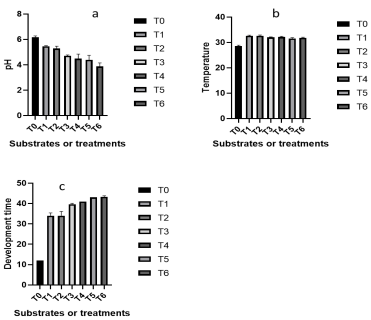
Figure 1 illustrates the effects of pH and substrate temperature on BSF production (Figure 1a and 1b), as well as the effect of artisanal ferment-based substrates on BSF larval development time (Figure 1c). The inclusion of artisanal ferment had a highly significant effect (p < 0.001) on the initial pH of the experimental substrates. The highest pH, approaching neutrality, was observed in the chicken-feed substrate (6.18 ± 0.09). Similarly, initial substrate temperature differed significantly among treatments (p < 0.005), with the highest temperatures recorded in substrates T1 and T2 (32.6 ± 0.28°C and 32.63 ± 0.32°C, respectively).
Figure 1. Influence of pH and substrate temperature on BSF production (Figure 1a and 1b) and effect of artisanal ferment-based substrates on BSF larval development time (Figure 1c).
Larval development time was significantly affected by substrate type (p < 0.001). Larvae fed chicken feed reached the prepupal stage in the shortest time (12 ± 0.00 days), whereas those reared on substrates T1 and T2 required significantly longer periods (34 ± 1 days).
Table 2 summarizes the effects of artisanal ferment-based substrates on substrate reduction rate, survival rate, bioconversion rate, emergence rate, and relative growth rate of BSF larvae. All five parameters differed significantly among substrates (p < 0.001). The substrate reduction rate was lowest in the chicken-feed substrate (77.39 ± 4.69%) and ranged from 90.82% to 95.87% in the fruit-based substrates (T1-T6). The survival rate was highest in larvae fed chicken feed (89.63 ± 1.09%), remained above 80% in T1-T3, decreased to 64.66 ± 0.65% in T4, and fell to about one-third in T5 and T6 (33.9 ± 1.65% and 33.4 ± 1.03%, respectively). The bioconversion rate was also highest in larvae receiving chicken feed (14.23 ± 0.86%) and declined from 7.04 ± 0.48% in T1 to 2.06 ± 0.27% in T6. Relative growth rate and emergence rate showed the same overall pattern, with the highest values recorded for the chicken-feed substrate (55.6 ± 11.43 and 96.66 ± 1.52%, respectively); among the fruit-based substrates, the emergence rate was highest in T1 (83.33 ± 3.21%).
Table 2. Effect of artisanal ferment-based substrates on substrate reduction rate, survival rate, bioconversion rate, emergence rate, and relative growth rate of BSF larvae.

Parameters

Treatments/substrates

P-Value

T0

T1

T2

T3

T4

T5

T6

SRR

77.39±4.69b

91.85±2.48a

92.81±2.8a

94.1±1.27a

95.87±1.23a

95.17±0.85a

90.82±3.1a

<0.001

BC

14.23±0.86a

7.04±0.48b

6.83±0.7b

6.07±1.09c

4.42±0.68d

2.71±0.16e

2.06±0.27f

<0.001

RGR

55.6±11.43a

15.59±3.32b

11.94±0.90c

11.14±0.68c

9.52±1.26d

9.72±1.43d

6.43±1.9e

<0.001

ER

96.66±1.52a

83.33±3.21b

60.66±1.15c

76.00±2.64d

67.33±3.05e

61.33±5.13f

71.66±1.52g

<0.001

SR

89.63±1.09a

80.73±2c

83.76±3.04b

80.16±0.76c

64.66±0.65d

33.9±1.65e

33.4±1.03e

<0.001

SRR = substrate reduction rate; SR = survival rate; BC = bioconversion rate; ER = emergence rate; RGR = relative growth rate; T0 = control substrate (chicken feed); T1 = 100% fruit; T2 = 90% fruit and 10% ferment; T3 = 80% fruit and 20% ferment; T4 = 70% fruit and 30% ferment; T5 = 60% fruit and 40% ferment; T6 = 50% fruit and 50% ferment. Values are means ± SD (n = 3). Means in the same row followed by different letters differ significantly (SNK test, p < 0.05).
Table 3 presents the weights of larvae and pupae, the substrate reduction index, and adult longevity. Initial mean larval weight and adult longevity did not differ significantly among treatments (p > 0.05). However, final larval weight and pupal weight differed highly significantly among treatments (p < 0.001), with the highest values recorded in the chicken-feed group (T0; 0.24 ± 0.018 g and 0.15 ± 0.01 g, respectively). In the fruit-based substrates, final larval weight ranged from 0.05 to 0.10 g and pupal weight from 0.04 to 0.06 g. In addition, the substrate reduction index was strongly affected by substrate type (p < 0.001), with the highest value observed in larvae fed chicken feed (6.44 ± 0.39), compared with 2.70 ± 0.06 in T1 and 2.09 ± 0.09 in T6.
Table 3. Effect of artisanal ferment-based substrates on final larval weight, adult longevity, substrate reduction index, and pupal weight.

Parameters

Treatments/substrates

P-Value

T0

T1

T2

T3

T4

T5

T6

Adult longevity (days)

7±1

7.33±0.57

7±0

7.33±0.57

6.66±1.52

9.33±2.08

8.66±3.21

0.409

Initial weight (g)

0.0003±4E-8

0.0002±1E-5

0.0003±4E-5

0.0002±1.9E-5

0.0002±3E-5

0.0003±3E-5

0.0003±1.5E-5

0.147

Final larval weight (g)

0.24±0.018a

0.05 ± 0.01

0.05 ± 0.02

0.05 ± 0.00

0.1±0.002bc

0.06 ± 0.00

0.09±0.015c

<0.001

Pupal weight (g)

0.15±0.01a

0.05±0.01b

0.05±0.02b

0.05±0.00b

0.04±0.01b

0.06±0.01b

0.06±0.00b

<0.001

SRI

6.44±0.39a

2.7±0.06b

2.73±0.13b

2.37±0.05c

2.33±0.03c

2.21±0.019c

2.09±0.09c

<0.001

Adult longevity = longevity of adult flies; SRI = substrate reduction index. Values are means ± SD (n = 3). Means in the same row followed by different letters differ significantly (SNK test, p < 0.05).
Table 4 presents the chemical composition of the experimental substrates. Chemical analysis indicated that dry matter, total nitrogen, and total ash contents were significantly higher (p < 0.001) in the chicken-feed substrate (T0; 93.67%, 25.24%, and 6.79%, respectively) than in the other substrates (10.5-17.5%, 3.33-6.65%, and 1.64-4.40%, respectively). These parameters also differed significantly among the experimental substrates (p < 0.001) and decreased progressively with increasing ferment inclusion. Gross energy content was highest in the 100% spoiled-fruit substrate (T1; 4380.05 kcal/kg DM), whereas the lowest gross energy value was recorded in substrate T6 (2101.02 kcal/kg DM); gross energy also decreased with increasing ferment inclusion and was lower in T0 (2455.58 kcal/kg DM) than in T1-T5.
Table 4. Chemical composition of the experimental substrates.

Parameters

Treatments/substrates

P-Value

T0

T1

T2

T3

T4

T5

T6

DM (%)

93.67±0.76a

17.5±1.32b

17±1bc

16.58±1.5bc

14.89±0.75c

12.5±0.5d

10.5±0.88e

<0.001

TN (%)

25.24±0.67a

6.65±1.88b

6.03±0.98b

5.96±0.05b

5.06±0.11bc

3.66±0.57c

3.33±0.57c

<0.001

GE (kcal/kg DM)

2455.58±1.4f

4380.05±1.95a

3888.04±0.98b

3439.04±0.97c

2966.03±0.95d

2530.03±0.95e

2101.02±0.97g

<0.001

TA (%)

6.79±1.11a

4.40±0.52b

3.06±0.95c

2.96±0.05c

2.30±0.51c

1.77±0.3d

1.64±0.76d

<0.001

DM = dry matter; TN = total nitrogen; GE = gross energy; TA = total ash. Values are means ± SD (n = 3). Means in the same row followed by different letters differ significantly (SNK test, p < 0.05).
4. Discussion
The results of this study showed that final larval weight and pupal weight were significantly higher in the control substrate (chicken feed). Among the fruit-based substrates, pupal weight did not differ significantly (0.04-0.06 g), and final larval weight (0.05-0.10 g) showed no consistent trend with the ferment level. The superior performance of the control may be attributable to the higher nitrogen and mineral contents of chicken feed (Table 4), as substrate quality is a key determinant of BSF larval growth performance . Protein-rich substrates, such as chicken feed, can promote rapid larval growth , which may explain the superior weight-related performance observed in the control group. In addition, insects must accumulate sufficient nutrient reserves to reach the critical weight required for successful metamorphosis , and both the quality and quantity of dietary substrate can positively influence larval weight across developmental stages . Nutrient intake is a further likely explanation. Because all substrates were supplied at the same rate (100 mg/larva/day), and assuming that this rate refers to fresh substrate, larvae in T0 (moistened to 60% moisture, i.e, about 40% dry matter) received about 40 mg of dry matter per day, compared with approximately 10.5-17.5 mg in the fruit-based substrates (dry matter contents in Table 4), i.e., a 2.3- to 3.8-fold lower dry-matter supply. Moreover, the fruit-based substrates combined a relatively high gross energy content with low nitrogen contents (3.33-6.65% versus 25.24% in T0). Such a carbohydrate-rich but protein-poor composition probably limited tissue growth, because larval performance depends on the balance between protein and carbohydrate and protein-deficient substrates prolong the life cycle . Our findings differ from those reported by Jucker et al. , Nyakeri et al. , and Liu et al. , who reported different responses in larvae reared on fruit waste, vegetable waste, and chicken feed, respectively.
Larval development time and adult emergence rate were both significantly improved in the control substrate (chicken feed). Among the alternative substrates, the 100% spoiled-fruit treatment showed the best performance. These differences may be related to nutrient availability and initial substrate pH. Diets rich in protein or energy generally accelerate insect development . The pH of the BSF midgut is buffered , and larvae reared on acidic substrates may increase substrate pH through digestive processes , potentially facilitating development. Ma et al. reported that substrates with an initial pH between 6.0 and 8.0 reduced development time, whereas pH values below 4.0 prolonged development. In the present study, the chicken-feed substrate had the highest initial pH (6.18; Figure 1a), whereas all fruit-based substrates were more acidic. In the latter, organic acids from the fruit and, probably, lactic acid and other metabolites produced during the three-day anaerobic fermentation of the substrates may have forced the larvae to spend time and energy buffering their environment before feeding efficiently, which may partly explain the longer development on fruit-based substrates. However, because the ferment and the fermented substrates were not characterized for organic acids, this interpretation remains to be tested. In the present study, larval development time was 12 days on chicken feed and 34 days on the 100% spoiled-fruit substrate. The development time on chicken feed was shorter than those reported by Gobbi et al. , Tariq et al. , and Oonincx et al. for chicken-feed diets (15-24 days), as well as those reported by Jucker et al. , Mohd et al. , and Tinder et al. for vegetable- and fruit-waste diets, whereas the 34 days observed on spoiled fruit exceeded the chicken-feed values, confirming that the fruit-based substrates strongly delayed development. Differences among studies may result from variation in substrate composition and texture , as well as feeding rate and larval density . The emergence rates observed in the present study (60.66-96.66%) were higher than that reported by Sheppard et al. for the Gainesville diet (27.2 ± 6.7%), and the emergence rates in T0, T1, T3, T4, and T6 were also higher than that reported by Jucker et al. for fruit and vegetable mixtures (63.55 ± 3.76%).
Survival rates were also significantly higher in the control substrate. In contrast, much lower survival rates were observed in substrates containing high proportions of artisanal ferment (40% and 50% in T5 and T6, respectively: 33.9 ± 1.65% and 33.4 ± 1.03%). These survival rates were lower than those reported by Gao et al. for larvae fed fermented maize straw (93 ± 1%) and by Jucker et al. , whose survival rates ranged from 88.67 ± 6.12% to 96.44 ± 2.62%. The reduced survival observed in T5 and T6 may be related to excessive substrate moisture, which can negatively affect larval survival . The dry matter contents of T5 and T6 (12.5% and 10.5%; Table 4) correspond to moisture contents of about 87.5% and 89.5%, far above the 60% moisture used for the control . Such wet substrates tend to become liquid and poorly aerated, which limits oxygen availability and may cause larvae to drown or to be stressed, and Lowet reported that at substrate moisture levels as high as 97.5%, survival rates could decrease to 19.5%. In addition, higher ferment proportions probably increased the concentration of organic acids and other microbial metabolites in the tightly closed, anaerobically fermented substrates, which may also have impaired larval survival; this could not be verified because these compounds were not measured.
Finally, both the bioconversion rate and substrate reduction index were significantly higher in the control substrate. These parameters are important indicators of larval production efficiency, particularly when lower-quality substrates are used, and may contribute to environmental benefits through organic-waste reduction and the generation of nutrient-rich residues . The higher substrate reduction index in T0 mainly reflects its shorter development time (12 days versus 34 days or more), because this index relates the reduction achieved to the duration of the trial; indeed, the substrate reduction rate itself was lower in T0 (77.39%) than in the fruit-based substrates (90.82-95.87%). The high reduction rates in the fruit-based substrates probably include water loss by drainage and evaporation and microbial degradation of the highly moist, fermentable fruit, in addition to larval consumption, so reduction rates calculated on a fresh-weight basis should be interpreted with caution when substrates differ markedly in moisture. The decline in the bioconversion rate with increasing ferment inclusion (from 7.04% in T1 to 2.06% in T6) parallels the decline in dry matter, nitrogen, ash, and gross energy contents (Table 4). Notably, the bioconversion rates observed for T1, T2, and T3 (7.04%, 6.83%, and 6.07%, respectively) were higher than those reported by Miranda et al. for BSF larvae reared on pig and dairy-cow manure substrates.
Overall, the graded inclusion of the artisanal ferment did not improve larval performance relative to unfermented spoiled fruit (T1): the bioconversion rate, relative growth rate, substrate reduction index, survival rate, and emergence rate all tended to decline as the ferment proportion increased. Three mechanisms may explain this pattern. First, dilution: the ferment is an aqueous solution that supplied sugar and microbial cells but few other nutrients, so each increment reduced the dry matter, nitrogen, ash, and gross energy contents per unit of fresh substrate (Table 4) and therefore the nutrients available to the larvae at a fixed feeding rate. Second, increased moisture and anaerobic conditions, as discussed above. Third, the microbial benefits reported for fermented substrates concern the pre-digestion of fibrous, poorly digestible materials such as maize straw or coconut endosperm; spoiled fruit is already rich in simple sugars, so pre-fermentation may offer little nutritional advantage, and the lactic acid bacteria may instead convert part of these sugars into organic acids, lowering the pH of the substrate. In addition, the citrus fruits that dominated the fruit mixture (oranges and lemons, 63%) may have contributed acidity and bioactive peel compounds that could affect larvae; this was not tested.
This study has limitations that should be considered when interpreting the results. The ferment was characterized by Gram staining only; its pH, titratable acidity, microbial counts, and organic-acid profile were not determined, and the microbial composition of the substrates was not monitored during the trial. Substrate moisture was derived from dry matter rather than measured at each feeding, the nutritional composition of the larvae produced was not analyzed, and the trial was conducted at a single site with three replicates per treatment. These aspects should be addressed in future work.
5. Conclusion
This study demonstrated that the control substrate (T0; chicken feed) produced the highest overall BSF larval growth and development performance (12-day development, 89.63% survival, 14.23% bioconversion rate, and 0.24 g final larval weight). Among the experimental substrates, 100% spoiled fruit (T1) gave the best results (34-day development, 80.73% survival, and 7.04% bioconversion rate), whereas increasing the proportion of artisanal ferment progressively reduced the bioconversion rate, relative growth rate, substrate reduction index, and survival rate, the latter falling to about 33% at 40-50% ferment. Under the conditions of this study, the artisanal ferment therefore did not improve larval performance. However, from an environmental-sustainability and waste-recycling perspective, substrate T1 (100% spoiled fruit) represents a potential low-cost alternative. The use of spoiled fruit as a rearing substrate can support BSF production while contributing to the recycling of organic waste and potentially reducing reliance on conventional feed substrates, provided that its slower larval development is taken into account.
6. Recommendations
Further research should (i) characterize the ferment (pH, titratable acidity, lactic acid bacteria counts, and organic acids) and test lower inclusion levels (below 10%) or drained substrates so that moisture is controlled; (ii) compare substrates at equal dry-matter and nutrient supply rather than at equal fresh-matter rates; (iii) evaluate spoiled fruit combined with protein-rich co-substrates to correct its nitrogen deficiency; (iv) analyze the proximate, amino acid, and fatty acid composition of the larvae produced and the economic cost of each substrate; and (v) validate the best substrates at larger scale while recording environmental conditions (temperature, relative humidity, and photoperiod).
Abbreviations

CERSA

Regional Center of Excellence on Poultry Sciences

UNA

National Agricultural University

FSA

Faculty of Agronomic Sciences

ISSMV

Higher Institute of Sciences and Veterinary Medicine

BSF

Black Soldier Fly

IITA

International Institute of Tropical Agriculture

DM

Dry Matter

GE

Gross Energy

TN

Total Nitrogen

TA

Total Ash

SRR

Substrate Reduction Rate

SRI

Substrate Reduction Index

BC

Bioconversion Rate

RGR

Relative Growth Rate

ER

Emergence Rate

SR

Survival Rate

ANOVA

Analysis of Variance

GLM

Generalized Linear Model

SNK

Student-Newman-Keuls

SD

Standard Deviation

Acknowledgments
The authors thank the National Agricultural University (UNA), Benin, for providing the resources used in this research.
Author Contributions
Bruno Dossou Sodjinou: Conceptualization, Data curation, Formal Analysis, Methodology, Resources, Software, writing original draft, Writing – review & editing
Spero Koba Ulrich Edikou: Conceptualization, Formal Analysis, Methodology, Software, Writing – original draft
Joseph Okpeolouwa Bamitefa: Conceptualization, Investigation, Methodology
Doha Yetongnon Awohouedji: Methodology, Supervision, Writing original draft
Razacki Osse: Methodology, Supervision, Writing – original draft
Frederic Mankpondji Houndonougbo: Methodology, Supervision, Validation
Data Availability Statement
The datasets generated and/or analyzed during the current study are available from the corresponding author on reasonable request.
Conflicts of interest
The authors declare that they have no conflict of interest.
References
[1] Abidin Z., Rusmini L. M., Hidayat N., Mentari S. D., Prima D. (2023). Isolation and Characterization Of Lactic Acid Bacteria From Rice Washing Water Waste. International Journal of Science, 184-191.
[2] Amanullah S. M., Kabir M. A., Rahman M. M., Halder P., Hossain S. M. J., Samad M. A. (2020). Isolation, identification and biochemical characterization of lactic acid bacteria from selected yogurt samples. Bang. J. Livs. Res., 27 (1&2), 64-72.
[3] AOAC (1995). Official Methods of Analysis of AOAC International, 16th ed., edited by P. Cunniff. AOAC International, Arlington, Virginia, USA: Association of Official Analytical Chemists.
[4] Attivi K., Mlaga K. G., Agboka K., Kouame Y. A. E., Tona K., Lin, H. (2022). Effect of fish meal replacement by black Soldier Fly (Hermetia illucens) larvae meal on serum biochemical indices, thyroid hormone and zootechnical performance of laying chickens. J. Appl. Poult. Res., 31: 100275
[5] Banks I. J., Gibson W. T., Cameron M. M. (2014). Growth rates of black soldier fly larvae fed on fresh human faeces and their implication for improving sanitation. Trop. Med. Int. Heal., 19, 14-22.
[6] Barragán-Fonseca K. B., Dicke M., van Loon J. J. A. (2017). Nutritional value of the black soldier fly (Hermetia illucens L.) and its suitability as animal feed - a review. Journal of Insects as Food and Feed, 3(2), 105-120.
[7] Barragán F. K., Pineda-Mejia J., Dicke M., van Loon J. J. A. (2018). Performance of the Black Soldier Fly (Diptera: Stratiomyidae) on Vegetable Residue-Based Diets Formulated Based on Protein and Carbohydrate Contents. Journal of Economic Entomology, 111(6), 2676-2683
[8] Barrantes S. L. V., Cuesta-Parra D. M., Correa-Mahecha F., García-Trejo J. F. (2024). Nutritional Content of Black Soldier Fly Larvae Achieved during Biotransformation of Organic Wastes. Chemical engineering transactions; 110: 385-390
[9] Caruso D., Devic E., Subamia I., Talamond P., Baras E. (2014). Technical handbook of domestication and production of Diptera black soldier fly (BSF), Hermetia illucens, Stratiomyidae. IRD, Jakarta, Indonesia, 141 pp.
[10] De Carvalho M. J. A., Mirth C. K. (2017). Food intake and food choice are altered by the developmental transition at critical weight in Drosophila melanogaster. Animal Behaviour, 126: 195-208.
[11] De Haas E. M., Wagner C., Koelmans A. A., Kraak M. H., Admiraal W. I. M. (2006). Habitat selection by chironomid larvae: fast growth requires fast food. Journal of Animal Ecology, 75(1): 148-155.
[12] Diener S., Zurbrügg C., Tockner K. (2009). Conversion of organic material by black soldier fly larvae: establishing optimal feeding rates. Waste Manag. Res., 27, 603-610.
[13] Diener S., Studt S. N. M., Gutiérrez F. R., Zurbrügg C., Tockner K. (2011). Biological treatment of municipal organic waste using black soldier fly larvae. Waste and Biomass Valorization. 2, 357-363.
[14] Dzepe D., Nana P., Fotso A., Tchuinkam T., Djouaka R. (2020). Influence of larval density, substrate moisture content and feedstock ratio on life history traits of black soldier fly larvae. Journal of Insects as Food Feed, 6(2): 133-140.
[15] Gao Z., Wang W., Lu X., Zhu F., Liu W., Wang X., Lei C. (2019). Bioconversion performance and life table of black soldier fly (Hermetia illucens) on fermented maize straw. Journal of Cleaner Production; 230: 974-980.
[16] Gobbi P., Martinez-Sanchez A., Rojo S. (2013). The effects of larval diet on adult life history traits of the black soldier fly, Hermetia illucens (Diptera: Stratiomyidae). Eur. J. Entomol., 110, 461-468.
[17] Gold M., Tomberlin J. K., Diener S., Zurbrügg C., Mathys A. (2018). Decomposition of biowaste macronutrients, microbes, and chemicals in black soldier fly larval treatment: A review. Waste Management, 82: 302-318.
[18] ISO (International Organization for Standardization). (1973). Meat and meat products—Determination of moisture content (ISO 1442: 1973). Geneva, Switzerland: International Organization for Standardization.
[19] Jeygowri N., Parahitiyawa N., Jeyatilake S., Ranadheera S., Madhujith T. (2015). Study on Isolation of Potentially Probiotic Lactobacillus species from Fermented Rice. Tropical Agricultural Research, 26 (3): 428 - 440.
[20] Jucker C., Erba D., Leonardi M. G., Lupi D., Savoldelli S. (2017). Assessment of vegetable and fruit substrates as potential rearing media for Hermetia illucens (Diptera: Stratiomyidae) larvae. Environ. Entomol, 46, 1415-1423.
[21] Lalander C. H., Fidjeland J., Diener S., Eriksson Vanneras B. (2015). High waste-to-biomass conversion and efficient Salmonella spp reduction using black soldier fly for waste recycling. Agronomy of Sustainable Development, 35(1): 261-271.
[22] Li Q., Zheng L., Qiu N., Cai H., Tomberlin J. K., Yu Z. (2011). Bioconversion of dairy manure by black soldier fly (Diptera: Stratiomyidae) for biodiesel and sugar production. Waste Manag., 31, 1316-1320.
[23] Liu X., Chen X., Wang H., Yang Q., Rehman K., Li W., Cai M., Li Q., Mazza L., Zhang J., Yu Z., Zheng L. (2017). Dynamic changes of nutrient composition throughout the entire life cycle of black soldier fly. PLoS ONE 12(8): e0182601.
[24] Lock E., Arsiwalla T., Waagbo R. (2015). Insect larvae meal as an alternative source of nutrients in the diet of Atlantic salmon (Salmo salar) postsmolt. Aquaculture Nutrition; 22: 1202-1213.
[25] Lohri C. R., Diener S., Zabaleta I., Mertenat A., Zurbrügg C. (2017). Treatment technologies for urban solid biowaste to create value products: A review with focus on low- and middle-income settings. Reviews in Environmental Science and Biotechnology, 16(1), 81-130.
[26] Lowet F. (2021). Optimisation of the maintenance of abiotic conditions in Hermetia illucens rearing by an automated stirring and monitoring system [in French]. Master’s thesis in bioengineering, Environmental Science and Technology, University of Liege. 74p.
[27] Ma J., Lei Y., Rehman K. U., Yu Z., Zhang J., Li W., Li Q., Tomberlin J. K., Zheng L. (2018). Dynamic effects of initial pH of substrate on biological growth and metamorphosis of black soldier fly (Diptera: Stratiomyidae). Environmental Entomology, 47(1), 159-165.
[28] Makkar H. P., Tran G., Heuzé V., Ankers P. (2014). State-of-the-art on use of insects as animal feed. Animal Feed Science and Technology, 197: 1-33.
[29] Meneguz M., Schiavone A., Gai F., Dama A., Lussiana C., Renna M., Gasco L. (2018). Effect of rearing substrate on growth performance, waste reduction efficiency and chemical composition of black soldier fly (Hermetia illucens) larvae. Journal of the Science of Food and Agriculture, 98: 5776-5784.
[30] Miranda C. D., Cammack J. A., Tomberlin J. K. (2019). Life-History Traits of the Black Soldier Fly, Hermetia illucens (L.) (Diptera: Stratiomyidae), Reared on Three Manure Types. Animals, 9, 281;
[31] Mohd N. S. N., Wong C. Y., Lim J. W., Mah-Hussin M. I. A., Uemura Y., Lam M. K., Ramli A., Bashir M. J. K., Tham L. (2017). Optimization of self-fermented period of waste coconut endosperm destined to feed black soldier fly larvae in enhancing the lipid and protein yields. Renew. Energy, 111.
[32] Myers H. M., Tomberlin J. K., Lambert B. D., Kattes D. (2008). Development of black soldier fly (Diptera: Stratiomyidae) larvae fed dairy manure. Environ. Entomol., 37, 11-15.
[33] Newton L., Sheppard C., Watson D. W., Burtle G. (2005). Using the black soldier fly, Hermetia illucens, as a value-added tool for the management of swine manure. Report for Mike Williams, Director of the Animal and Poultry Waste Management Centre, North Carolina State University, Raleigh, NC, USA. Available at:
[34] Nijhout H. F. (2003). The control of body size in insects. Developmental Biology, 261(1), 1-9
[35] Nworgu F. C., Alikwe P. C. N., Egbunike G. N., Ohimain E. I. (2015). Economic importance and growth rate of broiler chickens fed with water leaf (Talinum triangulare) meal supplements. AJAEES, 4(1): 49-57.
[36] Nyakeri E. M., Ogola H. J., Ayieko M. A., Amimo F. A. (2017). An open system for farming black soldier fly larvae as a source of proteins for smallscale poultry and fish production. J. Insects as Food Feed 3, 51-56.
[37] Oonincx D. G. A. B., Van Broekhoven S., Van Huis A., Van Loon J. J. A. (2015). Feed conversion, survival and development, and composition of four insect species on diets composed of food by-products. PLoS One 10, e0144601.
[38] Parra P. A. S., Carrejo N. S., Rodriguez C. H. G. (2015). Effects of Larval Density and Feeding Rates on the Bioconversion of Vegetable Waste Using Black Soldier Fly Larvae Hermetia illucens (L.), (Diptera: Stratiomyidae). Waste and Biomass Valorization, 6: 1059-1065.
[39] R Core Team (2019). R: A language and environment for statistical computing. R Foundation for Statistical Computing, Vienna, Austria.
[40] Rehman K. U., Rehman A., Cai M., Zheng L., Xiao X., Somroo A. A., Wang H., Li W., Yu Z., Zhang J. (2017). Conversion of mixtures of dairy manure and soybean curd residue by black soldier fly larvae (Hermetia illucens L.). J. Clean. Prod., 154, 366 373.
[41] Sheppard D. C., Tomberlin J. K., Joyce J. A., Kiser B. C., Sumner S. M. (2002). Rearing methods for the black soldier fly (Diptera: Stratiomyidae). Journal of medical entomology, 39(4): 695-698.
[42] Smetana S., Palanisamy M., Mathys A., Heinz V. (2016). Sustainability of insect use for feed and food: Life Cycle Assessment perspective. J. Clean. Prod., 137, 741 751.
[43] Tariq M. R., Liu S. Wang F., Wang H., Mo Q., Zhuang M., Zheng C., Liang Y., Liu Y., Rehman K., Helvaci M., Qin J., Li Chengpeng L. (2025). Black Soldier Fly: A Keystone Species for the Future of Sustainable Waste Management and Nutritional Resource Development: A Review. Insects 2025, 16, 750.
[44] Tinder A. C., Puckett R. T., Turner N. D., Cammack J. A., Tomberlin J. K. (2017). Bioconversion of sorghum and cowpea by black soldier fly (Hermetia illucens (L.)) larvae for alternative protein production. J. Insects Food Feed., 3, 121 130.
[45] Yu G., Cheng P., Chen Y. Y., Li Y., Yang Z., Chen Y. Y., Tomberlin J. K. (2011). Inoculating poultry manure with companion bacteria influences growth and development of black soldier fly (Diptera: Stratiomyidae) larvae. Environ. Entomol., 40, 30-35.
[46] Zheng L., Hou Y., Li W., Yang S., Li Q., Yu Z. (2012). Biodiesel production from rice straw and restaurant waste employing black soldier fly assisted by microbes. Energy, 47, 225-229.
[47] Zhou F., Tomberlin J. K., Zheng L., Yu Z., Zhang J. (2013). Developmental and waste reduction plasticity of three black soldier fly strains (Diptera: Stratiomyidae) raised on different livestock manures. J. Med. Entomol., 50, 1224-1230.
Cite This Article
  • APA Style

    Sodjinou, B. D., Edikou, S. K. U., Bamitefa, J. O., Awohouedji, D. Y., Osse, R., et al. (2026). Optimizing Black Soldier Fly (Hermetia illucens L.) Larval Production Using Artisanal Ferment-Based Substrates. International Journal of Animal Science and Technology, 10(4), 103-113. https://doi.org/10.11648/j.ijast.20261004.12

    Copy | Download

    ACS Style

    Sodjinou, B. D.; Edikou, S. K. U.; Bamitefa, J. O.; Awohouedji, D. Y.; Osse, R., et al. Optimizing Black Soldier Fly (Hermetia illucens L.) Larval Production Using Artisanal Ferment-Based Substrates. Int. J. Anim. Sci. Technol. 2026, 10(4), 103-113. doi: 10.11648/j.ijast.20261004.12

    Copy | Download

    AMA Style

    Sodjinou BD, Edikou SKU, Bamitefa JO, Awohouedji DY, Osse R, et al. Optimizing Black Soldier Fly (Hermetia illucens L.) Larval Production Using Artisanal Ferment-Based Substrates. Int J Anim Sci Technol. 2026;10(4):103-113. doi: 10.11648/j.ijast.20261004.12

    Copy | Download

  • @article{10.11648/j.ijast.20261004.12,
      author = {Bruno Dossou Sodjinou and Spero Koba Ulrich Edikou and Joseph Okpeolouwa Bamitefa and Doha Yetongnon Awohouedji and Razacki Osse and Frederic Mankpondji Houndonougbo},
      title = {Optimizing Black Soldier Fly (Hermetia illucens L.) Larval Production Using Artisanal Ferment-Based Substrates},
      journal = {International Journal of Animal Science and Technology},
      volume = {10},
      number = {4},
      pages = {103-113},
      doi = {10.11648/j.ijast.20261004.12},
      url = {https://doi.org/10.11648/j.ijast.20261004.12},
      eprint = {https://article.sciencepublishinggroup.com/pdf/10.11648.j.ijast.20261004.12},
      abstract = {Large-scale production of black soldier fly (BSF) larvae offers a promising approach to reducing competition for raw materials between humans and livestock. Efficient BSF production requires nutrient-rich, low-cost substrates capable of supporting rapid larval growth. Fermentation and microbial inoculation can modify substrate quality, but the use of a low-cost artisanal ferment (rice-washing water fermented with milk and sugar) in fruit-waste substrates has not been evaluated. This study assessed the growth performance of black soldier fly larvae (Hermetia illucens L.; Diptera: Stratiomyidae) reared on spoiled-fruit substrates formulated with increasing levels (0-50%) of artisanal ferment, in comparison with a chicken-feed control (T0). A total of 10,584 six-day-old larvae were allocated in a completely randomized design to seven treatment groups (substrates), with 1,512 larvae per treatment and three replicates per treatment. Data were analyzed using one-way ANOVA and generalized linear models in R software, version 3.6.2. Chemical analysis showed that dry matter, total nitrogen, and total ash contents were significantly higher (p < 0.001) in the control substrate (T0; chicken feed), whereas gross energy content was highest in the 100% spoiled-fruit substrate (T1). Larval performance parameters, including developmental duration, final larval weight, substrate reduction index, survival rate, relative growth rate, and bioconversion rate, differed significantly among treatments (p < 0.001), with the highest overall performance observed in the control substrate (T0; development time 12 days, survival 89.63%, bioconversion rate 14.23%). Among the experimental substrates, T1 (100% spoiled fruit) showed the best overall performance (34 days, 80.73%, and 7.04%, respectively), whereas increasing the ferment proportion progressively reduced performance, with survival falling to about 33% at 40-50% ferment. Under the conditions of this study, the artisanal ferment therefore did not improve larval performance; however, these findings indicate that T1 (100% spoiled fruit) may be a viable low-cost alternative substrate for black soldier fly larval production.},
     year = {2026}
    }
    

    Copy | Download

  • TY  - JOUR
    T1  - Optimizing Black Soldier Fly (Hermetia illucens L.) Larval Production Using Artisanal Ferment-Based Substrates
    AU  - Bruno Dossou Sodjinou
    AU  - Spero Koba Ulrich Edikou
    AU  - Joseph Okpeolouwa Bamitefa
    AU  - Doha Yetongnon Awohouedji
    AU  - Razacki Osse
    AU  - Frederic Mankpondji Houndonougbo
    Y1  - 2026/11/16
    PY  - 2026
    N1  - https://doi.org/10.11648/j.ijast.20261004.12
    DO  - 10.11648/j.ijast.20261004.12
    T2  - International Journal of Animal Science and Technology
    JF  - International Journal of Animal Science and Technology
    JO  - International Journal of Animal Science and Technology
    SP  - 103
    EP  - 113
    PB  - Science Publishing Group
    SN  - 2640-1312
    UR  - https://doi.org/10.11648/j.ijast.20261004.12
    AB  - Large-scale production of black soldier fly (BSF) larvae offers a promising approach to reducing competition for raw materials between humans and livestock. Efficient BSF production requires nutrient-rich, low-cost substrates capable of supporting rapid larval growth. Fermentation and microbial inoculation can modify substrate quality, but the use of a low-cost artisanal ferment (rice-washing water fermented with milk and sugar) in fruit-waste substrates has not been evaluated. This study assessed the growth performance of black soldier fly larvae (Hermetia illucens L.; Diptera: Stratiomyidae) reared on spoiled-fruit substrates formulated with increasing levels (0-50%) of artisanal ferment, in comparison with a chicken-feed control (T0). A total of 10,584 six-day-old larvae were allocated in a completely randomized design to seven treatment groups (substrates), with 1,512 larvae per treatment and three replicates per treatment. Data were analyzed using one-way ANOVA and generalized linear models in R software, version 3.6.2. Chemical analysis showed that dry matter, total nitrogen, and total ash contents were significantly higher (p < 0.001) in the control substrate (T0; chicken feed), whereas gross energy content was highest in the 100% spoiled-fruit substrate (T1). Larval performance parameters, including developmental duration, final larval weight, substrate reduction index, survival rate, relative growth rate, and bioconversion rate, differed significantly among treatments (p < 0.001), with the highest overall performance observed in the control substrate (T0; development time 12 days, survival 89.63%, bioconversion rate 14.23%). Among the experimental substrates, T1 (100% spoiled fruit) showed the best overall performance (34 days, 80.73%, and 7.04%, respectively), whereas increasing the ferment proportion progressively reduced performance, with survival falling to about 33% at 40-50% ferment. Under the conditions of this study, the artisanal ferment therefore did not improve larval performance; however, these findings indicate that T1 (100% spoiled fruit) may be a viable low-cost alternative substrate for black soldier fly larval production.
    VL  - 10
    IS  - 4
    ER  - 

    Copy | Download

Author Information
  • Abstract
  • Keywords
  • Document Sections

    1. 1. Introduction
    2. 2. Materials and Methods
    3. 3. Results
    4. 4. Discussion
    5. 5. Conclusion
    6. 6. Recommendations
    Show Full Outline
  • Abbreviations
  • Acknowledgments
  • Author Contributions
  • Data Availability Statement
  • Conflicts of interest
  • References
  • Cite This Article
  • Author Information