
 ,
Nahima Mahama,
Gideon Nkrumah,
Bright Kwaku Agbekey,
Ethel Bentil,
Lina Appiah-Nuamah
,
Nahima Mahama,
Gideon Nkrumah,
Bright Kwaku Agbekey,
Ethel Bentil,
Lina Appiah-Nuamah
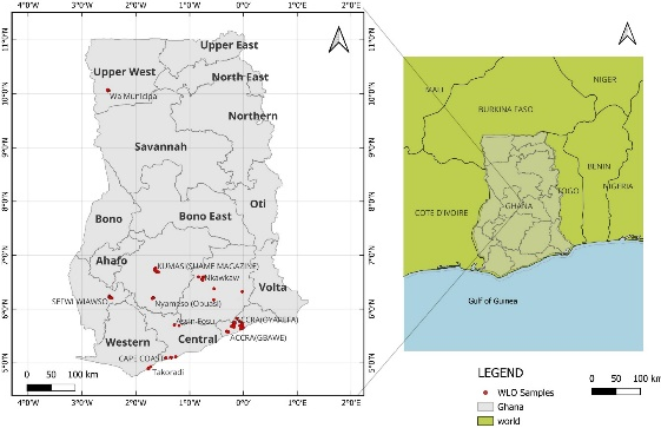
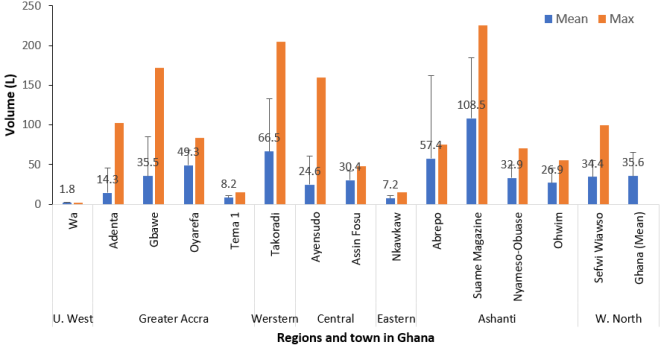
Inappropriate handling and disposal of waste lubricant oil (WLO) can lead to detrimental effects on soil and water matrices. Despite the documented economic and energy value of WLO, developing countries have not yet harnessed these opportunities due to a lack of information on quantities generated, perceived value, and infrastructure for collection, reuse, recycling, or disposal. In this study, the quantity of WLO generated and attitudes and environmental awareness of vehicle service technicians (n=329) were assessed in seven regions of Ghana. The mean volume of WLO generated was 35.6 L/shop/week, with southern urban suburbs generating more than their northern counterparts. Most (53%) technicians dispose of WLO by selling it, while 83.3% are aware that inappropriate disposal is detrimental to the environment. However, 10% discarded the WLO into sewers and soil. About two-thirds (63%) of vehicle service technicians are willing to use waste management services to dispose of WLO, but only 33% are willing to pay for such services. The study shows that closing the circular economy loop for the lubricant oil sector will have minimal barriers. Municipal waste management companies should invest in WLO collection infrastructure to help drive the circular economy of synthetic lubricating oils, reduce the fire hazard posed by improper WLO storage, educate technicians to eradicate soil and water contamination from poor waste oil handling and disposal practices, and safeguard ecosystem and human health in developing countries.
| Published in | International Journal of Science, Technology and Society (Volume 14, Issue 4) |
| DOI | 10.11648/j.ijsts.20261404.11 |
| Page(s) | 131-139 |
| Creative Commons |
This is an Open Access article, distributed under the terms of the Creative Commons Attribution 4.0 International License (http://creativecommons.org/licenses/by/4.0/), which permits unrestricted use, distribution and reproduction in any medium or format, provided the original work is properly cited. |
| Copyright |
Copyright © The Author(s), 2026. Published by Science Publishing Group |
Waste Lubricant Oil, Vehicle Technicians’ Attitudes, Waste Quantification, Environmental Awareness, Circular Economy, Ghana
Demographics and perceptions | Options to question | Frequency | Percentage |
|---|---|---|---|
Gender | Female | 11 | 3.3 |
Male | 318 | 96.7 | |
Age | 18 - 25 | 57 | 17.3 |
26 - 30 | 91 | 27.7 | |
31 - 40 | 108 | 32.8 | |
41 - 50 | 53 | 16.1 | |
51 - 60 | 19 | 5.8 | |
>60 | 1 | 0.3 | |
Educational level attained | No formal education | 133 | 40.4 |
Basic | 28 | 8.5 | |
Secondary | 147 | 44.7 | |
Tertiary | 21 | 6.4 | |
Years of experience as a service technician | < 5 years | 71 | 21.6 |
5 - 15 years | 188 | 57.1 | |
>15 years | 70 | 21.3 | |
How do you dispose of your waste lubricant oil? | Collected by MWS | 28 | 8.5 |
Collected by traders | 78 | 23.7 | |
Poured into drains or on the ground | 34 | 10.3 | |
Recycle/reuse | 4 | 1.2 | |
Sell | 174 | 52.9 | |
Other | 11 | 3.3 | |
Does the inappropriate disposal of WLO damage the environment? | Yes | 274 | 83.3 |
No | 55 | 16.7 | |
Are you willing to use MWMS for oil disposal | Yes | 210 | 63.8 |
No | 119 | 36.2 | |
Are you willing to pay for MWMS to collect the waste oil | Yes | 108 | 32.8 |
No | 221 | 67.2 |
Demographics of respondents | How do you dispose of your WLO? | Does inappropriate WLO disposal damage the environment? | Would you use MWMS if it were available? | Would you pay for such a service? | |
|---|---|---|---|---|---|
GENDER | Pearson corr. coeff. | .114* | -.038 | .001 | -.086 |
Sig. (2-tailed) | .039 | .492 | .989 | .119 | |
N | 329 | 329 | 329 | 329 | |
AGE | Pearson corr. coeff. | -.096 | .046 | -.141* | -.284** |
Sig. (2-tailed) | .081 | .401 | .011 | .000 | |
N | 329 | 329 | 329 | 329 | |
EDUCATION | Pearson corr. coeff. | -.066 | .113* | .056 | .066 |
Sig. (2-tailed) | .232 | .041 | .308 | .231 | |
N | 329 | 329 | 329 | 329 | |
YEARS OF EXPERIENCE | Pearson corr. coeff. | -.075 | -.119* | .046 | .072 |
Sig. (2-tailed) | .176 | .032 | .407 | .193 | |
N | 329 | 329 | 329 | 329 |
Would you use MWMS if it were available? | Would you pay for MWMS to dispose of your waste oil? | ||
|---|---|---|---|
How do you dispose of your waste oil? | Pearson Correlation | -.151** | -.100 |
Sig. (2-tailed) | .006 | .070 | |
N | 329 | 329 | |
Does inappropriate waste oil disposal damage the environment? | Pearson Correlation | -.015 | -.034 |
Sig. (2-tailed) | .784 | .542 | |
N | 329 | 329 |
LCA | Life Cycle Assessment |
SDG | Sustainable Development Goal |
WLOO | Waste Lubricant Oil |
WMS | Waste Management Services |
MWMSM | Municipal Waste Management Services |
| [1] | Cabrera-Escobar, C., Moreno-Gutiérrez, J., Rodríguez-Moreno, R., Pájaro-Velázquez, E., Calderay-Cayetano, F., & Durán-Grados, V. (2025). A review on global recovery policy of used lubricating oils and their effects on the environment and circular economy. Environments, 12(5), 135. |
| [2] |
Waste Framework Directive. (2026). European Commission. Available online:
https://environment.ec.europa.eu/topics/waste-and-recycling/waste-framework-directive_en (accessed on 10 March 2026). |
| [3] | Hassanain, E. M., Yacout, D. M., Metwally, M. A., & Hassouna, M. S. (2017). Life cycle assessment of waste strategies for used lubricating oil. The International Journal of Life Cycle Assessment, 22(8), 1232-1240. |
| [4] | Okebalama, C. B., Onwurah, C. L., Jidere, C. M., & Okolo, C. C. (2024). Disposal of spent oil into soils around auto parts markets impacts heavy metal concentrations and poses a potential ecological risk. Environmental Systems Research, 13(1), 15. |
| [5] | Nowak, P., Kucharska, K., & Kaminski, M. A. (2020). The new test procedure for group-type composition of base oils of lubricating oils, especially emitted into the environment. Energies, 13(15), 3772. |
| [6] | Parekh, K., Gaur, R., & Shahabuddin, S. (2024). A facile approach for refining waste lubricant oil: A hazardous water contaminant. Materials Today: Proceedings. |
| [7] | Tiwari, R., Agrawal, P., Bawa, S., Karadbhajne, V., & Agrawal, A. J. (2023). Soil contamination by waste transformer oil: A review. Materials Today: Proceedings, 72, 306-310. |
| [8] | Ossai, I. C., Hamid, F. S., Aboudi-Mana, S. C., & Hassan, A. (2024). Ecotoxicological effects, human and animal health risks of pollution and exposure to waste engine oils: a review. Environmental Geochemistry and Health, 46(10), 416. |
| [9] | Gawryluk, A., Stępniowska, A., & Lipińska, H. (2022). Effect of soil contamination with polycyclic aromatic hydrocarbons from drilling waste on germination and growth of lawn grasses. Ecotoxicology and environmental safety, 236, 113492. |
| [10] | Ngozi, E. J., Ifechukwu, A. E., & Lawrence, A. N. (2017). Effects of used engine oil polluted-soil on seeds’ germination and seedlings’ growth characteristics of some tropical crops. International Journal of Environment, Agriculture and Biotechnology, 2(2), 812-818. |
| [11] | Ikhajiagbe, B., & Ogwu, M. C. (2020). Hazard quotient, microbial diversity, and plant composition of spent crude oil-polluted soil. Beni-Suef University Journal of Basic and Applied Sciences, 9(1), 26. |
| [12] | Pinheiro, C. T., Quina, M. J., & Gando-Ferreira, L. M. (2020). Management of waste lubricant oil in Europe: A circular economy approach. Critical Reviews in Environmental Science and Technology, 51(18), 2015-2050. |
| [13] | Boadu, K. O. (2020). Removal of Contaminants In Used Lubricating Oil With Chemical Activated Carbons From Palm Kernel And Coconut Shells. (Doctoral dissertation, University of Port Harcourt). |
| [14] | Kalmykova, Y., Sadagopan, M., & Rosado, L. (2018). Circular economy-From review of theories and practices to development of implementation tools. Resources, conservation and recycling, 135, 190-201. |
| [15] | Jerez, S., Ventura, M., Molina, R., Pariente, M. I., Martínez, F., & Melero, J. A. (2021). Comprehensive characterization of an oily sludge from a petrol refinery: A step forward for its valorization within the circular economy strategy. Journal of Environmental Management, 285, 112124. |
| [16] | García-Gutiérrez, P., Tonini, D., Klenert, D., Marschinski, R., & Saveyn, H. G. (2025). Environmental and economic assessment of waste lubricant oil management in the EU. Journal of Cleaner Production, 492, 144878. |
| [17] |
United Nations Department of Economic and Social Affairs, Sustainable Development, The 17 Goals, Available from:
https://sdgs.un.org/goals (Accessed on: 02 April, 2026). |
| [18] | Mensah, L., Bentil, E., Agbekey, B. K., Nkrumah, G., Aidoo, I. A., Oti-Boakye, A., Owusu Sekyere, D., Sackey, L. N. A. (2026). Textile Waste from Fashion Shops and Imported Second-hand Clothing in the Greater Kumasi Sub-Region of Ghana: A Call for Policy Change, Environmental Challenges, 22, |
| [19] | Aduteye, E. K., Tsatsu, S., Adjeiwaa, E. O., & Addo, F. (2023). Analysis of Ghana’s Gross Domestic Product from 1960-2019. J. Econ. Sustain. Dev. |
| [20] | Atombo, C., Akuh, R., Turkson, R. F., & Liggie-Kudonoo, F. (2025). Examining fatal and non-fatal injuries of drivers in single-vehicle-involved crashes on urban roadways using random parameter logit model. International Journal of Injury Control and Safety Promotion, 32(1), 130-144. |
| [21] | Daskal, S., Ayalon, O., and Shechter, M., (2019). Closing the loop: The challenges of regulation in municipal solid waste management. Detritus, (5). |
| [22] | Ghana Statistical Service (2021), Population and Housing Census: General Report. |
| [23] | Acheampong, F., Akenten, J. W., Imoro, R., Agbesie, H. R., & Abaye, D. (2016). Evaluation of Heavy Metal Pollution in the Suame Industrial Area, Kumasi, Ghana. Journal of Health and Pollution, 6(10), 56-63. |
| [24] | Jayeola, O., Sidek, S., Owoeye, I., & Kazeem, Y. K. (2020). Gender and the performance of informal sector enterprises. European Scientific Journal, 16(4), 57-73. |
| [25] | Monney, I., Bismark, D. A., Isaac, O. M., & Kuffour, R. A. (2014). Practices among vehicle repair artisans in an urban area in Ghana. J Environ Occup Sci, 3(3), 147. |
| [26] | Enyoh, C. E., & Isiuku, B. O. (2020). Characterisation of some soils from flood basin in Amakohia, Owerri. Nigeria Int. J. Environ Anal Chem. |
| [27] | Azorji, J., Okechukwu, R. U., Udebuani, A. C., & Duru, C. M. (2022). An Appraisal of the Volume, Potential Use and Disposal Methods of Spent Engine Oil Generated in Selected Mechanic Workshops in Imo State, South-East Nigeria. Journal of Environmental Treatment Techniques, 10(3), 228-234. |
| [28] | Enwezor, W. O., Ohiri, A. C., Opowaribo, E. E., & Udo, E. J. (2020). A review of soil fertilizer use in crops in Southeastern zone of Nigeria (in five volumes). Produced by the Fed. Min. Agric and Nat. Re. Lagos. |
| [29] | Morshed, M., Hosen, M., & Asaduzzaman, M. (2021). A Review on pH, DO and BOD of the Sitalakhya River during Last Four Decades. Asian J. Fish. Aquat. Res, 14(1), 25-42. |
| [30] | Vural, U. S. (2020). Waste Mineral Oils Re-refining with Physicochemical Methods, Turkish Journal of Engineering, 4(2), 62-69. |
| [31] | Michael, A. (2015). Used oil storage and disposal practices in automobile repair garages in Ghana. International Journal of Science, Technology and Society, 3(4), 191-201. |
| [32] | Ayetor, G. K., Quansah, D. A., & Adjei, E. A. (2020). Towards zero vehicle emissions in Africa: A case study of Ghana. Energy Policy, 143, 111606. |
| [33] | Ackom, G. (2017). Vehicle emission enforcement, Air Quality and Mobility Unit, United Nations Environmental Development Programme. |
| [34] | Gössling, S., Kees, J., & Litman, T. (2022). The lifetime cost of driving a car. Ecological Economics, 194, 107335. |
| [35] | Wolak, A., & Zając, G. (2019). An empirical study of the variables affecting the frequency of engine oil change in the environmental aspect. Environmental Protection Yearbook, 21. |
| [36] | Kyando, M. J., Ntalikwa, J. W., & Kivevele, T. (2025). Effects of Mileage on Engine Oil of an Aged Spark Ignition Retrofitted Engine Fueled by Gasoline and Compressed Natural Gas. International Journal of Energy Research, 2025(1), 9989894. |
| [37] | Maceiras, R., Alfonsín, V., & Morales, F. J. (2017). Recycling of waste engine oil for diesel production. Waste management, 60, 351-356. |
| [38] | Avordeh, T. K., Salifu, A., Quaidoo, C., & Opare-Boateng, R. (2024). Impact of power outages: Unveiling their influence on micro, small, and medium-sized enterprises and poverty in Sub-Saharan Africa-An in-depth literature review. Heliyon, 10(13). |
| [39] | Prempeh, K. B. (2023). The impact of financial development on renewable energy consumption: new insights from Ghana. Future Business Journal, 9(1), 6. |
| [40] | Ani, I., Okafor, J., Olutoye, M., & Akpan, U. (2015). Optimization of base oil regeneration from spent engine oil via solvent extraction. Adv Res, 4(6), 403-411. |
| [41] | Hegazi, S. E. F., Mohamd, Y. A., & Hassan, M. I. (2017). Recycling of waste engine oils using different acids as washing agents. International Journal of Oil, Gas and Coal Engineering, 5(5), 69-74. |
APA Style
Mensah, L., Mahama, N., Nkrumah, G., Agbekey, B. K., Kwarteng, E., et al. (2026). Attitudes and Environmental Awareness of Vehicle Service Technicians in Generating and Disposing of Waste Lubricant Oil in Ghana: Barriers to the Circular Economy. International Journal of Science, Technology and Society, 14(4), 131-139. https://doi.org/10.11648/j.ijsts.20261404.11
ACS Style
Mensah, L.; Mahama, N.; Nkrumah, G.; Agbekey, B. K.; Kwarteng, E., et al. Attitudes and Environmental Awareness of Vehicle Service Technicians in Generating and Disposing of Waste Lubricant Oil in Ghana: Barriers to the Circular Economy. Int. J. Sci. Technol. Soc. 2026, 14(4), 131-139. doi: 10.11648/j.ijsts.20261404.11
AMA Style
Mensah L, Mahama N, Nkrumah G, Agbekey BK, Kwarteng E, et al. Attitudes and Environmental Awareness of Vehicle Service Technicians in Generating and Disposing of Waste Lubricant Oil in Ghana: Barriers to the Circular Economy. Int J Sci Technol Soc. 2026;14(4):131-139. doi: 10.11648/j.ijsts.20261404.11
@article{10.11648/j.ijsts.20261404.11,
  author = {Lawson Mensah and Nahima Mahama and Gideon Nkrumah and Bright Kwaku Agbekey and Evans Kwarteng and Ethel Bentil and Lina Appiah-Nuamah},
  title = {Attitudes and Environmental Awareness of Vehicle Service Technicians in Generating and Disposing of Waste Lubricant Oil in Ghana: Barriers to the Circular Economy},
  journal = {International Journal of Science, Technology and Society},
  volume = {14},
  number = {4},
  pages = {131-139},
  doi = {10.11648/j.ijsts.20261404.11},
  url = {https://doi.org/10.11648/j.ijsts.20261404.11},
  eprint = {https://article.sciencepublishinggroup.com/pdf/10.11648.j.ijsts.20261404.11},
  abstract = {Inappropriate handling and disposal of waste lubricant oil (WLO) can lead to detrimental effects on soil and water matrices. Despite the documented economic and energy value of WLO, developing countries have not yet harnessed these opportunities due to a lack of information on quantities generated, perceived value, and infrastructure for collection, reuse, recycling, or disposal. In this study, the quantity of WLO generated and attitudes and environmental awareness of vehicle service technicians (n=329) were assessed in seven regions of Ghana. The mean volume of WLO generated was 35.6 L/shop/week, with southern urban suburbs generating more than their northern counterparts. Most (53%) technicians dispose of WLO by selling it, while 83.3% are aware that inappropriate disposal is detrimental to the environment. However, 10% discarded the WLO into sewers and soil. About two-thirds (63%) of vehicle service technicians are willing to use waste management services to dispose of WLO, but only 33% are willing to pay for such services. The study shows that closing the circular economy loop for the lubricant oil sector will have minimal barriers. Municipal waste management companies should invest in WLO collection infrastructure to help drive the circular economy of synthetic lubricating oils, reduce the fire hazard posed by improper WLO storage, educate technicians to eradicate soil and water contamination from poor waste oil handling and disposal practices, and safeguard ecosystem and human health in developing countries.},
 year = {2026}
}
TY  - JOUR
T1  - Attitudes and Environmental Awareness of Vehicle Service Technicians in Generating and Disposing of Waste Lubricant Oil in Ghana: Barriers to the Circular Economy
AU  - Lawson Mensah
AU  - Nahima Mahama
AU  - Gideon Nkrumah
AU  - Bright Kwaku Agbekey
AU  - Evans Kwarteng
AU  - Ethel Bentil
AU  - Lina Appiah-Nuamah
Y1  - 2026/07/17
PY  - 2026
N1  - https://doi.org/10.11648/j.ijsts.20261404.11
DO  - 10.11648/j.ijsts.20261404.11
T2  - International Journal of Science, Technology and Society
JF  - International Journal of Science, Technology and Society
JO  - International Journal of Science, Technology and Society
SP  - 131
EP  - 139
PB  - Science Publishing Group
SN  - 2330-7420
UR  - https://doi.org/10.11648/j.ijsts.20261404.11
AB  - Inappropriate handling and disposal of waste lubricant oil (WLO) can lead to detrimental effects on soil and water matrices. Despite the documented economic and energy value of WLO, developing countries have not yet harnessed these opportunities due to a lack of information on quantities generated, perceived value, and infrastructure for collection, reuse, recycling, or disposal. In this study, the quantity of WLO generated and attitudes and environmental awareness of vehicle service technicians (n=329) were assessed in seven regions of Ghana. The mean volume of WLO generated was 35.6 L/shop/week, with southern urban suburbs generating more than their northern counterparts. Most (53%) technicians dispose of WLO by selling it, while 83.3% are aware that inappropriate disposal is detrimental to the environment. However, 10% discarded the WLO into sewers and soil. About two-thirds (63%) of vehicle service technicians are willing to use waste management services to dispose of WLO, but only 33% are willing to pay for such services. The study shows that closing the circular economy loop for the lubricant oil sector will have minimal barriers. Municipal waste management companies should invest in WLO collection infrastructure to help drive the circular economy of synthetic lubricating oils, reduce the fire hazard posed by improper WLO storage, educate technicians to eradicate soil and water contamination from poor waste oil handling and disposal practices, and safeguard ecosystem and human health in developing countries.
VL  - 14
IS  - 4
ER  -
Department of Environmental Science, Kwame Nkrumah University of Science and Technology, Kumasi, Ghana
Department of Environmental Science, Kwame Nkrumah University of Science and Technology, Kumasi, Ghana
Department of Environmental Science, Kwame Nkrumah University of Science and Technology, Kumasi, Ghana
Department of Environmental Science, Kwame Nkrumah University of Science and Technology, Kumasi, Ghana
Department of Environmental Science, Kwame Nkrumah University of Science and Technology, Kumasi, Ghana
Department of Environmental Science, Kwame Nkrumah University of Science and Technology, Kumasi, Ghana

Information


 Share This Article
 Twitter
 Linked In
 Facebook
 Copy
Copy Download