Abstract
The purposes of Construction performance evaluation, which involves setting new operating targets and standards has been raised among the majority of water supply construction projects. The thesis was focused on the factors identifying, performance evaluation, and improvement strategy, which makes a water supply construction project focus on identifying improvement areas. The goal of the study is to pinpoint the key elements influencing project performance and provide methods for enhancement. Both qualitative and quantitative methodologies were used in a mixed research strategy. 184 respondents, including clients, contractors, consultants, and community stakeholders engaged in 48 water supply construction projects carried out between 2019 and 2023, provided the data. Project characteristics, labor and material factors, contractual relationships, external environmental factors, client-related issues, contractor and consultant performance, safety and health conditions, leadership, and project procedures were among the categories of factors influencing project performance that were examined in this study. The data was analyzed using regression analysis and descriptive statistics with SPSS software. The findings showed that all of the projects under consideration had some level of cost escalation and delay, and the majority of water supply construction projects had considerable time and cost overruns. Contractor capability, consultant efficacy, project procedures, leadership, labor and material availability, client commitment, and external environmental circumstances are important variables that impact performance. The results demonstrate that while project procedures, quality flaws, and client satisfaction exhibit moderate significance, contractor and consultant-related factors, along with time and cost management, have very significant effects on project performance. The study concludes that modern construction management techniques like lean management, PDCA cycles, and Kaizen principles, as well as strengthening monitoring and evaluation systems and improving stakeholder coordination, can greatly improve project performance. In order to enhance the effectiveness, sustainability, and quality of water supply construction projects in the Oromia region, the study offers contractors, consultants, and project owners useful suggestions.
Keywords
Project Factors, Performance Evaluation, Improvement
1. Introduction
1.1. Background of the Study
This study explores the performance evaluation of water supply construction projects that can facilitate the management of activities within the Oromia Water and Energy Bureau. This section will therefore introduce the performance evaluation of the study, followed by stating the research question to be answered by the end of the report
| [1] | Bridget S. (2022), Factors Affecting Project Performance of Building Construction Projects in Federal Capital Territory (FCT) Abuja, Nigeria. |
[1]
. The water supply construction industry is playing a primary role in the advances and success of society's targets. The WS construction industry is one of the largest, and it contributes to the country's development. Water supply Construction industry is complex, in its nature, as it involves a large number of parties, such as clients, contractors, consultants, stakeholders, shareholders, and regulators. Performance is associated with several factors such as time, cost, quality, client satisfaction, productivity, and safety. There are other genuine reasons like closures, modifications of drawings, and changes to the design. Other grounds affecting construction projects include poor management and guidance; inapt participants; poor relations and coordination; lack of motivation, insufficient infrastructure, political problems, cultural problems, and economic conditions. Found that factors like inadequate leadership, poor site management, lack of manpower skills, and lack of breakdown of equipment play very important parts in water supply construction project performance in the Oromia region. The Recognized Co-ordination Among Participants, Leadership, Skills, and Co-ordination of Project Managers, Project Manager Competence, Support of the Top Management, Economic and Climatic Conditions, Social Conditions, Participants Co-ordination, Decision making as Key Factors. WHO Drinking Water Fact Sheet.
The water supply construction industry’s performance is affected by national economies. The WS construction industry is one of the largest single industries that contributes greatly to the development of the nation. The pace of the economic growth of any nation can be measured by the development of physical infrastructures such as WSC buildings, roads, and bridges. Successful building of WS construction projects is those projects finished on time, within Budget, by Specifications, and to the stakeholders' Satisfaction.
1.2. Statement of the Problem
The failure of any water supply project was mainly related to the problems and failures in performance. Moreover, there are many reasons and factors which attribute to this problem. In the Oromia region, there are many water supply construction projects that are failing in performance. Despite the water supply construction industry’s significant contribution to the economy of developing countries and the critical role it plays in those countries’ development, the performance of the water supply project remains generally low
| [10] | Gadisa, B., & Zhou, H. (2021). Exploring influential factors leading to the poor performance of public construction projects in Ethiopia using structural equation modelling. Engineering Construction and Architectural Management, 28(6), 1683–1712. 0689. |
[10]
. In the Oromia region of Ethiopia, the performance of WS construction projects appears in different directions. Many constructed projects fail in time performance, others fail in cost performance, and others fail in other performance indicators. In the recent past, there were many projects which are completed with poor performance because of many evidential reasons, such as obstacles by clients, non-availability of materials, road closures, amendment of the design and drawings, additional works, waiting for the decision, handing over, variation orders, amendments in the bill of quantities, and delay in receiving drawings. However, several projects are having problems with performance in the Oromia region,
| [11] | Alemayehu Y, (2020). Analysis of public building project performance: a case study in Oromia region. Department of Civil Engineering, College of Architecture and Civil Engineering, Addis Ababa Science and Technology University. |
[11]
. Therefore, this research proposal will evaluate the performance of water supply construction projects in the Oromia region to assist owners, consultants, and contractors in overcoming performance problems and improving the performance of their construction projects. Hence, the performance of any construction project will be evaluated according to key performance indicators.
1.3. Objectives of the Study
1.3.1. General Objective
This research aims to evaluate the performance of Water supply construction projects executed under the Oromia water and Energy Bureau.
1.3.2. Specific Objective
1. To identify factors affecting the performance of Oromia WSC Projects
2. To analyze the level of factors' influence on the performance of Oromia WSCPs Page 4
3. To develop the performance improvement techniques in Oromia WSCPs
1.4. Significance of the Study
The study is believed to be important since it is expected to evaluate the performance of water supply construction projects in the case of OWEB. Once the problems are identified, it is easy to overcome them and exploit the prospect. The study is significant in terms of addressing the recommendation for the performance evaluation of water supply construction projects in the Oromia region, as a result of lining the means of solving this problem.
1.5. Scope of the Study
This study was conducted in five areas of the Oromia region, namely North Oromia, South Oromia, Central Oromia, East oromia and West Oromia. The study covered 48 out of 55 water supply construction projects was carried out in six months.
1.6. Operational Definition of Terms
Dependent Variable: The dependent variable in the study is the project performance of WS construction projects.
Outcome variable: The outcome variable in this study is clients' satisfaction with the use of on-time, Cost, and quality completed projects. Performance means carrying out a task, the progress of which can be measured and compared using a set of stated requirements.
Project Performance: performance is closely related to efficiency and effectiveness, and is also defined at the level of each individual within the organization or at the organization level. This is for the simple reason that 'what gets measured gets managed' - and to measure is to know. By measuring the success of a project, you can also work to improve its performance further. Continuous measurement of a project's performance allows the team to set attainable and realistic targets for it.
Independent Variables: Based on the findings of the performance of WS projects' theoretical background, the following variables will be hypothesized to determine WS construction project factors. The potential explanatory variables hypothesized to influence WS construction projects in the study area is discusses as follows.
External environment: These forces include socio cultural, political and legal, technological, economic, and global influences, indirectly interactive forces may impact one organization more than another simply because of the nature of a particular business, external environment comprises of the factors that are outside the organization and which can have an impact on the operations, performance, decisions and profitability of the organization.
Labor and material related factor: the most significant problems affecting labor productivity were identified as the length of the workday, equipment breakdown, lack of materials, lack of proper equipment, lack of proper tools, inadequate supervision skills, material type, large volume of work, quality required, and work complexity.
Contractual relationship factor: A contractual relationship is a legal bond between at least two people who agree to at least one term or promise. Misrepresentation: False statement of fact that persuades someone to enter into a contract, negligent versus fraudulent. Misrepresentation Fraudulent misrepresentation (deceit) requires at least some guilty knowledge or willful disregard of the falsity of the information provided; negligent misrepresentation requires only a breach of the standard.
Project procedure/process factors: The project process corresponds to the project implementation, which is divided into sub-processes. The structure and process are defined in the project organization, considering the attainment of the corporate objectives and, therefore, also the project objectives. The components of the project process are: project start, project preparation, project planning, project implementation, and project completion. The last two components should also contain the project decision. The process is successful due to the following methods: personnel, resources, financial resources, establishments, techniques and methods, and present results at the end.
Client related factors: The most important client-related factor is poor initial planning by the client, followed by late payments by the client, lack of knowledge on the part of the client regarding most recent staff progress, improper consultant selection by the client, contractor selection by the client with a poor cash flow, contractor selection's poor attitude, late payments by the client, lack of knowledge on the part of the client, new proposal requests by newly hired officers, and lack of financial strength. The inability to choose an experienced design team, which may include the provision of a strong brief by the architect, engineer, quantity surveyor, and numerous contractors, Lack of top management support for energizing the project team members; failure of the client to obtain the designers' and project manager's consent; give the client's attitude toward ensuring timely availability of funding for the project and prompt payment for work completed; the client's influence in the selection of incompetent and ill experienced contractors and sub-contractors; and the client's inability to minimize bureaucracy in decision-making as a yardstick. Others include the client interfering with the ability of the system designers and contractors.
Factors relating to contractors: Include inadequate project planning and scheduling, a lack of experience on the part of the contractor, and frequent changes in the subcontractors. Outdated technology, improper construction techniques, rework required because of mistakes, etc. When a construction firm is involved in a big construction project, a contractor is generally appointed to carry out the construction work. Contractor Related Delay Factors type was recognized as one of the groups of causes of schedule delays of construction projects. Some factors of contractor-related delay in Construction projects are: Ineffective project planning and scheduling, Lack of experience of the contractor, frequent change of subcontractors, obsolete technology, and inappropriate construction method.
Factors associated with consultants: the ineffective delivery of knowledge or strategic counsel that is being presented for consideration and decision-making. Lack of project follow-up and consulting experience.
Project characteristics related factors: A project is typically for a customer. The project is temporary in nature. It typically has a defined start and a defined endpoint. The project will have a unique set of requirements that need to be delivered within the boundaries of this project. A project is typically a once-off endeavor, a project is not business as usual, and a project can be cross-functional.
Safety and health-related factors: preventing people from being harmed or becoming ill at work by taking the right precautions, providing a poor satisfactory working environment. Workplace injuries can lead to increased employee absence, higher healthcare costs, workers' compensation payments, lost productivity, and business disruption. These effects can have a significant financial impact on employers. A consultant's employment is project-based, and the duties they handle are frequently extremely specialized. Consultants are used in different construction projects. Project managers, architects, service engineers, and cost consultants are examples of typical consultant positions. On a broad level, consulting tasks include developing and assisting in the development of the design, working on tasks relating to project management, contract administration, inspecting the work of construction contractors, providing advice on sustainability, and developing the project with advice.
Quality: the standard of something as measured against other things of a similar kind; the degree of excellence of something, and it is Conformance to Customer Expectations.” Why does this shift? The new definition makes customer satisfaction even more central to the delivery of quality. But the quality defect is the inverse of these definitions. Quality Defect in a project means the non-conformance arising from poor construction materials, poor working process, and negligence of workers. Quality Defects may be defined as attributes of a worker’s negligence or poor construction materials that may affect the quality of project safety and/or efficacy of the project. Water supply Construction project faults are any issues with the plan, the contractor's work, or the materials employed. A flaw can have a wide range of effects, from minor cosmetic difficulties to hazardous structural problems that put locals at risk of harm. The owner often gets a certain amount of time to request that the contractor fix any defects that are found after the WSC building has been built.
2. Conceptual Framework/Literature Review
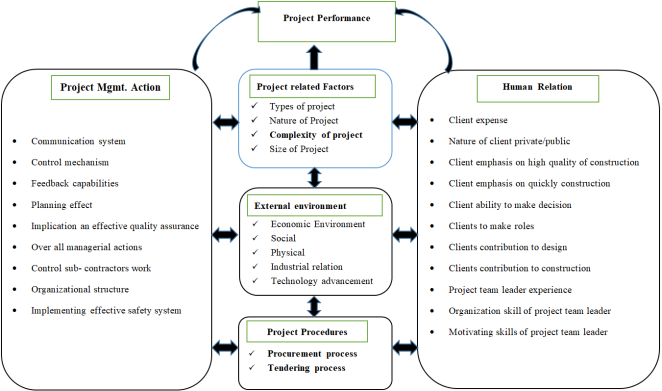
Figure 1. Factors affecting the performance of construction projects conceptual framework.
3. Materials and Method
The general framework and approach utilized to carry out a study and accomplish its goals are described by the research methodology and research approach taken together. The methodical strategy, steps, and strategies a researcher employs to gather, examine, and interpret data to solve the study topic are referred to as research methodology. It discusses the fundamentals of choosing particular study designs, sample strategies, data gathering tools, and data analysis processes
| [2] | Bhawna1 & Gobind (2015), Research Methodology and Approaches, M. Ed Scholar, Moga College of Education, Moga, Punjab, India. 2 Lecturer, S. B. S. S. T. C, Ferozepur, Punjab, India. |
[2]
.
3.1. Study Population
The research consists of the total population of 55 WS construction projects under the Oromia Water and Energy Bureau in last 5 years from 2019-2023 GC. Therefore, the targeted populations from twenty-four WSCPs are all of the owners, contractors, and consultants of each WS construction projects are the population of the study. The total population size from 55 WSCP was 350 (75 owners, 95 contractors, 65 consultants, and 115 stockholders/communities). The researcher was distributing questionnaires for owners, contractors, and consultants of building construction projects.
3.2. Sampling Procedure and Target Sample Size
The importance of the sampling process is crucial. Hence, the sample size is purposively and conveniently distributed among the sample frame as shown in
Table 1 based upon those who are directly or in directly involving in projects and have expertise in that field. A sample size of 184 will be taken from the total list of 48 WSCP workers, such as contractors, consultants, client and stack holders or the community. The sample size is determined based on the following Slovin’s sampling formula
| [3] | Slovin’s (1960), Research Sampling and Sample Size Determination: A practical Application calculate the minimum sample size needed to estimate a statistic based on an acceptable margin of error https://www.statology.org/slovins-formula |
[3]
.
Where: N = total number of populations from 24 WSCP (65+95+115+75=350)
n = number of samples
e = error margin/margin of error, a 95% confidence level was taken, and e = 0.05
Table 1. Population and sample size in the study area.
Sample source from 24 WSCP | Population size from 24 WSCP | Sample frame |
Consultant | 65 | 40 |
Contractors | 95 | 46 |
Client | 75 | 46 |
Stockholders / Communities | 115 | 52 |
Total | 350 | 184 |
Source: Authors field work
3.3. Pilot Testing and Validity
Pilot testing is conducting as the research instruments on the staff of clients, contractors, and consultants executing the Projects in the Oromia Water and Energy Bureau. Content validity, which is employed by this study, is a measure of the degree to which collecting data and a particular instrument represent a specific domain or content of a particular concept. Expert opinion is requested to comment on the representativeness and suitability of questions, and give suggestions for corrections to the structure of the research tools.
3.4. Reliability
It will be intended to select a pilot group from the target population to test the reliability of the research instruments. In order to test the reliability of the instruments, an internal consistency technique was applied.
3.5. Method of Data Collection
3.5.1. Questionnaire
A questionnaire was the simplest and time-saving method to collect data effectively from a huge number of respondents. When properly constructing a questionnaire as a scientific instrument to obtain data from a large number of individuals.
3.5.2. Focus Group Discussion
Focus group discussion was frequently used as a qualitative approach to gain an in-depth understanding of social issues. The method aims to obtain data from a purposefully selected group of individuals rather than from a statistically representative sample of a broader population.
3.5.3. Interview
An interview was a qualitative research method of data collection that involves two or more people exchanging information through a series of questions and answers. The questions were designed by a researcher to elicit information from interview participants on a specific topic or set of topics.
3.5.4. Method of Data Analysis
The qualitative and quantitative data obtained through the data collection method will be analyzed using appropriate methods for analysis. Qualitative data will be analyzed through interpretation and conceptual generalization. For quantitative data descriptive statistics, the logit model was employed to analyze the relationship between dependent and independent variables.
3.5.5. Descriptive and Inferential Analysis
The descriptive analysis makes use of frequencies, mean, standard deviation, maximum, and minimum values. Inferential statistics involving the t-test and chi-square test to compare different explanatory variables. The qualitative and quantitative data obtained through the data collection method will be analyzed using appropriate methods for analysis.
3.5.6. Regression Model Analysis
The Statistical Package for Social Science (SPSS) version 26.0 was used for data entry and analysis. Regression analysis is utilized to find the variance in the dependent variable that is explained by the independent variables. The perception of project performance is influenced by multiple study variables, according to a correlation analysis tool. A linear equation of the following form is being estimated with the use of multiple regression analysis:
Y = a+b1*X1+b2*X2+.......................+ b p*X p.
In this equation, each independent variable's independent contribution to the prediction of the dependent variable was represented by the regression coefficients, also known as B coefficients. After adjusting for all other independent variables, another i.e. variable, X1, will be correlated with the Y variable. As a result of the practical mathematical features of Z, we forecast Z rather than p in logistic regression. We may convert the prediction Z, which is a linear function of the predictors, into a probability using the formula
Z = log (p/1-p) = B0 + B1.X1 + B2.X2 + B3.X3. E e.
4. Result and Discussion
The conclusions of the questions designed to pinpoint the relevance of project performance evaluation cause and gauge the degree of their seriousness and significance are shown in the results and discussion that follow. Out of a total of 55 WSCPs in the region, 48 WSC project factors were chosen. They were divided into 14 categories and included project characteristics-related factors, client-related factors, contractor-related factors, consultant-related factors, labor and equipment-related factors, safety and health-related factors, contractual relationship-related factors, and external environment-related factors. Factors related to project procedures, leadership, cost and time overruns, quality problems, and productivity.
Table 2. Factors affecting the performance of WSCPs have been identified.
No | Group of factors | Reflection of factors |
1 | Project characteristics | Type and nature of projects, complexity of projects |
2 | Labor and material | Unavailability of skilled workers, Improper quality control of materials |
3 | Contractual relationship | Poor communication system, Poor contract mechanism of the project |
4 | External environments | Economic, social, political, and technological |
5 | Client-related factor | Client interference, poor commitment, and delay in progress payment |
6 | Project procedure | Poor tendering, poor engineering estimate, Poor Procurement method |
7 | Contractor-related factors | Poor motivating skills of project staff, Poor Project staff commitment, Low capacity of contractors |
8 | Safety and health factor | Poor application of safety and health equipment, Accident reported in the project |
9 | Consultant-related factors | Poor preparation of the drawing, poor approval of the drawing, a contract measurement problem, and a lack of experience in consultancy |
10 | Leadership-related factors | Irrelevant professional of a leader, Low experience of the leader |
11 | Time overrun | Delay of project time, Time overloaded |
12 | Cost overrun | Cost of variations, Cost due to poor performance |
13 | Quality defect | Poor design and specifications, Poor WSCP. Poor decision-making |
14 | Poor productivity | Poor Sequencing of work according to plan, Use of new technology, and high absenteeism rate on WSCP |
4.1. Measurement of Performance Evaluations
Time, quality, cost, stakeholder or community satisfaction, and project performance relative to the project case are the four factors that you should periodically assess during the WSC project. After a phase or stage, a formal project evaluation is helpful since it may show you clearly how the project is doing in comparison to the initial estimates.
Table 3. Summary of Contract Time and Actual Time Completion of Projects.
No | Quantity of Water supply construction projects | Rate of Time Overrun |
1 | 1 Water Supply Construction Projects | 49% |
2 | 7 Water Supply Construction Projects | 50% - 99% |
3 | 40 Water Supply Construction Projects | 100% - 2130% |
Project time overrun leads to delay of projects, contributing to the distraction of work, loss of construction materials, progress loss, and increased value of construction projects, construction claims, and termination of contracts. Furthermore, 48 projects in the Page 58 study area, as shown in
Table 3, were constantly showing signs of delays and poor performance.
Table 4. Summary of the cost overrun under the study area.
No | Water supply construction projects | Rate of cost overrun |
1 | 3 Water Supply Construction Projects | 40% _ 49% |
2 | 14 Water Supply Construction Projects | 50% _ 99% |
3 | 31 Water Supply Construction Projects | >100% |
The basic component of every water supply construction project was a cost. Cost overruns are one of the most common in water supply construction projects. A cost overrun, also known as a cost rise or budget overrun, entails unexpected costs incurred due to poor planning, an underestimation of the actual cost during budgeting, a lack of communication, a lack of clarity in project scope, inefficiency in site management, poor site coordination, and a lack of commitment. It was found that 48 out of 48 water supply projects had cost overruns.
4.2. Quality Defect of Water Supply Construction Projects
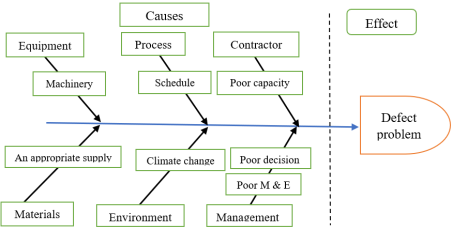
Measuring quality enables managers to know how close they are to their target and how to make the right decisions to improve the work process. Continual measuring of project performance for further improvement also helps in meeting customer expectations of the project outcome. Causes of defects in this research work. All the data has been collected from the water supply construction site. While collecting data, it was found that there are various effects of defects that occur in water supply building construction, which are categorized into six parts. Contractors Consultant, Corruption, material errors, Labor error, clients.
Figure 2. Fishbone or cause-and-effect diagram. Represented the Oromia Water Supply Construction project.
To evaluate the strength of a link between one dependent variable and one or more independent variables, regression analysis is performed. Using one or more independent variables, it aids in predicting the value of a dependent variable. Regression analysis aids in determining how much variance in a single answer (the dependent variable) is being accounted for by a collection of independent variables. Multiple regressions may capture the complex and varied nature of real-world occurrences, which is one of their key benefits. You can account for more variables that have an impact on the dependent variable and lower estimation error and bias by using several independent variables. The regression model refers to the residuals from running factors affecting the performance of WSCP. The results of the regression model are presented in the table.
Table 5. Regression analysis of the study area variables.
Variable | Coef. | Std. Err. | Z | P-Z | Marginal effect |
Safety & healthy | 1.265*** | 0.798 | 1.590 | 0.113 | 0.024 |
Leadership | -0.06*** | 0.057 | -1.180 | 0.237 | -0209 |
Project procedure | 0.600** | 0.826 | 3.730 | 0.006 | 0.245 |
Labor & material | 0.064*** | 0.206 | 0.310 | 0.756 | 0.016 |
Contractor | 3.710* | 0.742 | 5.000 | 0.000 | 0.016 |
Consultant | 0.745* | 1.196 | 1.750 | 0.054 | -0.000 |
Time | 3.652* | 0.737 | 4.650 | 0.000 | -0.004 |
Client | 2.248*** | 1.162 | 1.930 | 0.053 | -0173 |
Cost | 3.385* | 0.814 | 4.160 | 0.000 | 0.080 |
External envt | 1.130*** | 0.737 | 1.530 | 0.125 | 0.021 |
Quality defect | 3.712** | 0.743 | 4.000 | 0.000 | 0.082 |
Customer satisfaction | 0.058* | 0.548 | 2.305 | 0.007 | 0.045 |
Constant | -7.872 | 3.053 | -2.580 | 0.000 | -13.857 |
Number of observations 48 WSCP LR ch2 (10) 66.370, Prob ch2 0.000***, Pseudo R2 0.248, Adjusted R2 0.239, Log likelihood -138.629
The result of the regression model indicates that Project procedure, quality defect, and customer satisfaction were affecting the use of WSCP and significant effect at a 5% probability level, Contractors, consultants, time, and cost to WSCP was the highly significant effect at a 1% probability level, Leadership, safety, and health, labor and materials, client and external environment to WSCP significantly affects the performance of WSCP at 10% probability level,
Sensitivity analysis for unobserved biases: Results in the Appendix reveal that even if respondents were given the freedom to vary in odds up to e r = 2 (100%) in terms of unobserved factors, the influence of performance changes in water supply building projects can be inferred. In the analysis, set the maximum value for e r =2 (100%) with an increment of 0.05. These values are a good starting point for many data sets in the social sciences. Thus, we can conclude that our performance measurement is not sensitive to unobserved selection bias.
4.3. Implication of the Finding
The performance evaluation of water supply construction work was carried out in 2023. It included investigating the current.
These conditions, such as lack of defined design and specification, Monitoring and evaluations, project quality defects, contractors and project engineer commitments, and cost and time over-run were bad implications in water supply construction projects in the region. This problem has caused public complaints because all the stakeholders (Leadership, procurement procedure, Labor and materials, Contractors, Consultants, Client, and External environment) did not work with accountability and responsibility to complete the project according to the time and budget scheduled. The complete performance evaluation reports were compiled for academic purposes. Finally, some professional performance improvement suggestions were incorporated into the thesis paper.
4.4. Performance Improvement Strategy and Techniques
Continuous improvement strategy is an ongoing plan to improve an organization's production, products, service, and customer satisfaction
| [7] | Diana C, D. Monticolo, L. Muller, P. Lhoste (2021), Continuous Improvement process model: A Knowledge Management approach, “Continuous improvement and kaizen: Standardization and organizational designs”, Integrated Manufacturing Systems, Vol. 8 No. 2, pp. 110–117.
https://doi.org/10.1108/09576069710165792 |
[7]
. A culture of continuous improvement that is embedded in an organization empowers employees to constantly imagine how to improve and work smarter. The major improvement strategies and techniques are kaizen, plan does check act, lean management tools, and Lean construction Technology improvement.
In any construction industry, construction project management creates standards that employees must follow to perform the job
| [5] | Wei P, M Pan, 2022, Rethinking lean synergistically in practice for construction, Improvement, construction, and architectural management. |
[5]
. In a Kaizen environment, on Page 86, maintaining and improving standards is one of the main goals of management. When standards are improved, there should be an observable improvement in the output of a process or procedure.
It serves as a tool for project planning and is essential to lean management
| [9] | Bernardo L D. Andrade (2017). Lean Project Management: application of lean principles to project management. The Lean Methodology promotes the flow of value to the client through two guiding pillars: continuous improvement and respect for people. |
[9]
. To enhance the likelihood of delivering and maintaining the targeted gains, or to discontinue the intervention and try something else, the PDCA cycle's goal was to learn as rapidly as possible whether and how an intervention worked in a specific
| [8] | Patel, P. M., & Deshpande, V. A. (2017). Application of Plan Do-Check-Act Cycle For Quality And Productivity Improvement - A Review. 5(I), 197–201. |
[8]
. Plan-do-check-act, often known as the deeming wheel or deeming cycle, is a well-known technique for acquiring important learning and knowledge for ongoing process improvements of the project process.
| [6] | Zhaoxi Z, Y. Tang, C Wang 2022, System Dynamics Outlook on BIM, and LEAN Interaction, in Construction Quantity Surveying Iran J Sci Technol Trans Civ Eng.; 46(5): 3947–3962. |
[6]
, Applying Lean principles to your project management process won't happen automatically or without a concerted effort from the entire team or business
| [12] | Ayfokru, F., Mitikie, B. B., & Tekile, A. K. (2023). Evaluation of the Implementation of Lean Techniques to Reduce Construction Process Waste in Real Estate Firms in Addis Ababa, Ethiopia. 2023. https://doi.org/10.1155/2023/2379347 |
[12]
. Adopting one of the following tools, which might quicken the change, might be a good place to start. Lean methodology is forcing construction companies to reevaluate how they plan, manage, and carry out projects.
| [6] | Zhaoxi Z, Y. Tang, C Wang 2022, System Dynamics Outlook on BIM, and LEAN Interaction, in Construction Quantity Surveying Iran J Sci Technol Trans Civ Eng.; 46(5): 3947–3962. |
[6]
Lean construction relies heavily on having an effective performance management system. Web-based project management software, an automated scheduler, customizable engineering software, worker augmentation tools and equipment, Innovative construction materials and equipment, and VDC (Virtual Design and Construction) are some examples of lean construction technology that may be valuable for your water supply construction project.
Table 6. Critical challenges and problems need improvement in WSCPs.
No | Critical Gaps in WSCPs | challenges | Management action | Improvement strategy |
1 | Lack of a defined Design and specification | Desi Design copy pest Negligence of experts Expert Skill Gap Professional bias | Management should prepare design and specification training, Recruit committed and skilled experts, Motivate experts, Avoid design copy pest, and Check the design before the bid announcement | Define project goals. In the first step, define your project goals and determine outcomes. Next, narrow down the outcomes of the project, identify risks and constraints, refine your project strategy with a visual aid, estimate your budget, create a contingency plan, document your milestones, and Apply fully software engineering. Specifications must be clear, concise, complete, correct, and consistent. |
2 | Lack of defined monitoring and evaluation | Negligence of leadership, Negligence of experts, Expert Skill gap | Management prepares monitoring and evaluation training to fill the skill gap. Aware M&E experts are critical to follow the projects, prepare a monitoring and evaluation plan, and procure the most skilled M&E experts or organizations | Know your project inside and out. o Start planning M&E during the project design phase, make M&E an ongoing process, and explore different M&E tools and methodologies. Set up relevant indicators. Collect quality data from multiple sources. Employ a participatory and inclusive approach. Disseminating periodic results to a broad audience, monitoring, and evaluation can help to identify areas for improvement in order to achieve better results. |
3 | Lack of contractors commitment | Lack of capacity, Negligence of experts, and Skill gap | Select and procure efficient and skilled contractors, Communicate and prepare the session program weekly, | Improve your estimating process, use your project management software properly, and listen to staff. Establish your performance metrics and review progress frequently. Finally, improve your communication and training. |
4 | Lack of project engineer commitment | Negligence of experts, Skill gap | Check for the scheduling of projects, Aware project engineer to follow up on projects strictly | Say it with: communication, communication, communication. Be a safety advocate. Quality control. Learn our scheduling software. Get to know the foremen. Paperwork. Stay on top of requests for information, Master Autodesk. |
5 | Project quality defect | Poor quality of material, Poor workmanship, Material reduction | Purchase quality of materials, recruit skilled manpower, and control project quality | Say it with me: communication, communication, communication. Be a safety advocate. Quality control. Learn our scheduling software. Get to know the foremen. |
6 | Lack of accountability | Negligence of leadership, Negligence of the expert, Skill gap | keep your entire team on the right track, aware of the leadership expert's sense of accountability | Lead by example, give solid, clear feedback – often, hold each other accountable, have the tough talks with team members, consider how your employees view things, and set clear, achievable goals |
5. Conclusion
In this study, a purposive sampling procedure was adopted for the selection of sample respondents. First, the sample size of 48 WSCPs was taken from a total population of 55WSCPs based on the sampling formula. Finally, the empirical analysis used respondents from clients, contractors, consultants, and stakeholders’ data gathered from 184 respondents selected following a purposive sampling method from respective engineers based on their proportion to the size of the population. The study has applied a regression model technique, which is capable of extracting comparable treatments. The performance of water supply construction projects and the client’s satisfaction were affected by different factors. These include project procedure, labor, and material, contractual relationship, external environment, client, contractor, consultant, safety, and health. These factors of variables were statistically significant effects on project performance. This means that those who have poor performance of WSCPs were more likely to have spent more time on overrun and cost overrun, and admitted the low quality of projects and low client satisfaction. The result of the regression model shows that the performance of WSCPs was affected by contractor, consultant, time, cost and was (10%), project procedure, customer satisfaction, client, and quality defect (5%), safety and health, Leadership, labor and material, and external environment, and safety and health (1%) probability level. What we suggest is that they are related to some self-commitments of contractors, consultants, and clients on WSCPs, which were the essential point, and the administrative targeting process on projects was the priority.
Finally, the study investigated how to improve project performance by articulating factors that cause poor WSCP performance, which can be broadly summarized as Design issues, cost and time issues, quality defect issues, and. The study thus advises that professionals fully apply lean management tools, Kanban principles, and practice (kaizen, kairyo, PDCA) principles, and also adopt management software (for instance, building information modeling, drones, and cloud-based WS construction software.
5.1. Recommendations
1. Recommendation for contractors
1) The contractors should be dedicated to change existing working culture to improve the project practices by adopting cloud-based WSC project management software.
2) It is recommended to develop human resources in the WS construction projects through proper and continuous training programs about WS construction project performance improvements.
3) The contractors give special attention to understand and adopt the lean management tools (PDCA, kaizen, kairyo) and Kanban principles to improve the WSCP performance.
4) The contractor should also consider the proper use of project management tools and integration of new technology to ensure successful project performance.
2. Recommendation for consultant
1) Consultants evaluate project overtime through project construction in order to enhance and improve time, cost, and quality performance of WS projects.
2) Consultants should be done clear design and specify projects in order to improve their performance. And to give special attention to understand the basic key project management software to monitor and evaluate project performance,
3) The consultant should be dedicated to change existing working culture to improve the project practices by using a performance improvement strategy, lean management tools (PDCA cycle, Kanban principles and practice) in WSCPs.
3. Recommendation for Owners
1) The project manager should follow the scientific thinking mechanisms to solve problems, and apply lean management tools, the PDCA cycle approach extensively for process control and improvement.
2) The Water supply construction project owners should establish a kaizen and kairyo team to have scheduled visiting project in all project implementation areas to give their assistance when it needed.
3) Owners facilitate monthly and quarterly meetings for progress evaluation of WSCPs.
5.2. Areas of Further Research
The research work suggests a further study to be conducted in this angle of knowledge, by looking into
1. Role of water supply construction materials management method
2. The roles of the project procedure on the performance of WSCPs in Oromia
Abbreviations
WHO | World Health Organization |
WSC | Water Supply Construction |
WSCP | Water Supply Construction Project |
OWEB | Oromia Water and Energy Bureau |
GC | Gregorian Calendar |
SPSS | Statistical Package for Social Science |
PDCA | Plan-Do-Check-Act |
VDC | Virtual Design and Construction |
ME | Monitoring and Evaluation |
Author Contributions
Getahun Nagari Nukuse: Conceptualization, Data curation, Formal Analysis, Investigation, Methodology, Software, Writing – original draft
Bahiru Bewket Mitikie: Supervision, Visualization, Writing – review & editing
Conflicts of Interest
The authors declare there is no conflict.
References
| [1] |
Bridget S. (2022), Factors Affecting Project Performance of Building Construction Projects in Federal Capital Territory (FCT) Abuja, Nigeria.
|
| [2] |
Bhawna1 & Gobind (2015), Research Methodology and Approaches, M. Ed Scholar, Moga College of Education, Moga, Punjab, India. 2 Lecturer, S. B. S. S. T. C, Ferozepur, Punjab, India.
|
| [3] |
Slovin’s (1960), Research Sampling and Sample Size Determination: A practical Application calculate the minimum sample size needed to estimate a statistic based on an acceptable margin of error
https://www.statology.org/slovins-formula
|
| [4] |
WHO. Drinking Water Fact Sheet. 2018. Available online:
https://www.who.int/news-Room/fact-sheets/detail/drinking-water
(accessed on 9 December 2018).
|
| [5] |
Wei P, M Pan, 2022, Rethinking lean synergistically in practice for construction, Improvement, construction, and architectural management.
|
| [6] |
Zhaoxi Z, Y. Tang, C Wang 2022, System Dynamics Outlook on BIM, and LEAN Interaction, in Construction Quantity Surveying Iran J Sci Technol Trans Civ Eng.; 46(5): 3947–3962.
|
| [7] |
Diana C, D. Monticolo, L. Muller, P. Lhoste (2021), Continuous Improvement process model: A Knowledge Management approach, “Continuous improvement and kaizen: Standardization and organizational designs”, Integrated Manufacturing Systems, Vol. 8 No. 2, pp. 110–117.
https://doi.org/10.1108/09576069710165792
|
| [8] |
Patel, P. M., & Deshpande, V. A. (2017). Application of Plan Do-Check-Act Cycle For Quality And Productivity Improvement - A Review. 5(I), 197–201.
|
| [9] |
Bernardo L D. Andrade (2017). Lean Project Management: application of lean principles to project management. The Lean Methodology promotes the flow of value to the client through two guiding pillars: continuous improvement and respect for people.
|
| [10] |
Gadisa, B., & Zhou, H. (2021). Exploring influential factors leading to the poor performance of public construction projects in Ethiopia using structural equation modelling. Engineering Construction and Architectural Management, 28(6), 1683–1712. 0689.
|
| [11] |
Alemayehu Y, (2020). Analysis of public building project performance: a case study in Oromia region. Department of Civil Engineering, College of Architecture and Civil Engineering, Addis Ababa Science and Technology University.
|
| [12] |
Ayfokru, F., Mitikie, B. B., & Tekile, A. K. (2023). Evaluation of the Implementation of Lean Techniques to Reduce Construction Process Waste in Real Estate Firms in Addis Ababa, Ethiopia. 2023.
https://doi.org/10.1155/2023/2379347
|
Cite This Article
-
APA Style
Nukuse, G. N., Mitikie, B. B. (2026). Performance Evaluation of Water Supply Construction Projects: A Case of Oromia Water and Energy Bureau. Journal of Water Resources and Ocean Science, 15(3), 51-61. https://doi.org/10.11648/j.wros.20261503.11
 Copy
|
Copy
|
 Download
ACS Style
Nukuse, G. N.; Mitikie, B. B. Performance Evaluation of Water Supply Construction Projects: A Case of Oromia Water and Energy Bureau. J. Water Resour. Ocean Sci. 2026, 15(3), 51-61. doi: 10.11648/j.wros.20261503.11
Copy
|
Download
AMA Style
Nukuse GN, Mitikie BB. Performance Evaluation of Water Supply Construction Projects: A Case of Oromia Water and Energy Bureau. J Water Resour Ocean Sci. 2026;15(3):51-61. doi: 10.11648/j.wros.20261503.11
Copy
|
Download
-
@article{10.11648/j.wros.20261503.11,
  author = {Getahun Nagari Nukuse and Bahiru Bewket Mitikie},
  title = {Performance Evaluation of Water Supply Construction Projects: A Case of Oromia Water and Energy Bureau},
  journal = {Journal of Water Resources and Ocean Science},
  volume = {15},
  number = {3},
  pages = {51-61},
  doi = {10.11648/j.wros.20261503.11},
  url = {https://doi.org/10.11648/j.wros.20261503.11},
  eprint = {https://article.sciencepublishinggroup.com/pdf/10.11648.j.wros.20261503.11},
  abstract = {The purposes of Construction performance evaluation, which involves setting new operating targets and standards has been raised among the majority of water supply construction projects. The thesis was focused on the factors identifying, performance evaluation, and improvement strategy, which makes a water supply construction project focus on identifying improvement areas. The goal of the study is to pinpoint the key elements influencing project performance and provide methods for enhancement. Both qualitative and quantitative methodologies were used in a mixed research strategy. 184 respondents, including clients, contractors, consultants, and community stakeholders engaged in 48 water supply construction projects carried out between 2019 and 2023, provided the data. Project characteristics, labor and material factors, contractual relationships, external environmental factors, client-related issues, contractor and consultant performance, safety and health conditions, leadership, and project procedures were among the categories of factors influencing project performance that were examined in this study. The data was analyzed using regression analysis and descriptive statistics with SPSS software. The findings showed that all of the projects under consideration had some level of cost escalation and delay, and the majority of water supply construction projects had considerable time and cost overruns. Contractor capability, consultant efficacy, project procedures, leadership, labor and material availability, client commitment, and external environmental circumstances are important variables that impact performance. The results demonstrate that while project procedures, quality flaws, and client satisfaction exhibit moderate significance, contractor and consultant-related factors, along with time and cost management, have very significant effects on project performance. The study concludes that modern construction management techniques like lean management, PDCA cycles, and Kaizen principles, as well as strengthening monitoring and evaluation systems and improving stakeholder coordination, can greatly improve project performance. In order to enhance the effectiveness, sustainability, and quality of water supply construction projects in the Oromia region, the study offers contractors, consultants, and project owners useful suggestions.},
 year = {2026}
}
Copy
|
Download
-
TY  - JOUR
T1  - Performance Evaluation of Water Supply Construction Projects: A Case of Oromia Water and Energy Bureau
AU  - Getahun Nagari Nukuse
AU  - Bahiru Bewket Mitikie
Y1  - 2026/06/04
PY  - 2026
N1  - https://doi.org/10.11648/j.wros.20261503.11
DO  - 10.11648/j.wros.20261503.11
T2  - Journal of Water Resources and Ocean Science
JF  - Journal of Water Resources and Ocean Science
JO  - Journal of Water Resources and Ocean Science
SP  - 51
EP  - 61
PB  - Science Publishing Group
SN  - 2328-7993
UR  - https://doi.org/10.11648/j.wros.20261503.11
AB  - The purposes of Construction performance evaluation, which involves setting new operating targets and standards has been raised among the majority of water supply construction projects. The thesis was focused on the factors identifying, performance evaluation, and improvement strategy, which makes a water supply construction project focus on identifying improvement areas. The goal of the study is to pinpoint the key elements influencing project performance and provide methods for enhancement. Both qualitative and quantitative methodologies were used in a mixed research strategy. 184 respondents, including clients, contractors, consultants, and community stakeholders engaged in 48 water supply construction projects carried out between 2019 and 2023, provided the data. Project characteristics, labor and material factors, contractual relationships, external environmental factors, client-related issues, contractor and consultant performance, safety and health conditions, leadership, and project procedures were among the categories of factors influencing project performance that were examined in this study. The data was analyzed using regression analysis and descriptive statistics with SPSS software. The findings showed that all of the projects under consideration had some level of cost escalation and delay, and the majority of water supply construction projects had considerable time and cost overruns. Contractor capability, consultant efficacy, project procedures, leadership, labor and material availability, client commitment, and external environmental circumstances are important variables that impact performance. The results demonstrate that while project procedures, quality flaws, and client satisfaction exhibit moderate significance, contractor and consultant-related factors, along with time and cost management, have very significant effects on project performance. The study concludes that modern construction management techniques like lean management, PDCA cycles, and Kaizen principles, as well as strengthening monitoring and evaluation systems and improving stakeholder coordination, can greatly improve project performance. In order to enhance the effectiveness, sustainability, and quality of water supply construction projects in the Oromia region, the study offers contractors, consultants, and project owners useful suggestions.
VL  - 15
IS  - 3
ER  -
Copy
|
Download





 Share This Article
 Twitter
 Linked In
 Facebook